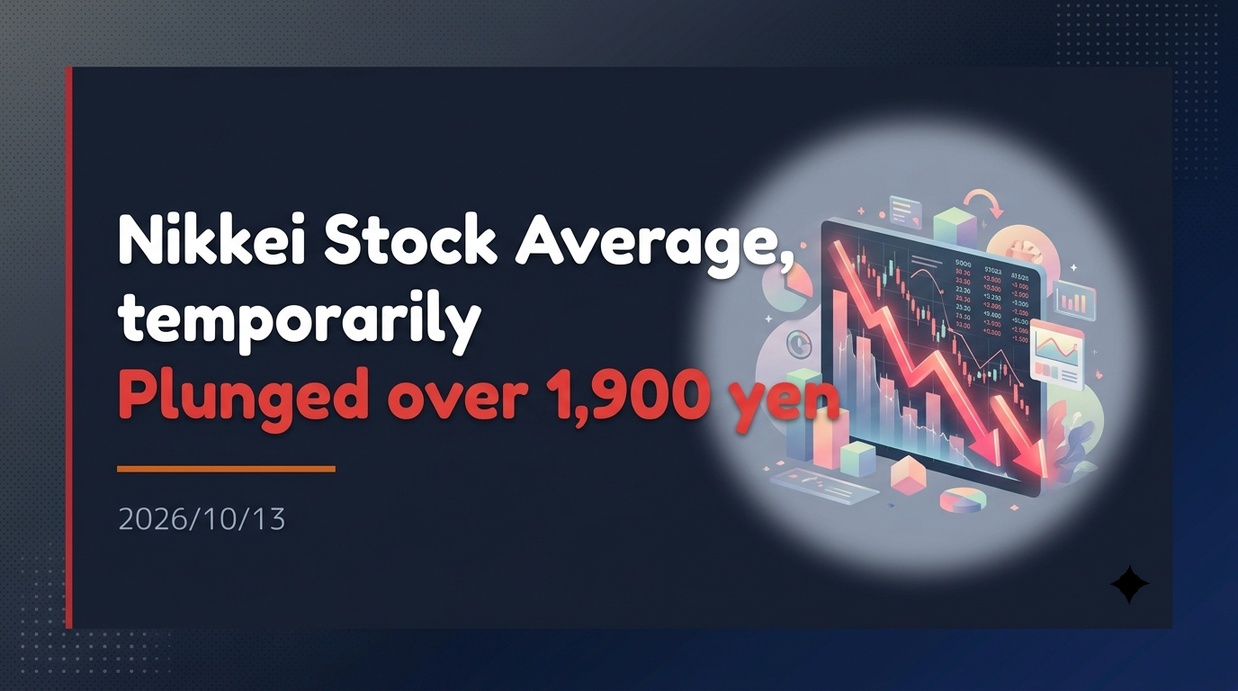
In the Tokyo stock market, the Nikkei Stock Average temporarily plummeted by over 1,900 yen, recording a massive drop during trading hours. This was driven by U.S. key economic indicators falling short of market expectations, which heightened concerns over an economic recession, as well as a surge in sell orders for AI and semiconductor-related stocks amid escalating tensions in the Middle East.
- Temporary plunge of over 1900 yen and selling pressure on high-tech stocks
- The Decline in US Economic Indicators and the Chain Reaction of Recession Concerns
- AI and Semiconductor Stock Overweighting and Position Adjustment Risk
- Amplification of Shocks Due to Yen Appreciation and the Unwinding of Leveraged Trades
- Comparison with Past Historical Market Crashes and the Soundness of the Financial System
- Earnings Trends of Major Semiconductor Companies and the Outlook for U.S. Interest Rates and Trade Policies
Temporary plunge of over 1900 yen and selling pressure on high-tech stocks
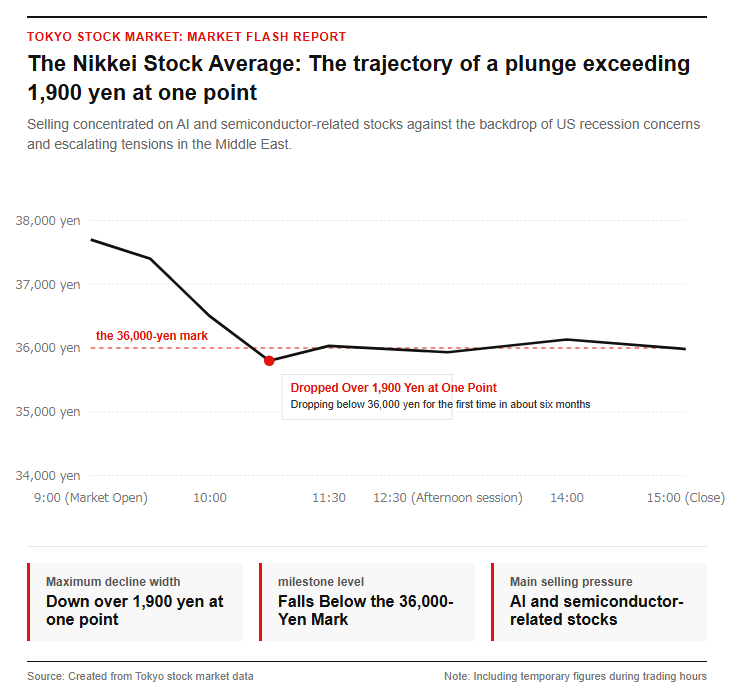
In the Tokyo stock market, the Nikkei Stock Average temporarily recorded a sharp decline of over 1,900 yen during trading hours, resulting in a market-wide sell-off that fell below the 36,000-yen mark for the first time in about six months. Following the sharp decline of major indices in the U.S. stock market the previous day, selling pressure swelled across a wide range of stocks right from the opening in the Tokyo market as well. Among them, the decline was led by major AI (artificial intelligence) and semiconductor-related stocks that had strongly driven the market’s gains until now. Profit-taking and risk-averse selling concentrated on major tech stocks, which became a factor in strengthening the risk-off sentiment across the entire market. The following figure illustrates the trend of stock price fluctuations at that time.
On the other hand, not all stocks in the market declined, with mixed performance observed across sectors. In particular, buying poured into the financial sector amid growing expectations of improved earnings in a rising interest rate environment, pushing Mitsubishi UFJ Financial Group’s stock price to a record high since its listing.
The main market topics are as follows:
- The Nikkei Stock Average temporarily plummeted by more than 1,900 yen, recording what was then the largest intraday drop of the year.
- Sell orders surged, primarily for AI and semiconductor-related stocks, causing tech stocks to fall sharply.
- Amid a market-wide downturn triggered by the decline in U.S. stocks, buying flowed into select issues such as financial stocks.
The Decline in US Economic Indicators and the Chain Reaction of Recession Concerns
The primary macroeconomic factor that triggered this sharp decline was that major economic indicators released in the United States fell short of market expectations, rapidly heightening concerns over a slowdown or recession in the US economy. As uncertainty surrounding the US economy increased, major indices on the New York stock market plummeted across the board, and that shock rippled through to the Tokyo market with a time lag. In addition, soaring crude oil prices and rising geopolitical risks accompanying the escalating tensions in the Middle East became factors that significantly dampened investor sentiment. High crude oil prices have sparked concerns about a resurgence of global inflation and are creating pressure to keep US long-term interest rates high.
Additionally, compounded by fiscal concerns in Europe and uncertainty surrounding various countries’ trade policies, risk-off sentiment accelerated across global financial markets. The sharp decline in Japanese stocks was reportedly triggered by foreign investors rapidly scaling back their positions out of concern over negative impacts on corporate earnings.
The main factors contributing to the worsening of the macroeconomic environment are as follows:
- Emergence of U.S. Recession Risk Due to Weaker-Than-Expected Major U.S. Economic Indicators
- Growing uncertainty in the Middle East and inflation concerns due to rising crude oil prices
- Trade Policy Uncertainty Across Countries and Concerns Over Persistently High Interest Rates Globally
Market Structure Vulnerabilities and Spillover Mechanisms
AI and Semiconductor Stock Overweighting and Position Adjustment Risk
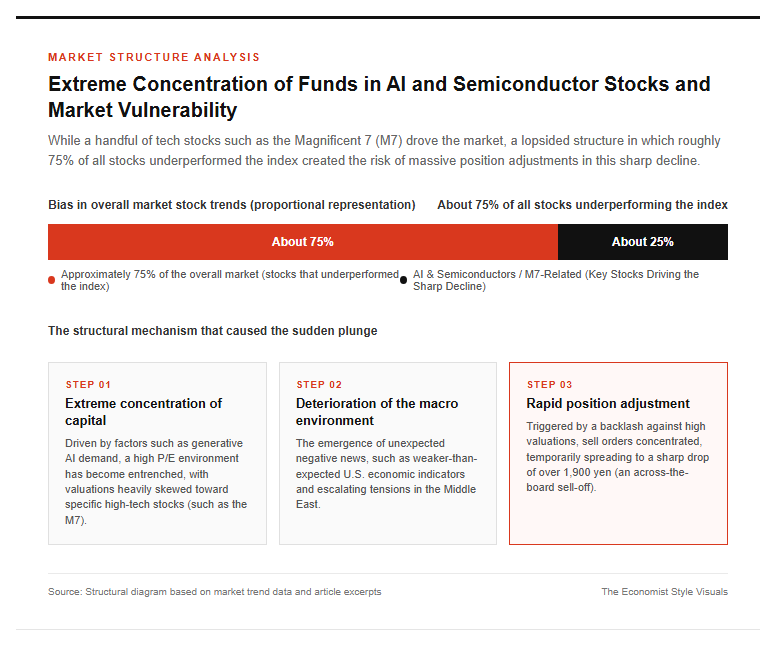
In recent stock markets, against the backdrop of the widespread adoption of generative AI and the surge in data center demand, there has been a continuing trend of extreme capital concentration in specific AI- and semiconductor-related stocks. Even in the 2025 market trends, while major tech companies known as the Magnificent Seven (M7) drove stock price gains, an extremely biased market had formed, with approximately 75% of all stocks underperforming the index. In such a market environment where high valuations (high P/E ratios) have become entrenched, there is a vulnerability where even minor negative news can easily trigger large-scale position adjustments. The following figure illustrates the structure of AI-related investment.
In fact, in early 2025, the announcement of a low-cost, high-performance AI model by Chinese AI startup DeepSeek rapidly spread concerns about a slowdown in AI investment, resulting in a phase where the stock market declined. Furthermore, a pattern has become entrenched in which the market reacts hypersensitively to the earnings trends of major semiconductor companies such as ASML of the Netherlands and TSMC of Taiwan, or to OpenAI’s revenue forecasts.
The structural challenges facing the AI and semiconductor sector are as follows.
- Concentration of capital in specific major tech stocks and a disproportionate rise in stock prices
- Concerns Over the Profitability of Massive AI Investments Due to the Emergence of Low-Cost AI Models
- Risk of surging volatility around earnings announcements due to high P/E multiples
Amplification of Shocks Due to Yen Appreciation and the Unwinding of Leveraged Trades
Another factor that intensified the ripple effects of the stock price plunge was the rapid appreciation of the yen in the foreign exchange market and the process of unwinding leveraged trades that had built up in the market. As concerns over a U.S. economic slowdown brought awareness to a narrowing interest rate differential between the U.S. and Japan, moves to sell the dollar and buy the yen intensified, causing the exchange rate, which had been hovering around 158 yen to the dollar, to swing toward a stronger yen. For Japanese listed companies—particularly export-oriented firms in sectors such as automobiles and machinery—the stronger yen acts as a direct downward factor on operating profits, thus acting as strong selling pressure on the stock market.
What further amplified the market shock was the unwinding of “yen carry trade” positions by hedge funds and others, as well as the panic selling of margin-bought positions by retail investors. Overseas funds that had borrowed low-interest yen to fund investments closed out their positions en masse to avoid risk, while margin calls occurred for retail investors who held high levels of margin buying balances, triggering a chain reaction of forced liquidations.
The factors behind the leveraged structure that amplified the market shock are as follows.
- The rapid appreciation of the yen and depreciation of the dollar amid expectations of falling U.S. interest rates, and concerns over export companies’ earnings
- Hedge Funds’ Unwinding of Yen Carry Trade Positions and Asset Sales
- Margin calls and cascading panic selling among individual investors in margin trading
Future Outlook and Key Points for Investors to Watch
Comparison with Past Historical Market Crashes and the Soundness of the Financial System
Looking back at past market movements, the market has repeatedly suffered historic plunges, such as Black Monday in 1987, the Lehman shock in 2008, the COVID-19 shock in 2020, and the August 2024 crash when the Nikkei Average recorded its largest-ever drop of 4,451 yen. However, unlike the Lehman shock—where the failure of financial institutions and a global credit crisis occurred simultaneously—this recent plunge is analyzed as having strong aspects of temporary market turbulence and position adjustments.
According to the findings of the Bank of Japan’s “Financial System Report (October 2025),” Japanese financial institutions possess sufficient capital and loss-absorbing capacity, and the overall robustness of the financial system is maintained at a high level. Corporate earnings and household balance sheets are also relatively sound, and if stock prices reach undervalued levels from the perspective of dividend yield or liquidation value, it could present an ideal buying opportunity for long-term investors.
A comparison with past market crashes and the current state of the financial system are as follows.
- The risk of developing into a global financial crisis like the Lehman shock is low at present.
- Bank of Japan’s review confirms financial institutions’ sufficient capital and loss-absorbing capacity
- Driven by solid corporate fundamentals, long-term buying tends to emerge on dips.
Earnings Trends of Major Semiconductor Companies and the Outlook for U.S. Interest Rates and Trade Policies
The biggest keys for the stock market to return to a stable upward trajectory are interest rate trends in Japan and the U.S. and the earnings reports of major tech companies. Going forward, earnings announcements are scheduled from global semiconductor giants such as the Netherlands’ ASML and Taiwan’s TSMC, and whether actual demand for AI-related products can show results that exceed market expectations will attract attention as a market catalyst. At the same time, it is necessary to assess U.S. inflation statistics (CPI) and the Federal Reserve’s monetary policy decisions, and if the rise in long-term interest rates is curbed, the downside for the stock market will become even more solid.
In Japan, a potential coalition between the Liberal Democratic Party and the Japan Innovation Party (Ishin no Kai), as well as growth strategies under a Takaichi administration (such as investment support for AI, semiconductors, defense, and shipbuilding), are anticipated as positive factors. With agreements in US-Japan tariff negotiations and strong corporate performance driven by the escape from deflation providing underlying support, there is a strong prevailing view that the mid-to-long-term upward trend of the Nikkei Stock Average will continue.
Here are the key points that investors should monitor in the upcoming market:
- Financial results of major overseas semiconductor companies such as ASML and TSMC and whether there were any positive earnings surprises
- US Inflation Statistics Such as the CPI, the Fed’s Rate Cut Decisions, and Trends in Long-Term Interest Rates
- Progress of Growth Sector Support Measures under the Takaichi Administration and the Robust Earnings Expansion Trend of Japanese Companies
Reference page
- [Nikkei Stock Average and Market-Related Indexes] https://indexes.nikkei.co.jp/
【#NikkeiAverage #StockMarket #AISemiconductors #JapaneseEconomy #InvestmentStrategy】

コメント