Japan’s Financial Services Agency (FSA) has initiated comprehensive hearings with regional financial institutions, including regional banks, focusing on real estate lending and out-of-district “cross-border” loans, with potential on-site inspections under consideration. This crackdown is driven by deep concerns over excessive concentration in real estate built up during years of low interest rates, alongside rising risks of non-performing loans as interest rates increase.
- The FSA’s Crackdown and Strategic Intent
- The Rapid Surge in Out-of-District “Cross-Border” Loans
- Flaws in Risk Management and Stress Testing Challenges
- The Pathology of Collateral Dependency Bred by Low Rates
- Profitability Squeeze from the First Rate Hike Cycle in 30 Years
- Strengthening Regional Finance and Shifting to Feasibility-Based Lending
The FSA’s Crackdown and Strategic Intent
The Financial Services Agency (FSA) has significantly intensified its oversight of real estate lending and risk management practices across regional financial institutions, including regional banks and shinkin banks. In December 2025, the FSA launched individual hearings with select regional banks that exhibited prominent out-of-district “cross-border” lending—financing properties or development projects outside their primary operating areas—and indicated a readiness to conduct on-site inspections if necessary. Furthermore, the 2026 policy guidelines for financial administration, finalized in September 2026, explicitly highlight the monitoring of domestic real estate exposure, large credit concentration, and ultra-long-term 50-year residential mortgages as top priorities. The primary objective of the regulator is not to halt credit creation altogether, but rather to make latent credit risks visible early on, thereby preventing future non-performing loans (NPLs). Please refer to the overview diagram below.
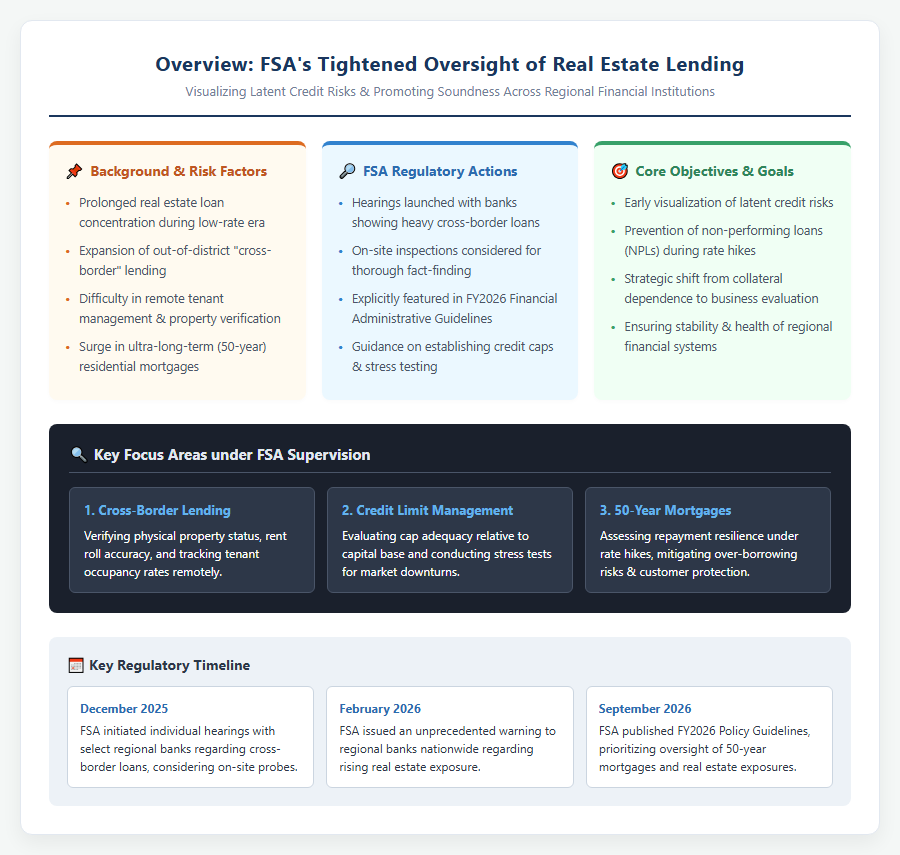
Throughout the prolonged period of ultra-low interest rates, regional institutions aggressively expanded their real estate portfolios to offset declining net interest margins. However, amid shifting market dynamics and rising interest rates, an overconcentration in a single sector threatens broader financial stability. Consequently, the FSA is scrutinizing whether lending decisions, underwriting rationales, and risk management frameworks are robust and fully defensible.
The Rapid Surge in Out-of-District “Cross-Border” Loans
Driven by population decline and sluggish local credit demand in regional Japan, regional financial institutions have increasingly deployed capital outside their traditional territories, financing commercial and residential properties in major metropolitan areas such as Tokyo. While prime urban real estate appears to offer attractive yields, extending loans to distant properties significantly increases information costs and administrative burdens, making it harder to track local market conditions, construction progress, and actual tenant occupancy. Real estate loans as a share of total corporate lending have reached multi-decade highs, creating loan portfolios heavily skewed toward specific property markets and geographic areas. FSA inquiries and hearings revealed numerous instances where lenders failed to conduct adequate due diligence—such as thoroughly verifying rent rolls or tracking physical occupancy rates—for properties located far from their headquarters. Relying excessively on collateral valuations rather than cash flow leaves institutions vulnerable to sudden market corrections. To address these vulnerabilities in cross-border lending, the FSA is pushing for strict credit limits and comprehensive verification of on-the-ground property conditions.
Risk Structures and Underwriting Pitfalls in Real Estate Finance
Flaws in Risk Management and Stress Testing Challenges
According to monitoring and analysis reports published by the FSA on July 31, 2026, critical deficiencies in risk management practices have surfaced at several regional financial institutions. A key concern is the lack of clear credit caps (limits) on real estate exposure, or the setting of limits that are disproportionately high relative to an institution’s capital base and risk-bearing capacity. Additionally, regulators noted that stress testing—simulating adverse scenarios such as rate hikes or real estate price declines—was either entirely omitted or conducted without being integrated into actual loan underwriting or board-level decision-making. For a detailed illustration of how rate hikes impact real estate loan risks, see the chart below.
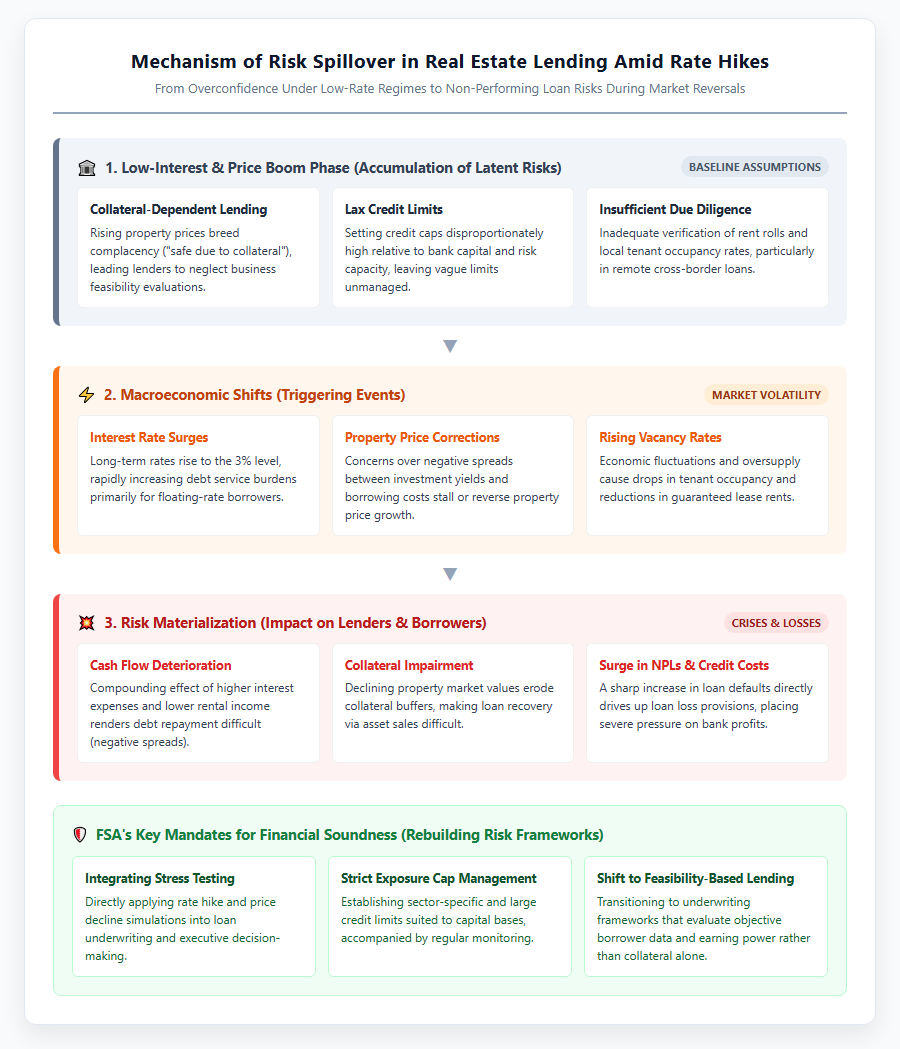
During property market booms, expanding collateral values foster complacency, encouraging the belief that loans are safe simply because they are secured by land or buildings. However, failing to test resilience against rising vacancy rates, elevated debt service costs, or illiquidity during downturns leaves lenders exposed to severe credit losses when market cycles reverse. Recalling past scandals—such as Suruga Bank’s improper share-house financing where loan documents were falsified—regulators are demanding that banks rebuild rigorous underwriting standards based on objective data rather than speculative asset appreciation.
The Pathology of Collateral Dependency Bred by Low Rates
Decades of ultra-low interest rate policy, combined with the widespread distribution of effectively zero-interest, uncollateralized loans during the COVID-19 pandemic, led to a dearth of viable corporate borrowers and a degradation of bank underwriting capabilities. Instead of conducting rigorous business feasibility evaluations—which require time and expertise to assess a borrower’s operational earning power—financial institutions increasingly retreated into the convenience of real estate collateral. Consequently, massive capital flowed not into productive business expansion, but into property markets, inflating land and building prices. This leverage-dependent model rests on the fragile assumption that ultra-low interest rates will persist indefinitely. Schemes where investors acquire income properties with nearly zero down payment through full loans represent little more than a gamble on interest rate spreads rather than genuine operational value creation. Even a modest rate hike can trigger a “negative spread,” where debt service wipes out operating income, jeopardizing business continuity. The FSA’s warnings signal the end of an era reliant on low-interest distortions, compelling lenders to abandon easy, collateral-backed lending in favor of sound financial fundamentals.
Impact of the Rate Hike Environment and Future Outlook
Profitability Squeeze from the First Rate Hike Cycle in 30 Years
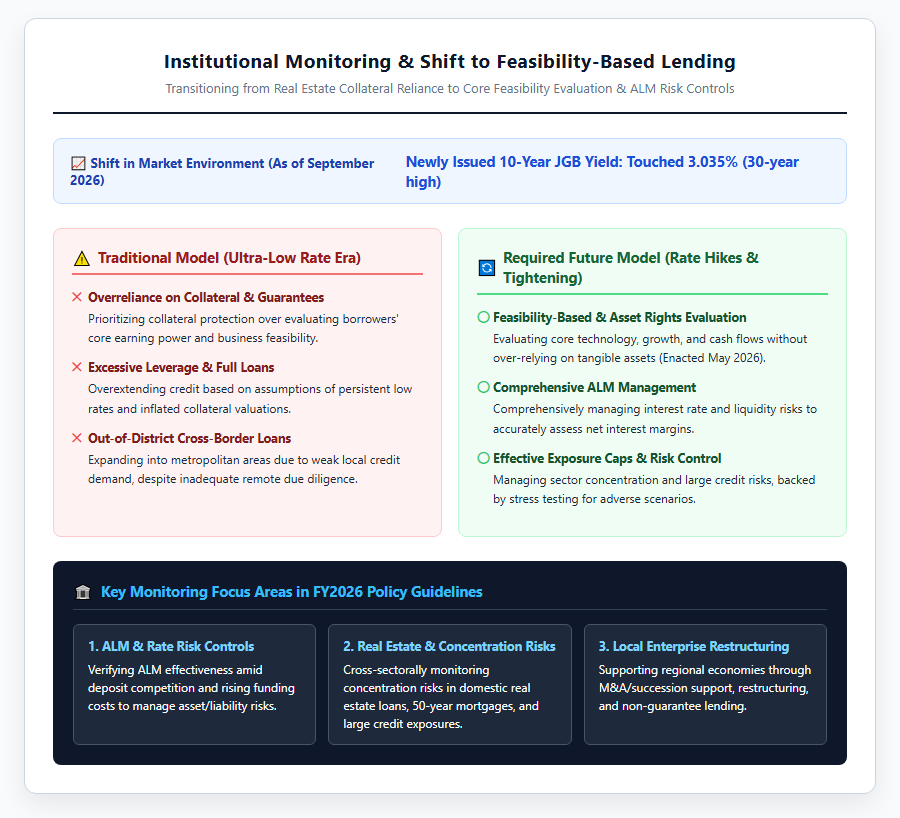
Japan’s financial markets have reached a historic inflection point. In September 2026, the yield on newly issued 10-year Japanese Government Bonds (JGBs) temporarily touched 3.035%, marking a high not seen in roughly 30 years. This sharp rise in long-term rates is shaking the financial foundations of real estate investments and residential mortgages structured around near-zero interest assumptions. Borrowers holding variable-rate loans face rapidly mounting debt service burdens that risk exceeding property cash flows. On the institutional side, with long-term rates hovering around 3%, banks are forced to confront narrowing net interest margins as funding costs rise relative to loan yields. In response, regional banks and shinkin banks are tightening credit standards, requiring larger down payments and subjecting borrower attributes and property cash flows to stricter scrutiny. This credit tightening directly impacts highly leveraged urban apartment investments, exerting downward pressure on property prices across the market. The structural framework for institutional monitoring innovations is detailed below.
Strengthening Regional Finance and Shifting to Feasibility-Based Lending
The central challenge facing regional finance is whether institutions can transition away from real estate collateral dependence toward true “feasibility-based lending”—evaluating a company’s core earning power and growth potential. In its 2026 financial administrative guidelines, the FSA outlined plans to enforce comprehensive interest rate risk management through Asset Liability Management (ALM) alongside cross-sectoral monitoring of credit and concentration risks. Furthermore, following the implementation of the Corporate Value Collateral Rights System in May 2026, regulators are encouraging banks to extend growth capital without relying heavily on personal guarantees or tangible assets. As guidelines for cross-border lending and exposure caps take hold, regional financial institutions are expected to return to their primary role: supporting local core industries, facilitating business restructurings, and financing M&A and business successions. Building resilient financial structures capable of navigating a “world with interest rates” is essential for curbing speculative real estate inflation and ensuring long-term financial stability.
Reference Pages
- [Financial Services Agency] Monitoring Report on Strengthening Regional Banks’ Stress Response Capabilities: https://www.fsa.go.jp/news/r6/ginkou/20250627-3/20250627-3.html
- [Financial Services Agency] Articles and Contributions by FSA Officials (FY2025): https://www.fsa.go.jp/frtc/kikou/R7.html
【#FinancialServicesAgency #RealEstateLending #RegionalBanks #CrossBorderLending #InterestRateHikes #FinancialAdministrativeGuidelines】


コメント