
On October 12, 2026, the Royal Swedish Academy of Sciences announced that it has awarded the Nobel Prize in Economics to Professors Robert Hall and Michael Woodford of the United States. This honor recognizes their achievement in overcoming the limitations of conventional policy models faced since the stagflation of the 1970s and establishing the theoretical foundation for modern macroeconomic stabilization policies based on the individual behavior of households and firms.
- Overview of the 2026 Nobel Prize in Economics and the Achievements of the Two Laureates
- The Limitations of the Traditional Keynesian Model and the Shift to “Microfoundations”
- Professor Hall’s “Random Walk Hypothesis of Consumption” and the Elucidation of Household Behavior
- Professor Woodford’s “New Keynesian Model” and Forward Guidance
- Implications for Japan’s Monetary and Fiscal Policies and Modern Measures Against Inflation
- [Future Outlook and Key Points to Watch] Evolution and Challenges of Next-Generation Macroeconomic Policies
Overview of the 2026 Nobel Prize in Economics and the Achievements of the Two Laureates
On October 12, 2026, the Royal Swedish Academy of Sciences announced that the 2026 Nobel Prize in Economic Sciences (the Sveriges Riksbank Prize in Economic Sciences in Memory of Alfred Nobel) will be awarded to Professor Robert E. Hall of Stanford University (83) and Professor Michael Woodford of Columbia University (71). The prize is being awarded for “contributions to the microeconomic foundations of macroeconomic stabilization.” The prize amount of 12 million Swedish kronor (approximately 190 million yen) will be shared equally between the two laureates.
Their research has brought about a major shift in the approach to economic stabilization policies implemented by governments and central banks. While traditional macroeconomics relied on statistical correlations of aggregate data—such as nationwide consumption and inflation—the two professors built new models that explain economy-wide movements by aggregating the rational decision-making (microfoundations) made individually by countless households and firms. This research outcome has enabled central banks and governments to drastically improve their precision in smoothing out the peaks and troughs of business cycles and addressing severe inflation and deep recessions.
The Limitations of the Traditional Keynesian Model and the Shift to “Microfoundations”
Following the Great Depression of the 1930s, the theory proposed by John Maynard Keynes became a pillar of policies aimed at stimulating aggregate demand and recovering the economy through increased government fiscal spending and interest rate cuts by central banks. However, during the oil crises of the 1970s, stagflation—characterized by simultaneous low growth, high unemployment, and high inflation—occurred, causing the conventional Keynesian model to malfunction. Policies relying solely on statistical correlations faced the “Lucas Critique,” which states that when policies change, people’s expectations and behavioral patterns themselves shift. Addressing these historical challenges, Mr. Hall and Mr. Woodford incorporated the perspective of how households and firms anticipate and react to future fluctuations. By acknowledging market imperfections and price stickiness while rebuilding a robust theory starting from the decision-making of individual economic agents, they laid the greatest foundation for modern economic policy.
Please refer to the figure below.
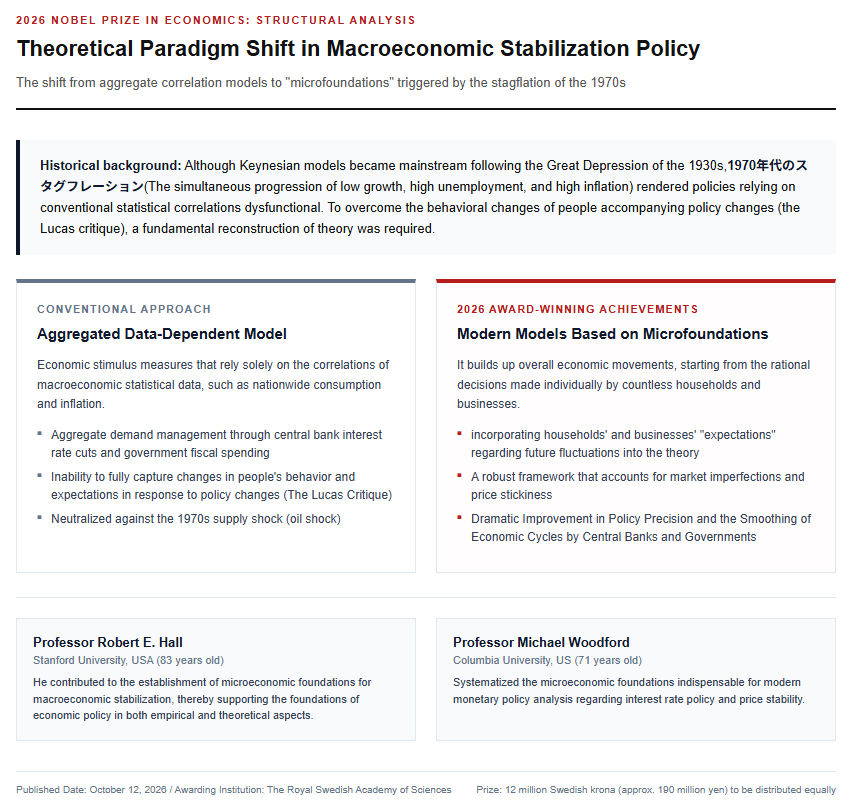
[The Core of the Theory] An Innovative Model Connecting Household Consumption and Monetary Policy
Professor Hall’s “Random Walk Hypothesis of Consumption” and the Elucidation of Household Behavior
Private consumption accounts for the largest share of total demand in the overall economy. While traditional theories assumed a simple mechanism where current income determines consumption, Professor Robert Hall proposed a model in a 1978 paper in which households attempt to smooth their lifetime consumption while anticipating uncertainties in future income and assets. This led to the “random walk hypothesis of consumption.” Because all currently available future information is already reflected in the current consumption of rational households, a “change” in consumption is said to occur only as a result of unexpected new events and cannot be predicted in advance. An empirical study conducted in 1982 by Hall and Frederic Mishkin showed that approximately 80% of all households engage in rational consumption behavior anticipating the future, while the remaining approximately 20% exhibit “hand-to-mouth” behavior due to borrowing constraints and other factors. This finding clearly explains why temporary tax cuts or stimulus payments do not necessarily lead to an immediate expansion in consumption, providing important implications for economic policy management.
Professor Woodford’s “New Keynesian Model” and Forward Guidance
Professor Michael Woodford systemized the “New Keynesian model”—which incorporates Professor Hall’s theory of consumption while taking into account “price stickiness (price-adjustment friction)” in corporate pricing—in his 2003 book Interest and Prices, among other works. This model explains the mechanism by which changes in demand do not immediately lead to price changes, instead affecting production and employment, and functions as a laboratory for evaluating the impact of policy interest rate manipulation on the broader economy. In particular, it provided the theoretical backing for central banks to shift from quantitative management of the money supply to the direct manipulation of nominal interest rates, and demonstrated the importance of the “Taylor principle,” which dictates raising interest rates by more than one-to-one in response to rising inflation rates. Furthermore, it elucidated the effectiveness of “forward guidance,” which involves presenting future interest rate policies in advance. Following the 2008 Lehman shock, in phases where policy interest rates reached near zero percent, it was adopted by central banks worldwide as a practical tool to influence public expectations by committing to maintaining low interest rates in the future, thereby preventing a sharp economic downturn.
Please refer to the figure below.
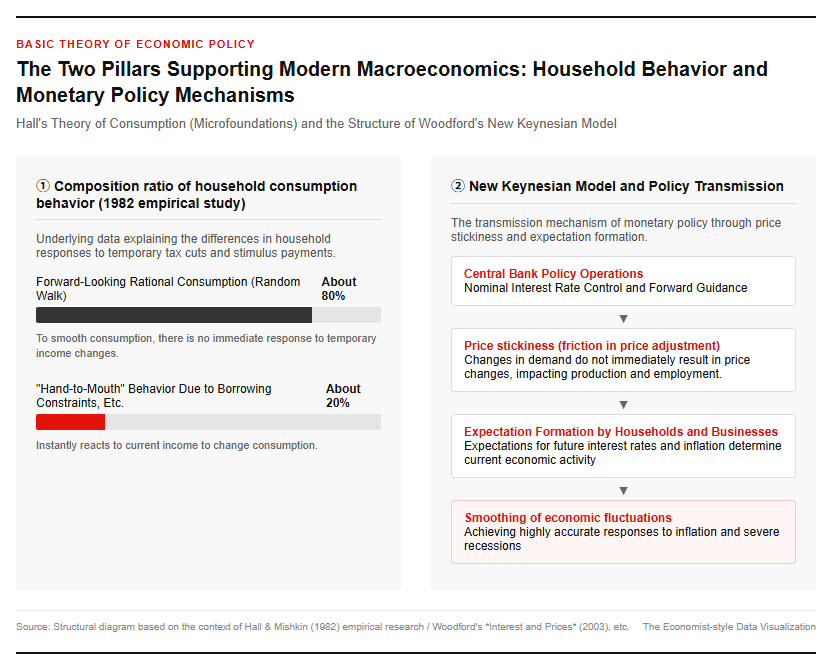
[Modern Significance and Outlook] Impact on the Japanese Economy and Global Policy
Implications for Japan’s Monetary and Fiscal Policies and Modern Measures Against Inflation
Both professors’ theories offer crucial implications for the current Japanese economy, which is at a historic turning point. At its Monetary Policy Meeting in September 2026, the Bank of Japan raised its policy interest rate target to around 1.25%. As the departure from the long-standing zero-interest-rate environment progresses, not only the central bank’s interest rate decisions, but also how markets and households anticipate future prices and interest rates, will determine the direction of the economy. Furthermore, amid concerns over the burden on households caused by rising prices—such as the Ministry of Internal Affairs and Communications’ Family Income and Expenditure Survey showing a 3.1% year-on-year decrease in real consumption expenditure for August 2026—it is essential to foster public expectations (trust) in future sustainable income growth, rather than relying on mere temporary allowances or benefits. Regarding how to combine policy interest rates and fiscal spending in response to supply shocks such as soaring imported energy and material costs, policymakers are required to stabilize the public’s “expectations for the future” through highly transparent communication and sincere dialogue.
[Future Outlook and Key Points to Watch] Evolution and Challenges of Next-Generation Macroeconomic Policies
Amid the recent COVID-19 pandemic, the situation in Ukraine, and the energy crises driven by geopolitical risks in the Middle East, New Keynesian models have served as an indispensable foundation for policy simulations by central banks and governments worldwide (such as Sveriges Riksbank’s MAJA model). Compared to the Great Depression of the 1930s, the relatively rapid economic recovery from modern financial crises and pandemics is backed by the evolution of modern stabilization policies that control “future expectations” based on microfoundations. However, theoretical updates are still ongoing, highlighted by issues such as the “forward guidance puzzle,” where the effects of forward guidance are theoretically overestimated, and the risk of inflation expectations becoming unanchored due to sudden uncertainties (black swans). Going forward, the primary focus will be on how macroeconomic stabilization theory, underpinned by microeconomic choices, will continue to evolve while incorporating new micro-environmental changes, such as structural shifts in the labor market driven by the proliferation of AI and the reorganization of global supply chains.
Reference page
- 【The Sveriges Riksbank Prize in Economic Sciences in Memory of Alfred Nobel 2026】https://www.nobelprize.org/prizes/economic-sciences/2026/summary/
- 【Popular science background: Microfoundations deliver macro insights】https://www.nobelprize.org/uploads/2026/10/popular-economicsciencesprize2026.pdf
- 【Press release: Sveriges Riksbank Prize in Economic Sciences in Memory of Alfred Nobel 2026】https://www.nobelprize.org/prizes/economic-sciences/2026/press-release/
【#NobelPrizeInEconomics #Macroeconomics #NewKeynesian #MonetaryPolicy #ForwardGuidance #BOJ #InflationExpectations #Microfoundations】
コメント