Consulting giant Accenture has acknowledged that in July 2026, it was subjected to unauthorized access by a hacker group, suspecting the leakage of about 35GB of confidential data. This situation occurred amid the company’s massive investment in strengthening its cybersecurity sector, drawing attention to its impact on customers and the company’s strategic evaluation.
- 35GB of data theft discovered in July 2026
- The History and Background of Repeated Cyberattacks
- Nature of the leaked data and secondary damage risk to clients
- .18 billion offensive in OT security
- The shock of a 10% stock plunge that offset strong earnings
- Intentions of a strategic shift toward protecting industrial infrastructure
- One in ten organizations is prepared for AI threats.
- The limitations of the “response cost” faced by companies and technical debt
- Future Developments and the Demand for “Security by Design”
35GB of data theft discovered in July 2026
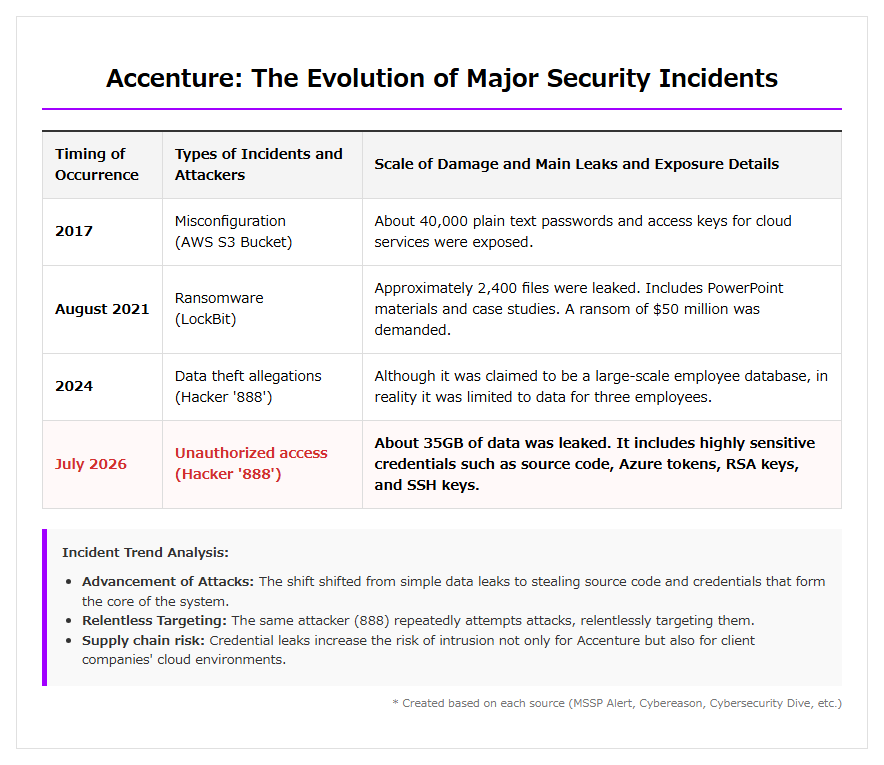
On July 8, 2026, it was revealed that Accenture, one of the largest companies in the consulting industry, is facing a crisis of information breaches due to cyberattacks. A threat actor named 888 claimed on a dark web forum that they stole about 35GB of confidential data from Accenture and put the data up for sale. The alleged stolen data includes highly critical credentials such as source code, Microsoft Azure personal access tokens, RSA encryption keys, and SSH keys. Peter So, a spokesperson for Accenture, recognizes the issue as an “isolated incident” and says the cause has already been resolved. The company claims that at this time, there is no impact on its operations or service offerings, but if the leaked data is authentic, the impact could be far-reaching. In particular, source code leaks increase the risk of secondary damage in the future, as attackers can easily understand the internal logic of applications and identify hardcoded secret information or vulnerable implementation patterns. The diagram below illustrates the scale and trends of recent data breach incidents.
The History and Background of Repeated Cyberattacks
This is not the first time Accenture has faced a major cyber incident. Over the past several years, the company has been the target of relentless attacks. One of the most famous cases was the LockBit ransomware group attack that occurred in 2021. During this time, the attackers demanded a massive ransom of about $50 million to stop the release of the stolen data. At the time, Accenture announced that the system had been fully restored from backups with no impact on operations, but it was ultimately confirmed that about 2,400 files were leaked. Furthermore, going further back to 2017, an external research organization pointed out that a misconfiguration of Amazon Web Services (AWS) buckets exposed about 40,000 plain text passwords and access keys for cloud services. The attacker this time, 888, claimed to have stolen Accenture’s employee database in 2024 as well, but at that time Accenture argued that the data was actually only for three people and that the attackers had greatly exaggerated the content. Such repeated incidents highlight just how complex security challenges a large organization like the company is.
Nature of the leaked data and secondary damage risk to clients
What concerns us most about this incident is not just the damage to Accenture itself, but the risk of spillover to the company’s vast number of clients. Accenture is one of the world’s largest consulting firms, serving the majority of Fortune Global 500 clients, and trust in its confidentiality is at the core of its business. According to analysis by SOCRadar, an intelligence firm, the alleged leaked configuration files and source code may contain clues to identify vulnerabilities in software used by clients or partners. Especially if Microsoft Azure access tokens or encryption keys are exposed, hackers can freely explore code repositories and cloud storage managed by Accenture, creating pathways for direct access to client data. Accenture has refrained from answering detailed questions about secondary impacts, but security experts warn that depending on data freshness, it could have a devastating effect on the entire customer base. For business models that rely on trust, credential leaks can be a major business blow beyond mere technical issues.
Massive acquisition strategy and the market’s lukewarm reaction
.18 billion offensive in OT security
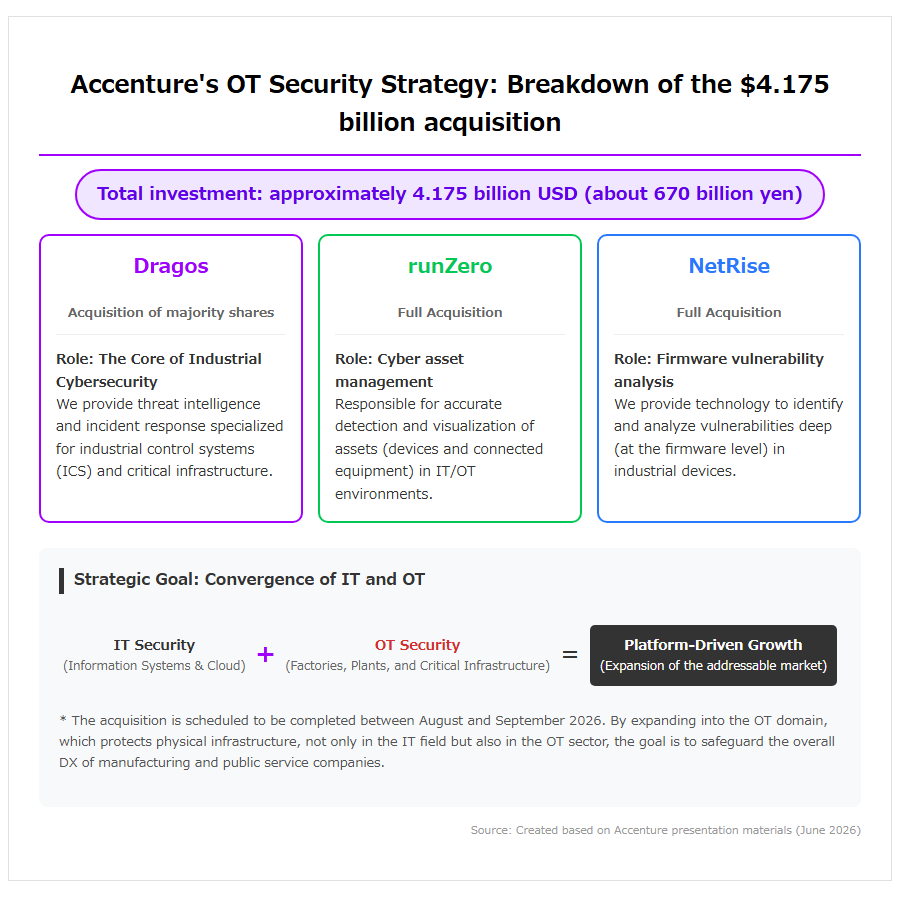
On June 18, 2026, just weeks before the discovery of the data breach, Accenture announced a large-scale acquisition plan worth $4.175 billion (approximately 670 billion yen) to dramatically expand its cybersecurity business. At the heart of this acquisition campaign is the acquisition of a majority stake in Dragos, a leader in industrial cybersecurity. Furthermore, it has decided to fully acquire runZero and NetRise, two companies specializing in operational technology (OT) and cyber asset management. CEO Julie Sweet called this transaction a “strategic defining move,” emphasizing that it will significantly expand the company’s addressable market as industrial control systems and critical infrastructure face digital threats. In recent years, as ransomware and supply chain attacks have intensified, the need to protect not only IT environments but also OT environments such as manufacturing sites has surged. By taking the lead in this area, Accenture aims to create platform-driven growth opportunities. The chart below shows the expansion of the security market driven by the convergence of IT and OT.
The shock of a 10% stock plunge that offset strong earnings
However, the market did not always respond favorably to this ambitious acquisition plan. The Q3 2026 financial results, released simultaneously with the acquisition announcement, showed a solid adjusted earnings per share of $3.80, exceeding the market expectation of $3.72. Nevertheless, Accenture’s stock price plunged more than 10% in pre-market trading. Investors were concerned about the dilution of short-term profits from massive expenditures exceeding $4.1 billion, as well as the consolidation risks associated with large-scale acquisitions. Acquisitions of high-multiples software and security companies often lead to margin compression until integration costs and synergy effects materialize, which Wall Street digested as a risk. Additionally, the company’s decision to lower the upper limit of its full-year sales growth forecast from 5% to 4% also cooled investor sentiment. Solid results from existing businesses are now being overshadowed by uncertainty over massive investments, putting the execution of strategies under strict scrutiny.
Intentions of a strategic shift toward protecting industrial infrastructure
Behind Accenture’s massive investment in OT security is the reality that digital transformation (DX) in client companies has penetrated manufacturing and infrastructure sites. Industrial networks, which were traditionally physically separated, have now become connected to the internet, making the risk of physical destruction from cyberattacks a reality. Dragos, the target for acquisition, is highly regarded for its threat intelligence and incident response capabilities tailored to industrial environments, while runZero and NetRise complement asset detection and firmware vulnerability analysis. By integrating these technologies, Accenture aims to establish a unique position by providing a seamless solution from consulting to implementation and operation. Although the market response was harsh in the short term, the company is confident that the integration of information technology and industrial systems will provide sustainable revenue opportunities in the medium to long term. This data breach comes just as they are trying to establish their brand as “defense experts,” and rebuilding their security management capabilities is urgent to justify their strategy.
The Worsening Global Cyber Resilience Disparity
One in ten organizations is prepared for AI threats.
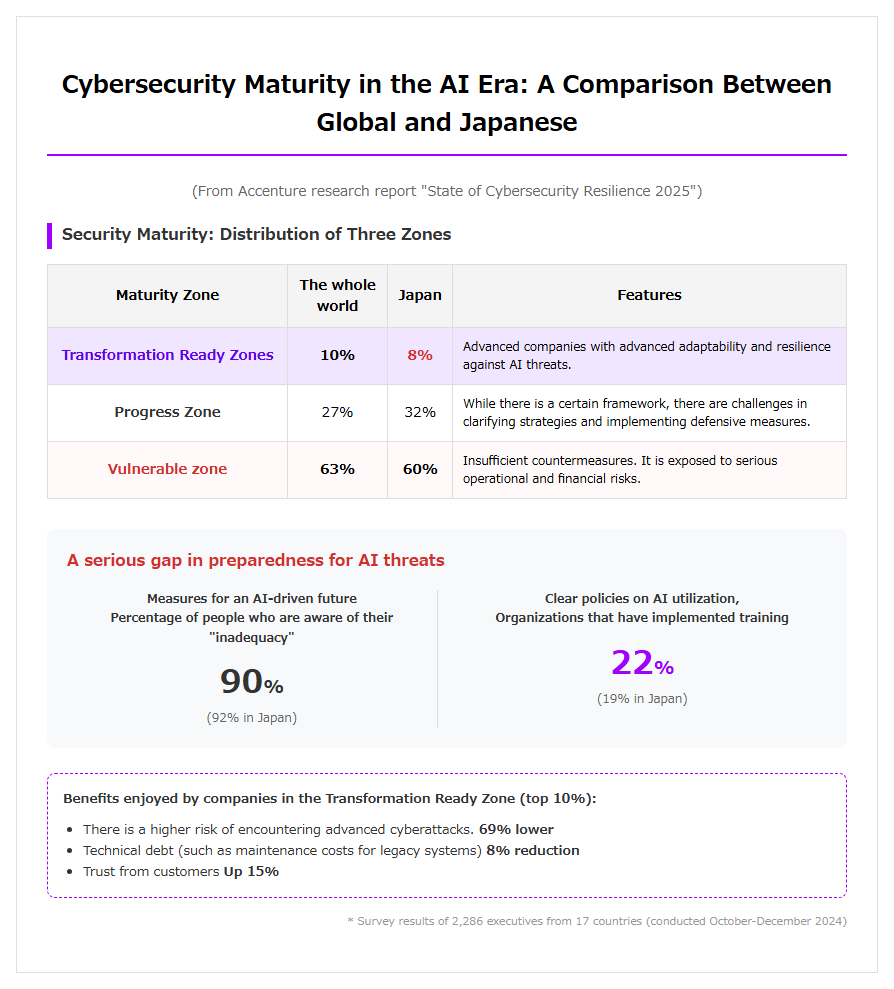
According to Accenture’s latest research report, “State of Cybersecurity Resilience 2025,” only 10% of organizations worldwide have a robust defense posture against cyber threats intensified by AI. In Japan alone, the proportion is even lower, at just 8%, making it an extremely serious situation. This survey targeted 2,286 executives from large companies with revenues over $1 billion across 17 countries, highlighting the rapid spread of AI that is dramatically increasing the speed and sophistication of attacks. The vast majority of companies (90% globally, 92% in Japan) recognize that their security measures for an AI-driven future are insufficient, resulting in a significant gap between motivation and execution. About 60% of companies are classified as “Exposed Zones,” lacking unified strategies and technical capabilities, and exposed to serious operational and financial risks. The chart below shows the distribution of security maturity levels in each country.
The limitations of the “response cost” faced by companies and technical debt
As cyberattack methods continue to evolve, many companies are crying out over the rising costs of response. In past Accenture surveys, 81% of respondents believed they could not maintain response costs in the face of evolving cyberattacks, a significant increase from 69% the previous year. Despite over 80% of companies expanding their security investments, the average number of unauthorized access incidents per company per year has reached about 270, a 31% increase year-over-year. Behind this situation of “increasing investment but also increasing damage” lies the “technical debt” caused by outdated systems and increasingly complex networks. Meanwhile, the top 10% of companies defined as “ready for transformation” in the survey are 69% less likely to encounter advanced attacks and have succeeded in reducing technical debt by 8%. These advanced companies are characterized not only by implementing tools but also by viewing security as a driving force behind business growth and closely aligning with their management goals.
Future Developments and the Demand for “Security by Design”
The recent unauthorized access case, Accenture’s massive acquisition, and the company’s investigation results all point to a single conclusion. This means that cybersecurity is no longer a “cost” that can be postponed, but rather the top management priority. Paolo Dar Chin of Accenture emphasizes that a “security by design” approach, which incorporates security from the design stage of every initiative, is essential. OT security technologies such as Dragos, which the company acquired, are expected to be integrated between August and September 2026, drawing attention to how far the company can enhance its security capabilities and pass them on to customers. Upcoming focus will be whether the allegedly leaked 35GB of data will actually be used to attack others, and whether Accenture can quickly leverage the synergies of major acquisitions to restore market trust. As AI-abusing attacks become more widespread, companies are required more than ever to have resilience to quickly respond to disruptive changes and to ensure transparent disclosure.
[#アクセンチュア #サイバーセキュリティ #データ漏洩 #M&A #ランサムウェア #OTセキュリティ #AI脅威 #企業経営]

コメント