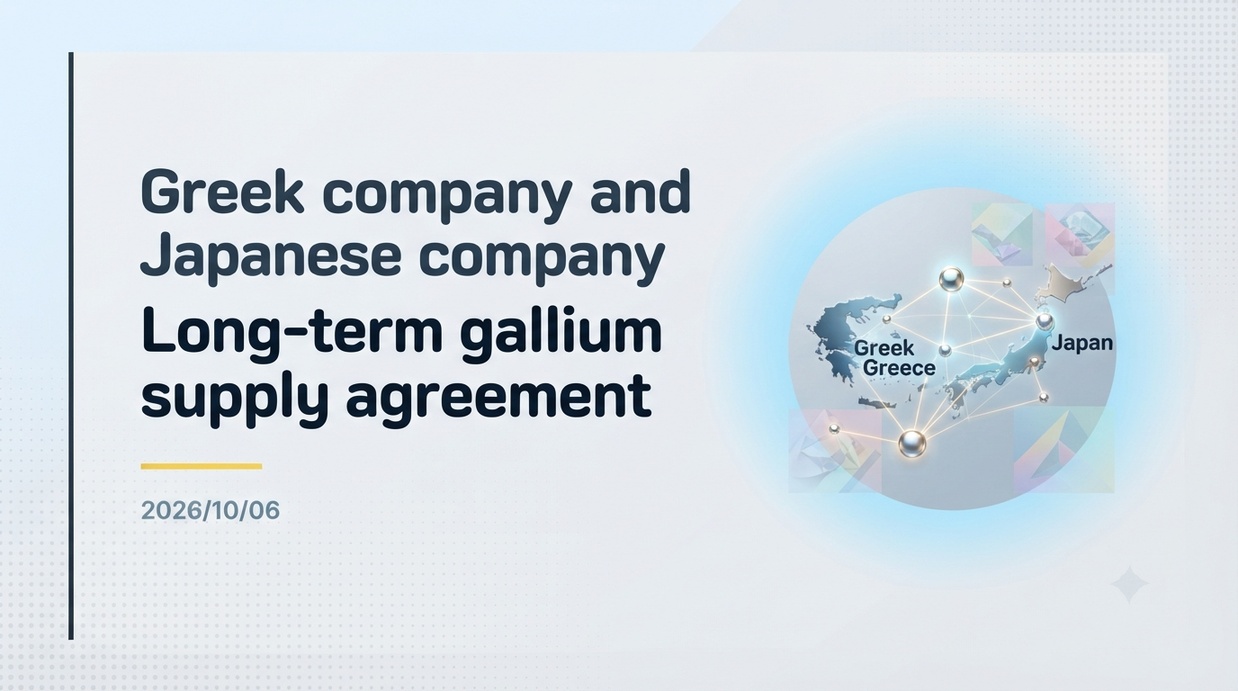
Greek energy and metals major METLEN has signed a long-term gallium supply contract with a major Japanese chemical company. As China accounts for the vast majority of global production and tightens export controls, the diversification of supply chains for critical minerals through Japan-Europe cooperation is accelerating in earnest.
- Key points of the event: Up to 16% supply allocation and an annual production plan of 50 tons
- Integrated Production System and Technical Background at the Greek Facility
- China’s Tightened Export Controls and the Materialization of Supply Risks
- The Strategic Importance of Gallium in Next-Generation Semiconductors and Advanced Technologies
- The European Critical Raw Materials Act (CRMA) and the Role of Strategic Projects
- Future Outlook and Key Focus Areas: Challenges and Market Impact Toward the 2027 Start of Operations
Key points of the event: Up to 16% supply allocation and an annual production plan of 50 tons
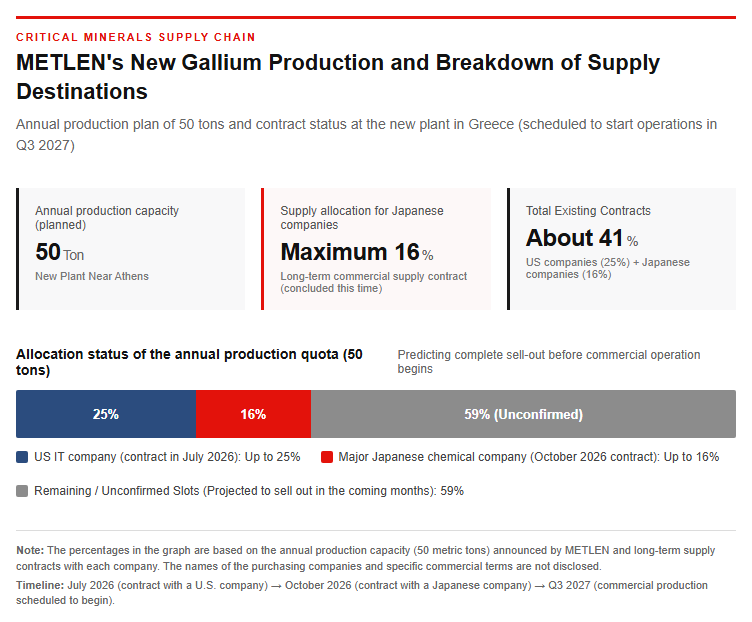
METLEN (Metlen Energy & Metals), a major Greek integrated energy and metals company, announced in October 2026 that it has signed a long-term commercial contract to supply gallium, a critical mineral for semiconductor materials, to a major Japanese chemical manufacturer from a production facility it is currently constructing in Greece. Although the name of the purchasing company and specific commercial terms have not been disclosed, this contract secures the Japanese buyer the right to receive up to 16% of METLEN’s total annual gallium production.
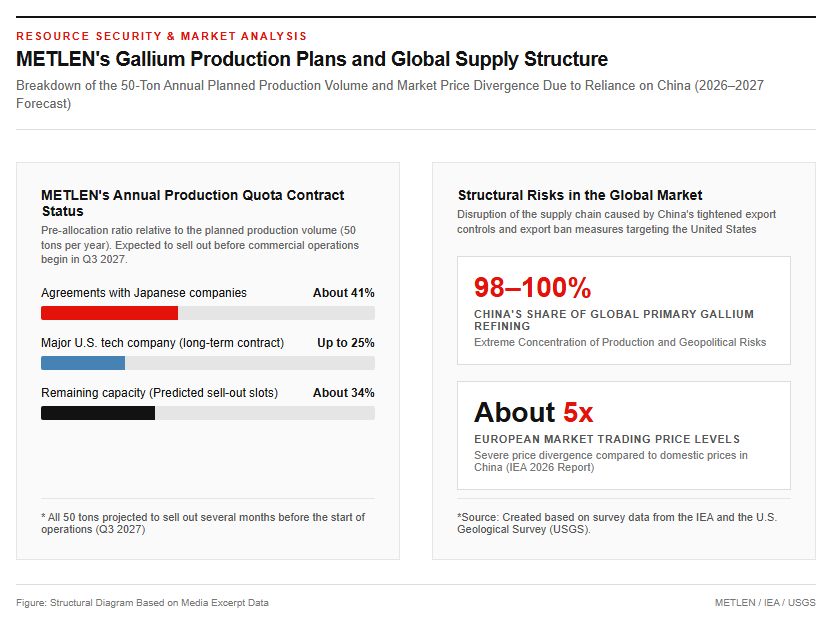
METLEN’s new plant, currently being prepared near Athens, is scheduled to begin commercial production in the third quarter of 2027 (July–September), with an expected annual production capacity of 50 metric tons (50 tons). In late July 2026, the company had already announced the signing of a long-term contract to supply up to 25% of its output to a major US IT company. With this latest agreement with a Japanese company, roughly 41% of the planned annual production volume has already been secured more than a year before operations begin.
Driven by growing demand, the company predicts that its entire annual production capacity of 50 tons will be completely sold out several months ahead of the start of commercial operations in the third quarter of 2027. This development clearly illustrates how major industrial players in Japan, the U.S., and Europe are rapidly securing reliable alternative supply sources as export restrictions by China heighten the risks associated with raw material procurement.
Integrated Production System and Technical Background at the Greek Facility
At the core of the recent gallium supply agreement is a vertically integrated production model independently established by METLEN. Through its wholly-owned aluminum and refining subsidiary, Aluminium of Greece, the company owns and operates a large-scale plant in Greece that refines alumina from bauxite. Gallium is a rare metal that has no concentrated standalone deposits in the Earth’s crust, and is recovered in trace amounts from by-products (residues) generated during the smelting process of bauxite, the raw material for aluminum, or zinc ore.
METLEN has developed a technology to efficiently extract gallium from bayer liquor—a byproduct of its smelting process—using its proprietary, patented purification technology. This establishes Europe’s first integrated production pipeline that completes everything from raw material procurement to final purification within a single industrial facility.
Greek Minister of Environment and Energy Papastavrou has also expressed expectations that this project could become a fantastic area of cooperation with Japan’s cutting-edge technology industries. This initiative, which transforms conventional aluminum smelting residues into high-value, high-tech raw materials, holds extremely important significance not only for the circular utilization of resources and the improvement of self-sufficiency within the European region, but also for Japanese chemical and electronic material manufacturers in building a long-term and stable procurement network.
China’s Export Controls and the Global Gallium Supply Chain Crisis
China’s Tightened Export Controls and the Materialization of Supply Risks
The global production structure of gallium suffers from a structural vulnerability in that it is extremely concentrated in a single specific country. According to research data from the International Energy Agency (IEA) and the U.S. Geological Survey (USGS), approximately 98% to nearly 100% of the world’s primary gallium is refined in China. Since August 2023, citing security reasons, the Chinese government has significantly tightened export controls on gallium- and germanium-related items and introduced an export licensing system. Furthermore, in December 2024, it stepped up regulations to implement a general ban on exports to the United States.
Due to this series of export controls, the supply and demand balance of gallium in the global market has tightened dramatically. According to the IEA’s 2026 report, trading prices outside of China, such as in European markets, have soared to about five times the domestic price level within China, resulting in a severe price divergence.
Supply restrictions and soaring prices pose a direct threat to the production activities of semiconductor and electronics manufacturers worldwide. Just as oil dependency once constituted a geopolitical risk, the risk of strategic rare metals, starting with gallium, being used as “weaponized resources” is now materializing, making a break from dependence on specific countries an urgent priority for advanced industrial nations, including Japan.
The Strategic Importance of Gallium in Next-Generation Semiconductors and Advanced Technologies
The reason gallium is regarded with such high importance is that it is an indispensable foundational material that supports modern cutting-edge technology and a decarbonized, digital society. In particular, gallium nitride (GaN), a compound of gallium and nitrogen, and gallium arsenide (GaAs), a compound of gallium and arsenic, possess superior physical properties that surpass conventional silicon semiconductors. Gallium nitride excels in high voltage, high heat resistance, and high-speed switching, and is rapidly gaining widespread adoption in drive inverters for electric vehicles (EVs), rapid chargers, and power semiconductors for renewable energy.
Furthermore, gallium arsenide excels in high-frequency operation and optical emission characteristics, making it indispensable for 5G and future 6G communication base stations, smartphones, laser devices, LED lighting, and even optical data transmission components used in artificial intelligence (AI) data centers.
In addition, it is used in military radar, aerospace equipment, high-efficiency CIGS thin-film solar cells, and as a heat-resistance-improving dopant for neodymium magnets, making it a top-priority strategic material for both economic and defense security. Because a disruption in the supply of gallium directly leads to the shutdown of massive industries ranging from automobiles and telecommunications to defense and renewable energy, securing reliable new sources of supply has become an imperative mandate for leading companies around the world.
Japan-EU Cooperation and the Path to Reducing Dependence on China in Economic Security
The European Critical Raw Materials Act (CRMA) and the Role of Strategic Projects
METLEN’s gallium production project in Greece goes beyond the business of a single company, holding a core position in the economic security strategy of the entire European Union (EU). To reduce excessive resource dependence on specific countries and strengthen intra-EU supply chains, the EU enacted the Critical Raw Materials Act (CRMA) in May 2024. The CRMA sets clear benchmark targets to cover at least 10% of the bloc’s consumption from extraction within the EU, 40% from processing within the EU, and 25% from recycling by 2030.
Under this framework, METLEN’s investment in gallium production has been officially designated as an EU “Strategic Project,” receiving streamlined permitting procedures and preferential financial support. In addition, financing support through the REPowerEU framework by the European Investment Bank (EIB) has also been approved, and a rapid rollout is underway by leveraging public support.
The fact that a major Japanese chemical company has secured a long-term supply allocation this time can be said to be a concrete example of how European-produced rare metals, generated through EU initiatives, directly contribute to the stabilization of global supply chains via the Japan-Europe strategic partnership. This also aligns with the policy to ensure a stable supply of specified critical materials promoted by the Japanese government, serving as a model case for Japan-Europe cooperation in both the public and private sectors.
Future Outlook and Key Focus Areas: Challenges and Market Impact Toward the 2027 Start of Operations
The biggest point of focus moving forward will be the start of commercial operations at METLEN’s Greek plant, scheduled for the third quarter of 2027, and the smooth production ramp-up that follows. If this plant achieves its production capacity of 50 tons per year as planned, gallium supply capacity outside of China will be significantly expanded, serving as a major driving force to alleviate the extreme supply shortages and soaring prices facing industries in Europe and Japan.
On the other hand, there are also technical hurdles and quality control challenges to be addressed before the actual start of production. Gallium used for semiconductor applications requires an ultra-high purity of 99.9999% (6N) to 99.99999% (7N), so whether high-quality gallium meeting contract specifications can be stably refined and shipped in actual operations will be a crucial evaluation criterion moving forward.
As for the impact on the market, while METLEN’s initiation of European production supply will not immediately cause global prices to drop, it serves as a powerful deterrent against supply restrictions by China. Starting with this long-term contract secured by a Japanese company, whether cooperation will expand into Japan-EU joint investments and recycling projects for other critical minerals such as scandium and germanium will be closely watched from the perspective of future international geopolitics and resource security.
Reference page
- [METLEN: New Gallium Agreement with a Major Japanese Chemical Company – Kyodo News PR Wire] https://kyodonewsprwire.jp/release/202610057325
- 【Executive summary – Global Critical Minerals Outlook 2026 – IEA】https://www.iea.org/reports/global-critical-minerals-outlook-2026
- 【Enhancing supply resilience for critical materials: case study of gallium supply in the United States – Lawrence Berkeley National Laboratory】https://escholarship.org/uc/item/2j64q0xq
【#Gallium #METLEN #CriticalMinerals #SemiconductorMaterials #SupplyChain #EconomicSecurity #JapanEUCooperation #ReducingRelianceOnChina】

コメント