Shimizu Corporation, in collaboration with Nippon Carrier and Kyoritsu Air Tech, has developed a temporary cooling system for skyscraper construction sites following the installation of exterior curtain walls. Against the backdrop of mandatory heatstroke prevention measures due to the revision of the Industrial Safety and Health Regulations in June 2025 and the recent normalization of extreme heat, it is being introduced for the first time at the construction site of the “Torch Tower,” which will become the tallest building in Japan upon completion.
- “Confined Space Heat” and the Problem of Insufficient Ventilation After Curtain Wall Construction
- Cooling Mechanism Using a Forced Heat Exhaust Duct and a Cardboard Air Outlet
- Demonstration Experiment and Remote Monitoring on a Massive 100-Meter-Square Floor
- Enforcement of the Amended Industrial Safety and Health Regulations in June 2025 and Legal Obligations Required of Business Operators
- The spread of utilizing pre-installed ducts and environmental optimization using wearable devices
- Balancing the safety of skilled workers and productivity improvement through the promotion of construction DX
“Confined Space Heat” and the Problem of Insufficient Ventilation After Curtain Wall Construction
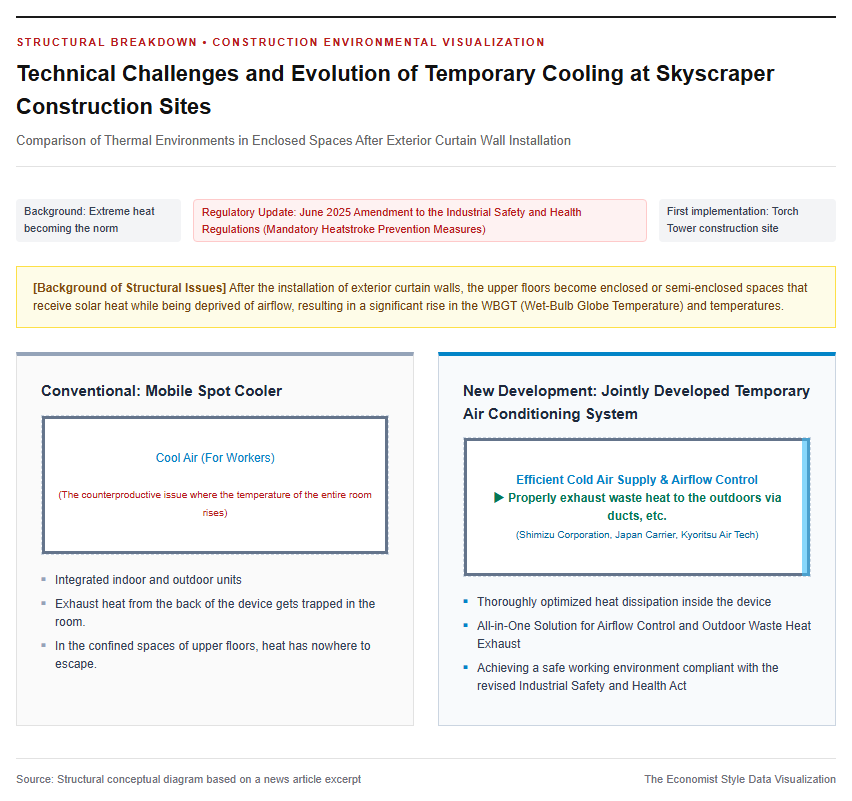
In recent years, due to the effects of global warming and climate change, record-breaking summer heatwaves have become the norm, making heatstroke prevention at construction sites involving extensive outdoor work an extremely crucial management issue. Particularly at skyscraper construction sites, there is a structural challenge where the indoor working environment deteriorates significantly after the building’s structural frame is assembled and the exterior glass (curtain walls) is installed. The interior of the building, blocked off by the outer walls, is susceptible to solar radiation heat, creating a sealed or semi-sealed space with extremely low ventilation. Conventionally, mobile small spot coolers have been widely used at such sites. However, spot coolers with integrated indoor and outdoor units, while blowing cold air toward workers, release exhaust heat from the back of the unit directly into the indoor space, resulting in the paradoxical problem of actually raising the temperature of the entire room. Especially on upper floors where exterior curtain walls have been installed, pathways for wind are cut off, making it easy for heat to become trapped indoors and creating an environment where the WBGT (Wet-Bulb Globe Temperature) and air temperature rise significantly. To address this fundamental risk, Shimizu Corporation has embarked on the development of a new cooling system that integrally resolves internal exhaust heat processing and air volume control. Please refer to the schematic diagram below.
Cooling Mechanism Using a Forced Heat Exhaust Duct and a Cardboard Air Outlet
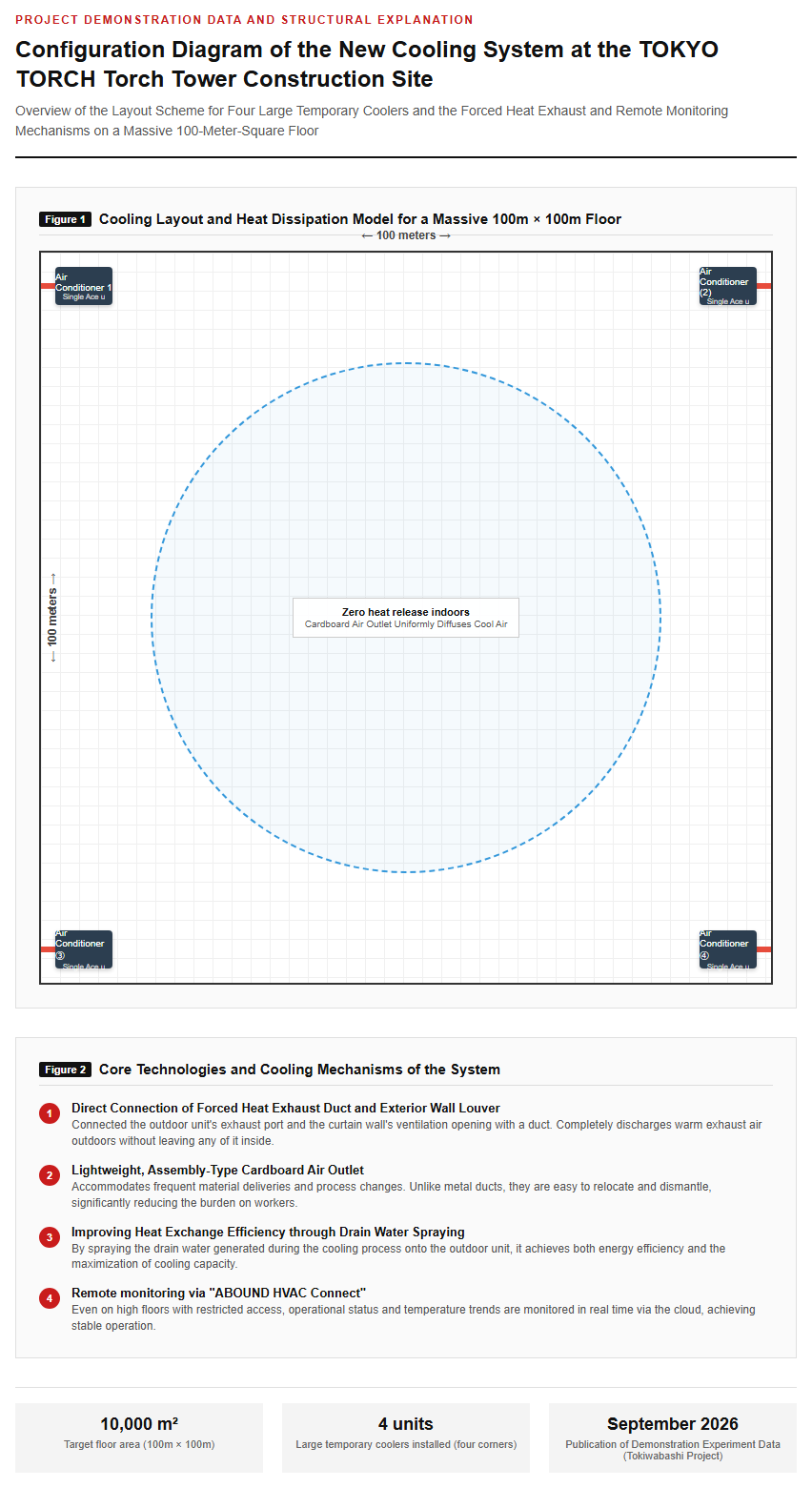
Shimizu Corporation, in collaboration with air conditioning manufacturer Nippon Carrier Corporation and air outlet manufacturer Kyoritsu Air Techno Co., Ltd., has independently improved the exhaust heat structure and transportation mechanism of a large-scale temporary cooler. At the core of this system is Nippon Carrier’s “Single Ace u” air-cooled integrated packaged air conditioner, which has been transformed into a portable unit that can be freely moved around the site by attaching a dedicated mount. The primary technical feature is the establishment of a mechanism that directly connects the exhaust port of the heat-exchanging outdoor unit with the ventilation opening (louver section) of the exterior curtain wall using an exhaust duct, forcibly expelling hot exhaust air to the exterior of the building. This makes it possible to efficiently circulate only cold air without leaving any heat whatsoever in the enclosed indoor space. Moreover, taking into account the operational realities of construction sites—where material deliveries and schedule changes frequently occur—the companies developed and deployed a lightweight, assembly-type cardboard air diffuser capable of uniformly blowing cool air over a wide area. Unlike metal ducts, relocating and dismantling them is easy, greatly reducing the operational burden on-site. Additionally, the system is equipped with a function that enhances heat exchange efficiency by spraying drain water, generated during the indoor unit’s cooling process, onto the outdoor unit, thereby achieving both energy conservation and maximized cooling capacity.
Implementation in Japan’s Tallest Skyscraper “Torch Tower” and Mandatory Heatstroke Countermeasures
Demonstration Experiment and Remote Monitoring on a Massive 100-Meter-Square Floor
As the first practical application of this system, the construction site of the “TOKYO TORCH Torch Tower”—a super-high-rise building currently under construction as part of the Tokiwabashi Project in front of Tokyo Station’s Nihonbashi Exit, which will become the tallest building in Japan upon completion—has been selected. In the demonstration experiment announced in September 2026, four large temporary coolers in total (one placed in each of the four corners of a vast construction site floor) were installed to collect detailed data on how uniformly the massive 100m x 100m indoor space could be cooled. Prior to implementation, an experimental environment simulating an actual construction site was constructed at Nippon Carrier’s Fuji Plant, where air volume changes and cooling performance when connecting supply and exhaust ducts were strictly verified in advance. Furthermore, for on-site operation, a remote monitoring demonstration test utilizing Nippon Carrier’s digital platform for commercial air conditioning, “ABOUND HVAC Connect,” was also conducted. Even on high-rise construction floors where access is restricted from a safety perspective, the operational status of equipment and temperature trends can be grasped in real-time via the cloud, aiming for stable operation and improved maintenance efficiency. Shimizu Corporation plans to analyze the measurement data obtained from this project and aim for full-scale deployment across future high-rise projects in general. An image of the demonstration site is as follows.
Enforcement of the Amended Industrial Safety and Health Regulations in June 2025 and Legal Obligations Required of Business Operators
The biggest background factor accelerating the development of on-site cooling systems in the construction industry is the revision of the Industrial Safety and Health Regulations. In response to the rapid increase in heatstroke-related casualties in the workplace, the Ministry of Health, Labour and Welfare enforced the revised Industrial Safety and Health Regulations on June 1, 2025. According to statistics from the Ministry of Health, Labour and Welfare, the number of heatstroke casualties in workplaces in 2025 reached 1,803 (confirmed figure), recording a record-high level. Due to the legal revision, for work performed under environments with a WBGT (Wet-Bulb Globe Temperature) of 28°C or higher or a temperature of 31°C or higher for 1 hour or more consecutively or exceeding 4 hours a day, business operators are clearly obligated by law to “establish a reporting system for early detection,” “create procedures to prevent worsening,” and “inform relevant workers.” Businesses that violate this regulation may face penalties such as imprisonment for up to 6 months or a fine of up to 500,000 yen, making the fulfillment of the duty of care for safety a top priority concerning corporate survival. In particular, skilled workers with underlying health conditions such as hypertension are at high risk of severe heatstroke, and establishing environments to prevent rapid body temperature elevation is considered an urgent task. Shimizu Corporation’s drastic reforms in equipment aspects hold significant meaning not only as legal compliance but also as a preventive measure to protect workers’ lives.
Heat Countermeasures DX by Major General Contractors and Future Safety Management in the Construction Industry
The spread of utilizing pre-installed ducts and environmental optimization using wearable devices
Heat stroke countermeasures at construction sites are advancing rapidly—not just in the case of Shimizu Corporation, but also through the adoption of DX (Digital Transformation) and new technologies by major general contractors. For example, in July 2025, Obayashi Corporation launched the “Construction Site Ryojin Project” at an office building construction site in Chuo-ku, Tokyo, where large temporary air conditioners were connected to permanently installed air conditioning ducts pre-installed within the building to cool the entire unfinished structure. In addition, Obayashi Corporation and Kajima Corporation have adopted smartwatch-type wearable devices such as “GenVital LTE” and “Work Mate,” advancing initiatives to detect signs of heat stroke in real time using proprietary algorithms that combine workers’ heart rates and location data with on-site WBGT (Wet-Bulb Globe Temperature) values. Takenaka Corporation uses thermography-equipped drones to capture temperature distribution across entire sites and leverages digital twin technology for environmental visualization, while Taisei Corporation utilizes floor-display alerts via digital signage and projectors. Conventional heat stroke countermeasures, which relied on individual efforts, are transforming into comprehensive safety management systems that integrate structural building cooling with digital data.
Balancing the safety of skilled workers and productivity improvement through the promotion of construction DX
Establishing comprehensive heat countermeasures at construction sites is directly linked not only to reducing the risk of heatstroke, but also to solving challenges facing the construction industry as a whole, such as the upper limit regulations on overtime work (the “2024 problem”), the aging of skilled workers, and labor shortages. Conventionally, on severely hot days with a WBGT value of 25 or higher or temperatures exceeding 31 degrees Celsius, taking at least 10 minutes of rest per hour and limiting continuous work hours were essential to ensure workers’ health, making construction delays and decreased work efficiency in the summer inevitable. However, if temporary cooling systems and digital twin management can maintain the room temperature of the work area at an appropriate level (around 28 degrees Celsius), it becomes possible to safely continue work even on extreme heat days with the same rest frequency as normal times. This achieves a significant reduction in physical load while simultaneously stabilizing the construction period and maintaining work quality. Including the release of patented technology through co-creation with manufacturers and the promotion of open innovation, the fusion of on-site environmental improvement and construction DX is expected to become increasingly important as a foundation supporting the elevation of safety and health standards and sustainable productivity improvement in the future construction industry.
Reference page
- [Shimizu Corporation News Release] https://www.shimz.co.jp/company/about/news-release/2026/2026038.html
- [Japan Carrier Corporation News Release] https://www.toshiba-carrier.co.jp/
- [Obayashi Corporation Press Release] https://www.obayashi.co.jp/news/detail/news20250711_1.html
- [Ministry of Health, Labour and Welfare: Regarding the Strengthening of Heatstroke Prevention Measures in the Workplace] https://www.mhlw.go.jp/
【#ShimizuCorporation #HeatstrokePrevention #ConstructionDX #TorchTower #IndustrialSafetyAndHealthRegulations #NihonCarrier #SafetyAndHealth】
コメント