Yaskawa Electric has upwardly revised its full-year consolidated net profit forecast for the fiscal year ending February 2027 to 47.5 billion yen, a 34.8% increase year-on-year. This is driven by the robust global expansion of demand for AI and data centers, as well as a revision of the assumed exchange rate to a weaker yen.
- Key takeaways from the event: Upward revision of full-year net profit and interim financial results
- Two Factors Behind the Gap Between Revenue Growth and Operating Profit Decline
- Re-accelerating Production from the Second Half and Addressing Order Backlogs
- Rapid Growth of Motion Control and Challenges in the Robotics Business
- New Mid-Term Management Plan “Dash 35” and Massive Investment in Physical AI
- Future Outlook and Key Points of Interest for Investors and Industry
Key takeaways from the event: Upward revision of full-year net profit and interim financial results
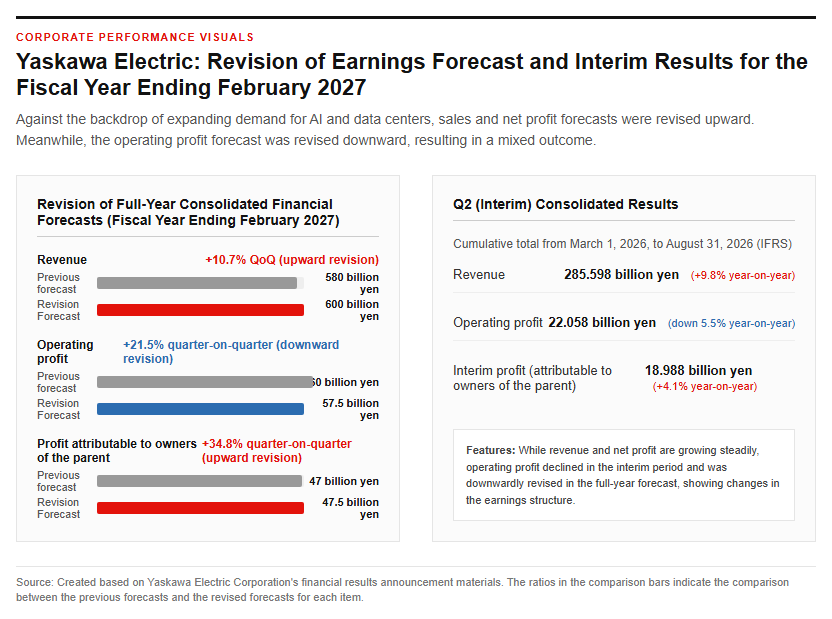
Industrial robot giant Yaskawa Electric Corporation announced its consolidated financial results (IFRS) for the second quarter (interim period) of the fiscal year ending February 2027 on October 9, 2026. For the cumulative period from March 1, 2026, to August 31, 2026, revenue was 285.598 billion yen (a 9.8% increase year-on-year), operating profit was 22.058 billion yen (a 5.5% decrease year-on-year), and interim profit attributable to owners of the parent company was 18.988 billion yen (a 4.1% increase year-on-year). Concurrently, the company revised its full-year consolidated financial forecasts, upgrading its revenue forecast from the previous 580 billion yen to 600 billion yen (a 10.7% increase year-on-year) and its net profit attributable to owners of the parent company (final profit) from 470 billion yen to 475 billion yen (a 34.8% increase year-on-year). Meanwhile, the full-year operating profit forecast, which indicates core business earnings, was downgraded from the previous forecast of 60 billion yen to 57.5 billion yen (a 21.5% increase year-on-year). This resulted in a unique financial outcome where revenue and net profit were revised upward while operating profit was marked down. Please refer to the figure below to visually grasp the overall balance.
Two Factors Behind the Gap Between Revenue Growth and Operating Profit Decline
Behind the gap between the upward revision of net sales and the downward revision of operating profit lies a complex interplay of tailwinds from the external environment and uncertainties involving internal factors. The first factor is a worldwide surge in demand for data center investments and semiconductor manufacturing equipment driven by the widespread adoption of generative AI. Orders for core control equipment and inverters are expanding at a pace exceeding the company’s initial expectations, and further boosting yen-denominated net sales was the revision of the average assumed exchange rate for the second half toward a weaker yen—from 145 yen to 155 yen per US dollar, and from 170 yen to 180 yen per euro. The second factor is the impact on production and shipments associated with the switchover of core IT systems implemented in May to strengthen the company’s management foundation. Glitches during the system migration caused temporary delays in factory shipments, leading to opportunity losses, increased fixed costs, and temporary structural reform expenses in the European business, which caused the operating profit margin for the first half to fall from 9.0% in the same period of the previous year to 7.7%.
Re-accelerating Production from the Second Half and Addressing Order Backlogs
At the earnings press conference, Representative Director, Chairman and President Hiroshi Ogasawara explained regarding the core system migration troubles that “production temporarily dropped, and we were unable to obtain the expected earnings in the interim period,” while also showing strong confidence in the strength of the demand itself. Orders are performing extremely well due to the ripple effects of global data center investments, and the company has accumulated an abundant backlog of orders internally. Therefore, the company has set a basic policy to rapidly normalize and re-accelerate the production system from the second half (September 1, 2026 to February 28, 2027) through the fiscal year ending February 2028, and to ship and monetize the delayed orders. In order to achieve the full-year operating profit target of 57.5 billion yen, it is necessary to generate approximately 3.5442 billion yen in operating profit (an operating profit margin of about 11.3%) in the second half alone, requiring a pace of earnings recovery that significantly exceeds the results of the first half.
Segment Trends and Mid-to-Long-Term Growth Strategies
Rapid Growth of Motion Control and Challenges in the Robotics Business
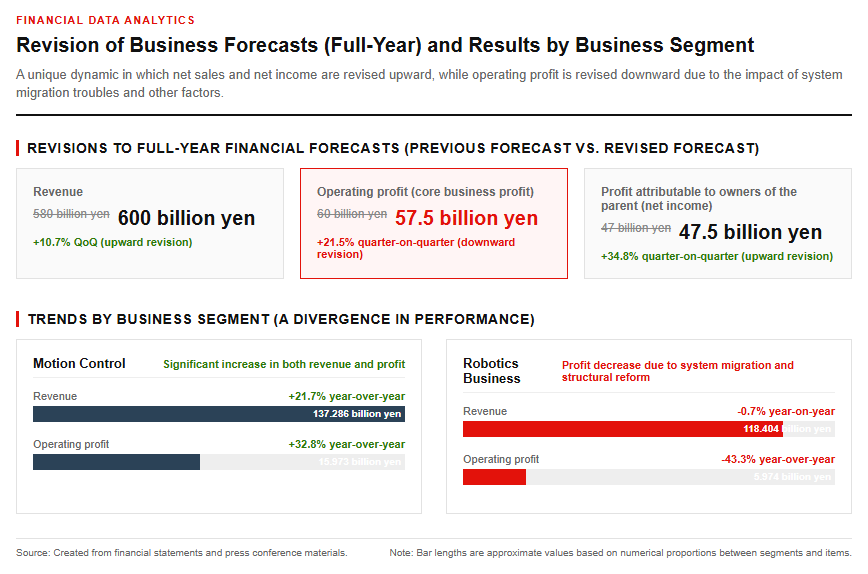
Looking at the performance by business segment, the results show a stark contrast. The Motion Control segment, which handles AC servo motors and inverters, achieved a significant increase in both revenue and profit, with revenue reaching 137,286 million yen (a 21.7% increase year-on-year) and operating income hitting 15,973 million yen (a 32.8% increase year-on-year). Capturing demand for semiconductor and electronic component manufacturing equipment as well as cooling inverters for data centers, it grew significantly in major regions such as the Americas, China, South Korea, and Taiwan. On the other hand, the Robotics segment posted a severe profit decline, with revenue at 118,404 million yen (a 0.7% decrease year-on-year) and operating income at 5,974 million yen (a 43.3% decrease year-on-year). Although sales expanded in the American automotive market and for semiconductor applications in China, shipments declined due to the impact of core system migration in Japan, and structural reform costs in Europe weighed heavily on profits. For a detailed breakdown by business, please refer to the figure below.
New Mid-Term Management Plan “Dash 35” and Massive Investment in Physical AI
Aiming for medium- to long-term growth, Yaskawa Electric announced in May 2026 its new medium-term business plan, “Dash 35,” which covers a four-year period from fiscal 2026 to fiscal 2029. The company has set ambitious targets to increase consolidated operating profit to 100 billion yen—about 2.1 times the 47.3 billion yen recorded in the fiscal year ended February 2026—and to raise revenue to 650 billion yen by the final year, the fiscal year ending February 2030. Under the plan, a total of 250 billion yen will be invested over the four years, with approximately half of that amount, 120 billion yen, allocated to “strategic investments” for the external acquisition of physical AI-related technologies, capital alliances, and M&A. Physical AI refers to technology where AI autonomously controls real-world robots and machinery, and the company aims to shift from traditional hardware-centric manufacturing focused on motors and machinery bodies to a software- and AI-integrated business model that recognizes situations and makes decisions.
Future Outlook and Key Points of Interest for Investors and Industry
There are broadly three key points that market participants and the industrial sector should monitor regarding Yaskawa Electric’s future business performance. First is the normalization of production shipments in the second half of the year and the pace of improvement in the operating profit margin (with a target of 11.3%). The primary short-term test will be whether the disruptions associated with the core system migration subside and the accumulated order backlog can be shipped smoothly. Second is the difference in profit structures compared to competitors like FANUC, along with the operating leverage effect. Because Yaskawa Electric has a high fixed-cost ratio, its profits tend to expand explosively when sales grow beyond the breakeven point; the key focus is to what extent the re-acceleration of production in the second half will directly translate into profit growth. Third is whether massive investments in the physical AI domain will bear fruit in earnings from the fiscal year ending February 2029 onward, as its evolution from a hardware manufacturer into a next-generation solutions company will determine its medium- to long-term corporate value.
Reference Page
- [Yaskawa Electric: Financial Results Briefing for the Second Quarter of the Fiscal Year Ending February 2027 (IFRS) (Consolidated)] https://www.yaskawa.co.jp
[#YaskawaElectric #FinancialResults #UpwardRevision #Semiconductors #DataCenters #PhysicalAI #Robots #MotionControl]
コメント