SK Group Chairman Chey Tae-won called for accelerating the expansion of semiconductor plants and indicated his willingness to preemptively start construction on the Honam semiconductor cluster. Behind this is a sharp surge in global AI demand and a strong sense of crisis regarding capital investment competition with U.S. and Chinese companies.
- Key Points of Events and Chairman Choi’s Surprise Visit
- Falling behind in the race for speed risks shrinking market share.
- Ripple Effects of the US-China Conflict and Restraints on Operations in China
- Challenges in Securing Massive Infrastructure and the Aim of Preemptive Investment
- Robust Financial Stability Supported by Strong AI Memory Demand
- Future Outlook and Key Focus Areas
Key Points of Events and Chairman Choi’s Surprise Visit
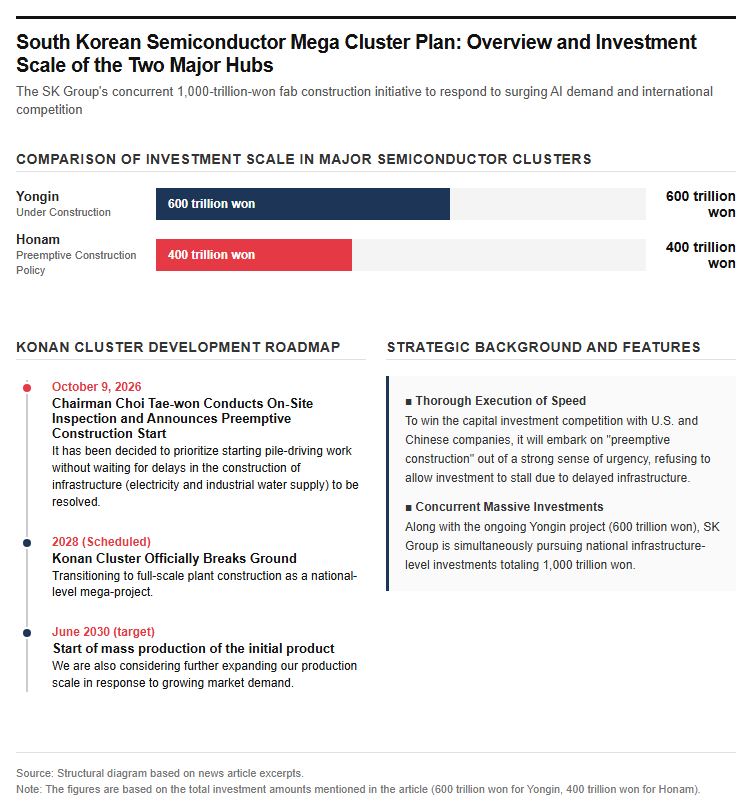
On October 9, 2026, SK Group Chairman Chey Tae-won, along with key executives including SK Hynix President Kwak Noh-jung, made his first direct visit to the planned site of the Honam region semiconductor cluster at the former Gwangju military airport site in South Korea. During the visit, he met with officials including Jeonnam-Gwangju Integrated Special Mayor Min Hyung-bae and revealed a plan for preemptive construction, starting with foundation work such as pile driving ahead of schedule, without waiting for delays in the construction of social infrastructure such as power and industrial water supply. The Honam semiconductor cluster is a massive national-level project with a total investment of 400 trillion won, aiming to break ground in 2028 and begin mass production of its first products in June 2030. Chairman Chey indicated a policy to proceed with the construction of the fab in Honam in parallel with the ongoing construction of the Yongin semiconductor cluster, which has a total scale of 600 trillion won, and also mentioned the possibility of further expanding the production scale depending on the growth of semiconductor demand. This series of prompt on-site inspections and statements of intent served to dispel concerns about investment stagnation caused by infrastructure issues and demonstrated a strong resolve to win the speed race for semiconductor expansion as a group. Please refer to the planning diagram below.
Falling behind in the race for speed risks shrinking market share.
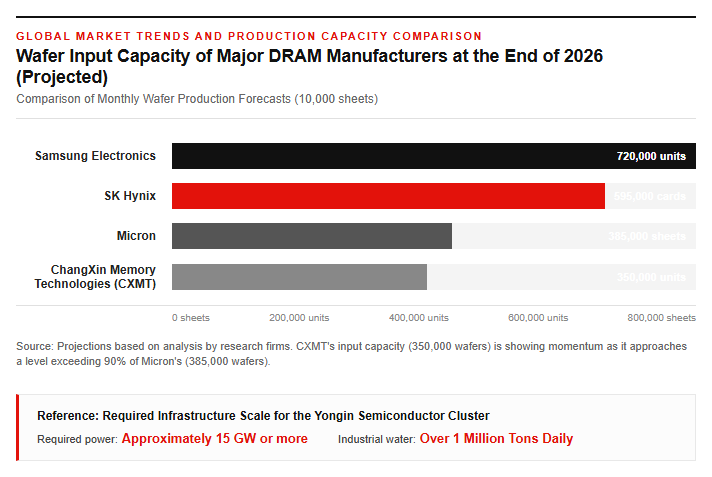
On October 11, 2026, at the International Business Leaders’ Advisory Council held in Shanghai, China, Chairman Chey Tae-won expressed an urgent sense of crisis to reporters regarding the global competition to expand semiconductor capacity. As memory demand explodes with the widespread adoption of artificial intelligence technology, U.S.-based Micron Technology and Chinese semiconductor companies are pursuing aggressive capital expenditures. According to analysis by research institutions, the wafer input capacity of China’s major DRAM manufacturer, ChangXin Memory Technologies (CXMT), is projected to reach 350,000 wafers per month by the end of 2026, and is estimated to approach a level exceeding 90% of Micron’s 385,000 wafers per month for the same period. Compared to Samsung Electronics’ 720,000 wafers per month and SK Hynix’s 595,000 wafers per month at that time, the catch-up pace of the emerging players is exceptionally striking. Chairman Chey warned that if the expansion of domestic production capacity lags behind, the high market share and industrial dominance in the memory market that South Korean companies have historically secured could rapidly diminish. Consequently, he emphasized that it is essential to push forward with the expansion of domestic production bases at maximum speed, free from regional constraints.
The Background of Dramatic Changes in the Global Market and Investment Strategies
Ripple Effects of the US-China Conflict and Restraints on Operations in China
Behind the global semiconductor competition lie the severe geopolitical confrontation and tightened trade regulations between the United States and China. In US political circles, a special committee of the US House of Representatives has raised issues with Samsung Electronics’ Xi’an NAND plant, as well as SK Hynix’s Wuxi DRAM plant and Dalian NAND plant, intensifying concerns that production bases in China could pose national security risks. In response, Chairman Chey Tae-won expressed the view that it is unrealistic to unilaterally suppress the growth of Chinese companies and domestic production bases through regulations and sanctions alone. Although the SK Group has made massive investments in the Chinese market, it continues to operate in an environment where it faces restrictions on bringing in advanced manufacturing equipment and upgrading technology due to US export controls against China and the review of the Validated End-User (VEU) program. Amidst such a climate of mounting geopolitical constraints and uncertainties, the importance of strategies to rapidly expand production capacity within South Korea and enhance the security and flexibility of the global supply chain has become increasingly critical.
Challenges in Securing Massive Infrastructure and the Aim of Preemptive Investment
To operate semiconductor manufacturing lines, an extremely advanced and stable power grid and massive amounts of ultrapure water are indispensable. It is estimated that the Yongin Semiconductor Cluster as a whole will require approximately 15 GW or more of electricity and over 1 million tons of industrial water per day—a gigantic scale that far exceeds existing infrastructure capacity. In past cases, complex administrative approval procedures, opposition movements from local communities, and demands to bury power lines underground caused approximately five years of construction delays at Samsung Electronics’ Pyeongtaek plant, while SK Hynix’s Yongin plant also took many years before construction could begin. Drawing on the experience where such delays in infrastructure construction became investment bottlenecks, Chairman Choi took the unusual step of initiating preemptive construction by proceeding with foundation work without waiting for the infrastructure to be completed. The aim of this speed-focused management strategy is to prevent opportunity losses caused by permit and infrastructure delays, and to supply products without missing the peak of demand amid intensifying market competition. Please refer to the layout diagram below for an overview of the local plant.
Financial Foundation and Future Outlook
Robust Financial Stability Supported by Strong AI Memory Demand
Behind SK hynix’s ability to drive aggressive facility expansion investments is its overwhelming profitability in the high-end memory market for AI, centered around High Bandwidth Memory (HBM). According to a credit rating analysis by Korea Ratings, the company has significantly improved its financial performance and cash-generating capability based on strong AI demand and technological leadership, maintaining a virtually debt-free structure through the reduction of net interest-bearing debt. Although the general-purpose memory market for PCs and smartphones is susceptible to cyclical economic fluctuations, the company has a high proportion of high-value-added, AI-specialized products in its revenue structure, and possesses superior market bargaining power and resilience against trade risks compared to its competitors. With abundant cash on hand and improved financial stability, an environment has been established where it can stably continue massive capital expenditures (CAPEX) reaching several trillion won annually, and this serves as a major driving force supporting its agile factory expansions.
Future Outlook and Key Focus Areas
The biggest point to watch moving forward is whether the relocation of the Gwangju military airport and land preparation will progress as planned toward the scheduled start of construction of the Honam semiconductor cluster in 2028. Furthermore, as the two major bases of Yongin and Honam are built simultaneously, whether infrastructure support measures promised by the government and local governments—starting with electricity—are executed in a timely manner will be the key to the project’s success. The expansion of production bases not only to the capital region but also to the southwestern region is expected to form a networked industrial ecosystem through collaboration with materials, parts, and equipment companies, as well as partnerships with research institutes and universities. On the other hand, external factors such as fluctuations in the global semiconductor market, trends in U.S. trade policy, and geopolitical risks still remain. For South Korea’s semiconductor industry to maintain its leadership in the global market, it is necessary to have swift execution capabilities toward the June 2030 mass production target and to establish a rapid support system that unites the public and private sectors.
Reference Page
- [National Assembly Legislative Research Service] Controversies and Reality Surrounding the Creation of the Yongin Semiconductor Cluster
[suspicious link removed] - [Korea Corporate Evaluation] SK Hynix Inc. Credit Rating Report
[suspicious link removed]
[#SKHynix #Semiconductors #CheyTaeWon #HBM #AISemiconductors #KoreanEconomy #CapitalExpenditure]
コメント