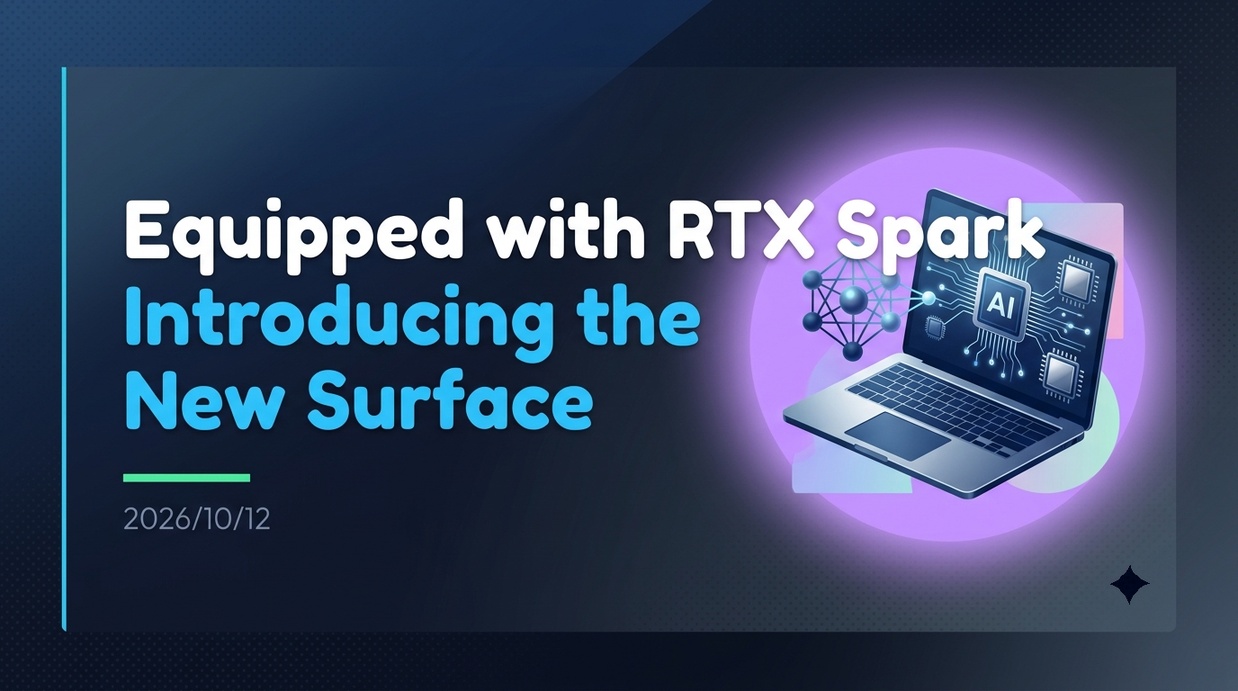
Microsoft has officially announced its flagship laptop, the “Surface Laptop Ultra,” equipped with NVIDIA’s latest “RTX Spark” SoC. It is attracting significant attention for its advanced local AI processing performance, which breaks free from cloud dependency, and as an execution platform for autonomous AI agents integrated into Windows 11.
- Key points of the announcement and its positioning as a next-generation local AI node
- The Hardware Architecture and Overwhelming Core Specs of the RTX Spark
- The Importance of Memory Capacity in Local AI Processing and the 48GB+ Barrier
- Integration of Autonomous AI Agents into Windows 11 and Operational Environment
- Security Risks and Access Control Associated with AI Agent Implementation
- Memory and CPU Price Surges: PC Market Price Changes and Future Outlook
Key points of the announcement and its positioning as a next-generation local AI node
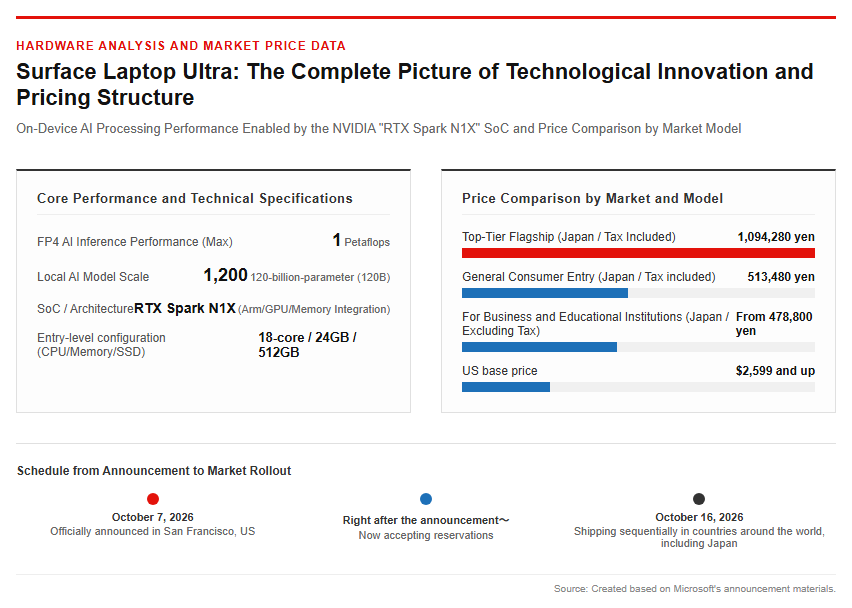
On October 7, 2026, Microsoft held a new product announcement event in San Francisco, USA, officially unveiling the “Surface Laptop Ultra,” a new laptop equipped with NVIDIA’s “RTX Spark” SoC. Microsoft CEO Satya Nadella and NVIDIA CEO Jensen Huang took the stage at the event, strongly emphasizing the shift from traditional cloud-dependent AI to on-device AI that performs advanced inference processing directly on personal devices. At the heart of this product is the “RTX Spark N1X” SoC, which fuses an Arm-based CPU co-developed with MediaTek, an NVIDIA GPU, and unified memory, achieving an FP4 AI inference performance of up to 1 petaflop. This makes it possible to run AI models with a scale of 120 billion (120B) parameters autonomously in a local environment without a network connection. The US retail price starts at $2,599. In the Japanese domestic market, the price for the consumer-facing entry-level model (18-core CPU, 24GB memory, 512GB SSD, Windows 11 Home) starts at 513,480 yen including tax, while the top-tier flagship model is priced at 1,094,280 yen including tax. Models for business and educational institutions are also available, starting at 478,800 yen excluding tax. Pre-orders are already open, and shipments are scheduled to begin sequentially worldwide, including in Japan, starting October 16, 2026. The photo below shows the physical device exterior unveiled at the announcement venue.
The Hardware Architecture and Overwhelming Core Specs of the RTX Spark
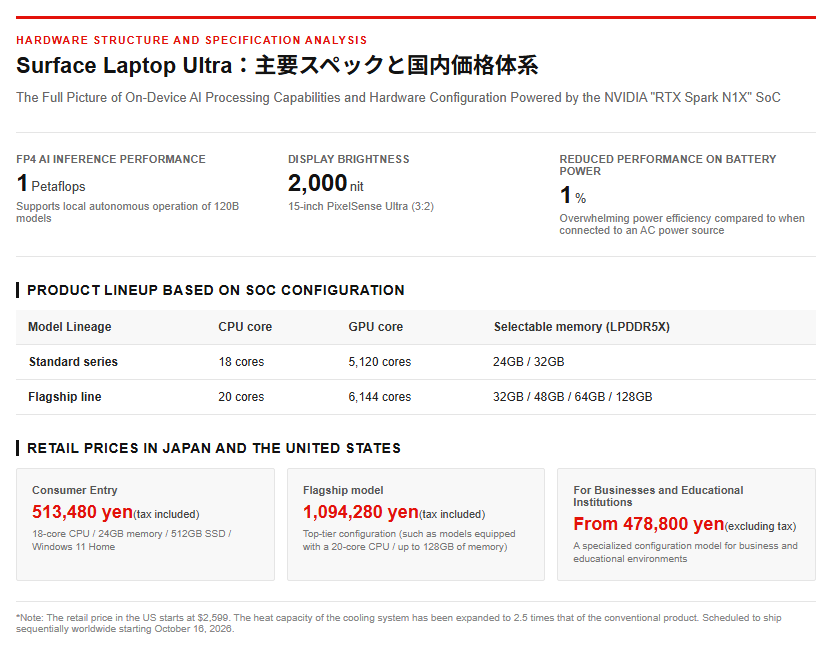
The Surface Laptop Ultra significantly redefines traditional standards not only in AI processing capability but also in its hardware chassis design. It features a 15-inch PixelSense Ultra display (3:2 aspect ratio), which achieves overwhelming clarity and display quality with a peak brightness of 2,000 nits thanks to a mini-LED backlight. The body thickness is kept to approximately 19 mm and the weight to about 2 kg, introducing a newly developed magnetic USB Type-C charging connector. To cope with the heat generated by high-load AI inference, the heat capacity of the cooling system has been expanded to 2.5 times that of conventional Surface products. Furthermore, it boasts exceptional power efficiency, with only a 1% performance drop when running on battery power compared to when connected to an AC power source. The product lineup is broadly divided into two main categories based on the SoC configuration.
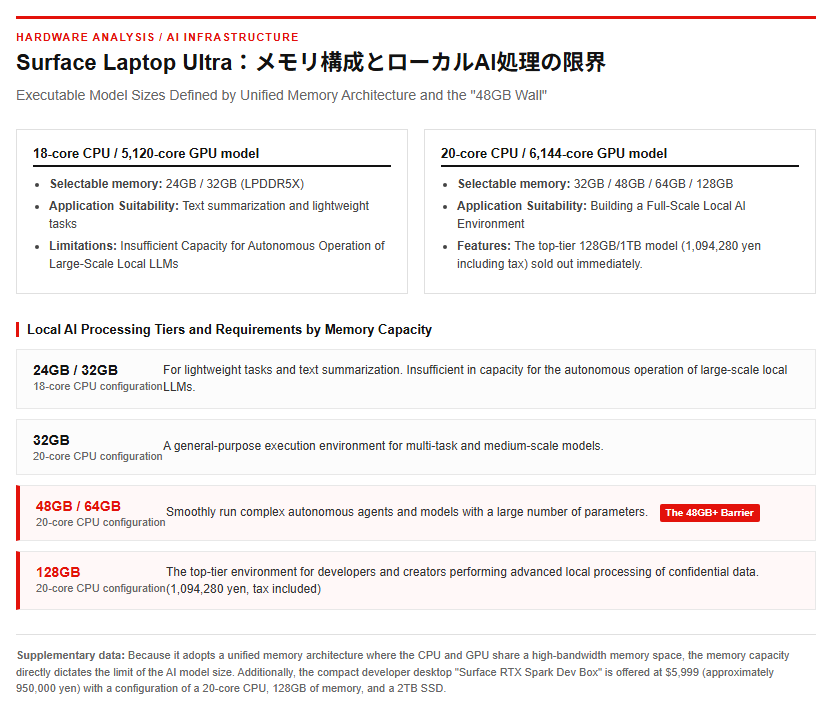
- 18-core CPU / 5,120-core GPU model: Available with a choice of 24GB or 32GB of memory (LPDDR5X)
- 20-core CPU / 6,144-core GPU model: Available with 32GB, 48GB, 64GB, and 128GB of memory (LPDDR5X)
The main parts of the internal structure feature a modular design that takes disassembly and repair into consideration, achieving a balance between robustness and maintainability. The arrangement of the ports on the side of the chassis and the magnetic attachment mechanism are as shown in the figure below.
The Importance of Memory Capacity in Local AI Processing and the 48GB+ Barrier
When selecting the Surface Laptop Ultra, the most decisive factor is the main memory capacity configuration. Similar to Apple’s M-series processors, this device adopts a unified memory architecture where the CPU and GPU share a high-bandwidth memory space. Consequently, the installed memory capacity directly dictates the limits for both the size of executable AI models and processing speeds.
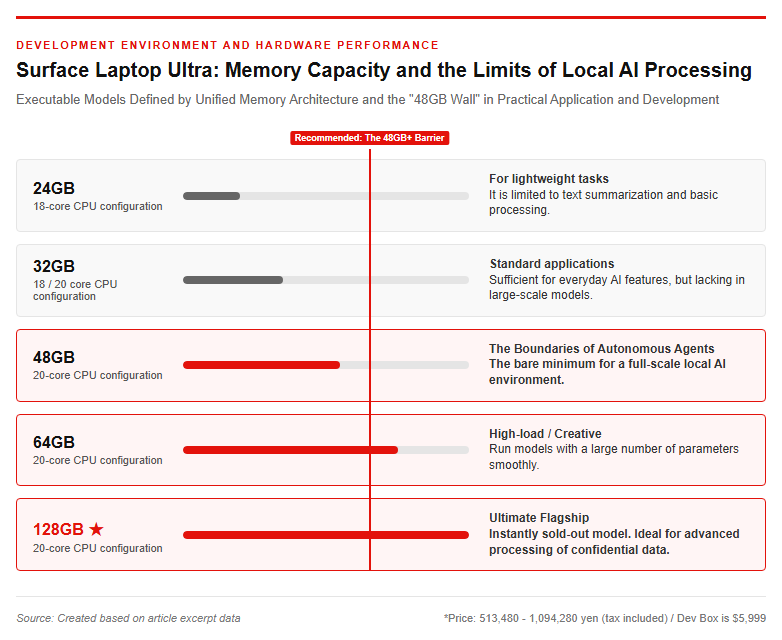
- 18-core CPU configuration (24GB/32GB memory): Sufficient for text summarization and lightweight tasks, but lacks the capacity to autonomously run large-scale local LLMs.
- 20-core CPU configuration (32GB to 128GB memory): Suitable for building a full-scale local AI environment, with a memory capacity of at least 48GB recommended to comfortably run complex autonomous agents and models with a large number of parameters.
Immediately after pre-orders began at the official store in Japan, the top-tier configuration featuring a 20-core CPU, 128GB of memory, and a 1TB SSD (1,094,280 yen including tax) sold out immediately as of 5:00 a.m. on October 8, 2026. This phenomenon reflects strong demand from developers and creators who want to process sensitive data locally at an advanced level without sending it to the cloud. Additionally, the compact desktop machine “Surface RTX Spark Dev Box” (20-core CPU, 128GB memory, 2TB SSD, $5,999 / approx. 950,000 yen) is also being offered for developers. Below is an example configuration for memory deployment in a development environment.
The Impact and Challenges of Integrating Windows 11 with AI Agents
Integration of Autonomous AI Agents into Windows 11 and Operational Environment
Alongside the announcement of this product, Microsoft has announced its strategy to evolve Windows 11 into an integrated platform for autonomous AI agents. Moving a step beyond conversational chat interfaces like the traditional Copilot, the OS will now provide workflows capable of continuously executing complex tasks without requiring step-by-step human instructions. Specifically, in addition to directly integrating AI search and agent capabilities into the taskbar, a mechanism has been implemented to allow users to select various AI agents—such as Hermes Agent, OpenClaw, and Perplexity—during the initial “Get Started” setup screen and automatically install them locally. Furthermore, Microsoft announced the official release of the “OS-Controlled Container” feature, designed to securely and continuously run agents in the background under OS supervision. Microsoft is executing a strategy to offload a portion of the computing resources previously handled by Azure data centers onto individual Windows PCs. This will deliver an always-on, intelligent working environment free from the concerns of network bandwidth caps or response latency. The overall system agent integration concept is as follows.
Security Risks and Access Control Associated with AI Agent Implementation
Realizing an environment where AI agents autonomously perform tasks such as file searching, application operations, and system setting modifications brings convenience, while simultaneously highlighting critical security concerns regarding access control management. Should an agent be compromised by malicious prompt injection or execute unintended processes due to a misunderstanding of commands, there is a risk that its broad system privileges will directly lead to an escalation of damage. Even for on-device AI that operates entirely within a local environment, the risks of communication with external services and erroneous operations cannot be eliminated, making it extremely dangerous to overconfidently assume that it is “safe because it is offline.”
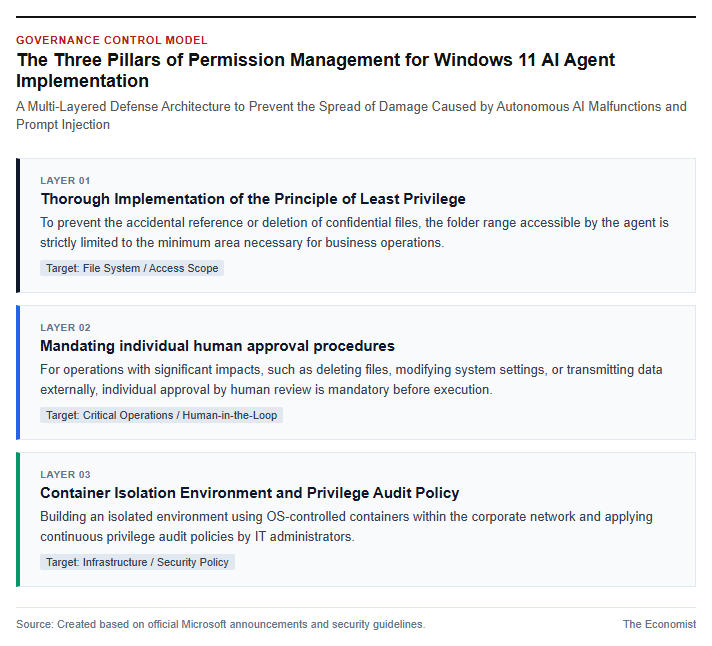
- Strict enforcement of the principle of least privilege, limiting the agent’s access permissions to only the necessary folders to prevent accidental reference or deletion of confidential files
- Mandating individual human approval procedures for critical operations such as file deletion, system configuration changes, and external data transmission
- Building Isolated Container Environments within Corporate Networks and Applying Privilege Audit Policies by IT Administrators
When companies deploy AI agents, building a governance framework that not only ensures high processing power but also enables safe isolation and control on Windows is an essential requirement. The appropriate permission management model is shown below.
Memory and CPU Price Surges: PC Market Price Changes and Future Outlook
The arrival of the Surface Laptop Ultra points to the future of personal computing, while also confronting the reality of severe cost surges in semiconductor components. According to analysis by market research firm TrendForce, as of the third quarter of 2026, the three major components of CPU, DRAM, and SSD accounted for approximately 68% of a standard laptop’s bill of materials (BOM), a significant increase from about 45% in early 2025. Driven by soaring component costs—including large-capacity 128GB memory—NVIDIA raised the price of its DGX Spark desktop by approximately 75% to $6,950. This global surge in component costs is translating directly into retail prices, leading to forecasts that global laptop shipments will follow a year-on-year downward trend through 2027. Microsoft is also facing a situation where it has no choice but to lower its revenue outlook for its Windows OEM and device divisions. Moving forward, ASUS is set to release the “ProArt P14/P16,” and companies such as Dell, HP, Lenovo, MSI, and Acer are planning to sequentially introduce RTX Spark-equipped devices. However, the key to widespread adoption will be how well these brands can deliver the convenience of autonomous AI while curbing rising hardware prices. Individuals and businesses will need to look beyond mere spec comparisons and carefully evaluate comprehensive cost-effectiveness, including security management.
Reference Page
- [Microsoft Press Release] https://blogs.windows.com/devices/2026/10/07/pre-order-our-most-powerful-surface-devices-ever/
【#SurfaceLaptopUltra #RTXSpark #Microsoft #Windows11 #LocalAI #AIAgents #NVIDIA #OnDeviceAI】

コメント