Autonics has released the BTF series, an ultra-thin 3.7mm thick photoelectric sensor specialized for installation in ultra-small spaces. The background is the simultaneous increase in demand for miniaturization of equipment and advanced digital diagnostics in manufacturing sites in 2026.
- Installation flexibility and ultra-small object detection brought by the 3.7mm thickness
- Achieving protective structures and high-density layouts that withstand harsh environments
- Optimal model number selection and compatibility based on detection principles
- Understanding material properties and maintenance management for longer lifespan
- Expansion of the Photoelectric Sensor Market and Shift to ‘Sensing + Diagnostics’
- The role of sensors as digital technology to address labor shortages
Installation flexibility and ultra-small object detection brought by the 3.7mm thickness
Autonics’ “BTF Series” is an optoelectronic sensor featuring an astonishing slim design with a thickness of just 3.7mm. It enables installation in the slight gaps of production lines and confined spaces inside equipment that conventional sensors have been difficult to install. This thinness will dramatically increase design flexibility in manufacturing equipment by 2026, as parts become increasingly dense. Please refer to the diagram below.
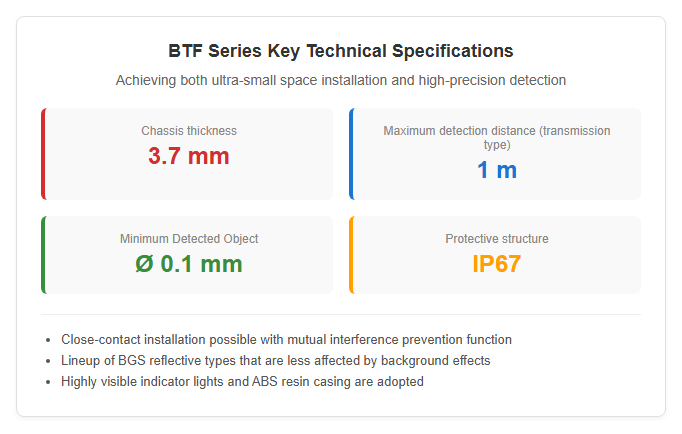
There is no compromise in detection performance; the transmission model achieves long-range detection up to 1 meter, while also supporting detection of extremely small objects as small as Φ0.1 mm. This ensures that even wires as thin as hair or tiny electronic parts pass through. Additionally, the lineup includes the “BGS Reflective Type,” which prevents false detections caused by background color or material, and its major strength is the ability to maintain stable detection accuracy even when the target is mirror-like or dark colors. It demonstrates its true value in applications requiring precise positioning, such as component detection with part feeders or PCB loaders.
Achieving protective structures and high-density layouts that withstand harsh environments
The BTF series is designed with the premise of operation in harsh industrial environments. The protection structure complies with IP67, ensuring stable operation without damaging internal circuits even in environments with fine dust or splashes during cleaning. Such robustness has become an essential requirement in smart factories, where reduced maintenance frequency is required.
Furthermore, it is notable that it is equipped with a unique cross-interference prevention feature. Normally, placing photoelectric sensors close together carries the risk of malfunctioning by picking up light from adjacent sensors, but this feature allows sensors to be installed in close contact. This feature enables sensors to be centrally arranged in limited spaces and acquire more detailed process data in modern automated lines for high-speed, small-lot, multi-variety production.
Selection Criteria and Operational Wisdom for Manufacturing Sites in 2026
Optimal model number selection and compatibility based on detection principles
For engineers in 2026, selecting BTF series is not just about specifying model numbers; precise matching with on-site conditions is required. Within the series, there are options such as the “BTF15-BDTL,” which is suitable for detecting the presence or absence of objects over short distances; the “BTF30-DDTL,” which demonstrates power over medium to long distances with wide conveyor belts; and the “BTF1M-TDTD,” which requires connection to special PLCs or specific connector outputs.
A key point in selection is not to confuse BDTL (diffuse reflective type) with DDTL (counter-firing or mirror reflective type). Since the detection principles differ between these two types, easy substitution can lead to detection failure. Also, if the target material is made of special materials such as black rubber or transparent glass, it is necessary to discount the detection distance or select a specific material. Before implementation, it is essential to carefully examine five elements: the material of the target to be detected, color, movement speed, ambient light source, and controller interface, and to compare them with the specifications.
Understanding material properties and maintenance management for longer lifespan
The BTF series enclosure uses ABS material. This material offers industrial advantages such as excellent insulation and lightweight, but caution is needed in environments involving strong acids, strong alkalis, hot oils, or frequent physical impacts. For harsh environments, measures such as adding a stainless steel protective cover are recommended.
As of 2026, industry consensus is that products from global manufacturers like Autonics are manufactured under the same quality control systems as the Korean headquarters, and their reliability has reached international standards. However, sensors always have a lifespan. If the light intensity falls below 70% of the initial value or if the indicator light brightness changes, a replacement should be planned as predictive maintenance to prevent sudden line stoppages. Additionally, it is important to carefully check the output logic of NPN and PNP during wiring to prevent circuit burn-in caused by inconsistencies with the PLC.
Market Transformation and Future Outlook
Expansion of the Photoelectric Sensor Market and Shift to ‘Sensing + Diagnostics’
The global optoelectronic sensor market is projected to grow from approximately USD 2.275 billion in 2025 to USD 3.669 billion by 2032, showing a steady CAGR of 7.2%. However, even more noteworthy than this growth is the qualitative shift in demand. From simply detecting the presence or absence of objects, advanced functions are now required to acquire process data and diagnose the health status of the equipment itself.
Following this trend, some new sensors have begun to widely use the IO-Link protocol to transmit detailed data such as light intensity margins and ambient temperature to upstream systems. Products like Autonics’ BTF series are also positioned within this trend of digital communication support. The definition of sensors has evolved beyond being merely “eyes” to becoming a “self-diagnosis tool” aimed at maximizing equipment utilization rates.
The role of sensors as digital technology to address labor shortages
Japan’s manufacturing sector in 2026 faces structural challenges such as severe labor shortages and the retirement of skilled workers. According to the survey, over 80% of managers predict that labor shortages will continue or worsen in the future. In this context, high-precision sensing technologies like the BTF series digitize the “subtle anomaly detection” that traditionally relied on veterans’ intuition and experience, establishing a system that enables anyone to maintain stable quality control.
Additionally, while overseas FA manufacturers like Autonics are gaining prominence, Omron has won a patent infringement lawsuit against the company, further highlighting the growing importance of intellectual property management. Going forward, we will not only introduce products with excellent specs but also choose sensors based on “comprehensive strength” including supply stability, post-implementation support systems, and technical compliance.
Reference Page
-
【Autonics | BTF Series】https://www.autonics.com/jp/series/BTF
-
[Caddy Co., Ltd. | 2026 Manufacturing Outlook Survey]https://caddi.com/
-
[Omron | Patent infringement lawsuit against Korean Autonics (Victory)https://www.fa.omron.co.jp/new/information/2025/01/001.html
[#光電センサー #製造業DX #オートニクス #スマートファクトリー #FA機器 #産業自動化 #2026年トレンド #科学技術]


コメント