
When migrating core enterprise and government systems to the cloud, increasing emphasis is being placed on an approach that seamlessly combines the use of standard package features with custom development. This is driven by the reality that excessive custom modifications made in the past have become technical debt, hindering system upgrades and causing operating costs to balloon.
- Survey Reveals the Current State of Cloud Migration and Customization Limitation
- Technical Debt and Data Migration Risks Caused by Excessive Custom Development
- Loosely Coupled Integration via Clean Core Principles and a Decoupling Layer
- Implementing Sustainable Standardization Based on the Pace-Layering Strategy
- Addressing Increasing Operational Expenses and Practical Data Migration & Quality Control
- Future Outlook and Key Focus Areas for Next-Generation Cloud Infrastructure and AI Utilization
Survey Reveals the Current State of Cloud Migration and Customization Limitation
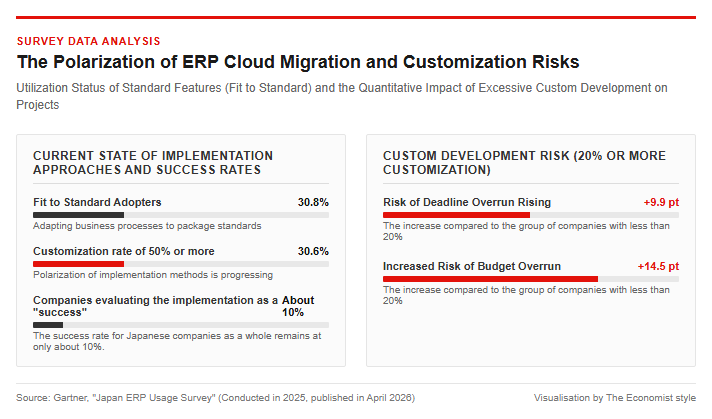
According to the domestic ERP usage status survey (conducted in 2025) released by Gartner in April 2026, 30.8% of companies have adopted the “Fit to Standard” approach, aligning their operations with the standard functions of the package. On the other hand, 30.6% of companies have a customization rate of 50% or more for the functions used in their systems, highlighting a polarization in implementation methods. The survey demonstrated that companies with a customization rate of 20% or higher face a 9.9 percentage point higher risk of project schedule overruns and a 14.5 percentage point higher risk of budget overruns compared to those with less than 20%. Excessive custom development becomes an obstacle during version upgrades and hinders the adoption of advanced technologies such as AI. Therefore, management decisions to keep the customization rate below 20% are essential for achieving successful digital transformation. Please refer to the implementation trend chart below.
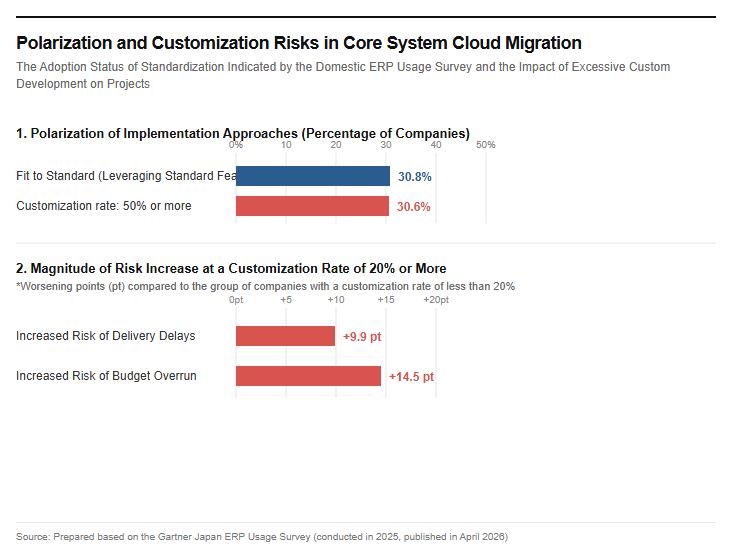
In addition, only about 10% of Japanese companies rate their implementation as a “success,” making a mindset shift toward standardization an urgent priority.
Technical Debt and Data Migration Risks Caused by Excessive Custom Development
Addons (custom-developed features) that have been added over the years in response to on-site demands have become not system assets, but serious technical debt. In core systems bloated with addons, bugs occur frequently during the application of package patches or version upgrades, leading to an “addon hell” where keeping up with the latest environment becomes impossible. In international cases as well, when the UK’s Vodafone attempted to migrate over 28 million customer accounts containing more than 1 billion data fields to a new system, inconsistencies occurred, resulting in the company being slapped with massive fines. While technical and performance migrations proceed relatively smoothly during cloud migrations, data migration errors involving complex legacy data and proprietary rules become the greatest risk factors. Successful data migration requires clear data governance, a phased testing plan, and an accurate assessment of the existing customization scale.
An Architecture That Balances Package Standards and Custom Development
Loosely Coupled Integration via Clean Core Principles and a Decoupling Layer
To implement custom requirements without compromising the package’s standard functionality, maintaining a clean core and building a loosely coupled system architecture are recommended. By keeping the core system (ERP) itself unmodified and maintaining its standard state (a clean core), automatic updates and security patches provided by vendors can be applied promptly. For custom features and industry-specific requirements, they are built as external microservices or external SaaS by connecting to Web APIs or a decoupling layer (intermediate integration infrastructure) via APIs (Application Programming Interfaces). This approach makes it possible to achieve both the robustness of the core and the scalability and agility of peripheral functions. Please refer to the system architecture overview diagram below.
Implementing Sustainable Standardization Based on the Pace-Layering Strategy
Attempting to standardize all requirements indiscriminately risks damaging the areas of differentiation that are a company’s strengths. In the pace-layered strategy proposed by Gartner, internal systems are classified and managed in three tiers: foundational, differentiated, and innovative systems. While thoroughly applying “Fit to Standard” in foundational areas such as accounting and human resources to align operations with standard functions, external expansion using API integration is chosen for differentiated areas directly linked to competitive advantage. It is important to thoroughly conduct a fit-and-gap analysis in advance to clarify differences from standard functions, and to establish a strict approval process for adding customizations. Executive leadership making the decision to change business operations and supporting mindset shifts on the front lines through change management are prerequisites for success.
Challenges and Future Outlook in the Migration Sites of Local Governments and Enterprises
Addressing Increasing Operational Expenses and Practical Data Migration & Quality Control
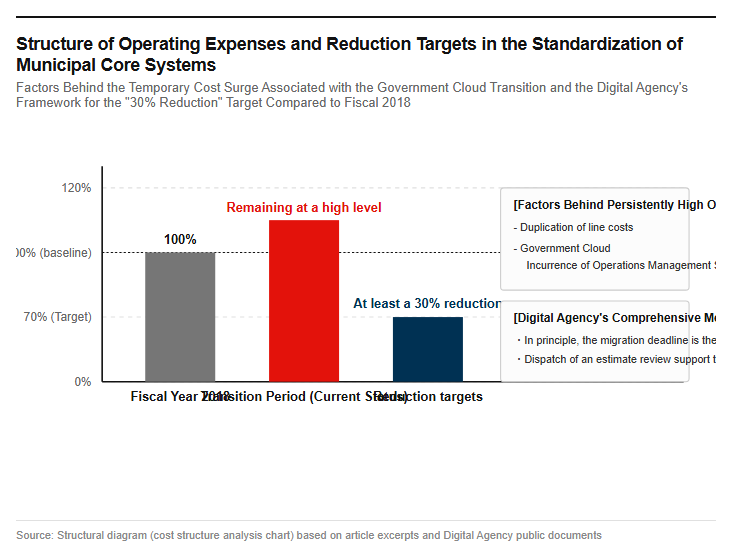
In the administrative sector as well, efforts are underway, centered around the Digital Agency, to migrate core business systems for 20 operations across local governments nationwide to standard-compliant systems. The migration deadline is, in principle, the end of fiscal year 2025 (the end of Reiwa 7), and systematic migration support is also being provided for specific migration support systems whose migration will take place in fiscal year 2026 (Reiwa 8) or later. However, issues have surfaced where operating costs remain high due to the duplication of network line costs post-migration and the emergence of Government Cloud operation and management subsidy expenses. The Digital Agency has set a goal of establishing an environment to reduce operating costs by at least 30% compared to fiscal year 2018 (Heisei 30), and is implementing comprehensive measures such as establishing an estimate review support team and providing local government financial measures and subsidies for fiscal year 2025. Please refer to the cost structure analysis chart below.
Future Outlook and Key Focus Areas for Next-Generation Cloud Infrastructure and AI Utilization
Cloud migration is not merely a replacement of infrastructure, but rather the establishment of a foundation for instantly adopting generative AI and advanced data analytics. In next-generation SaaS ERP systems adopting a composable architecture, it is possible to flexibly reconfigure functional modules in response to changes in the market environment. Going forward, advanced use cases will expand where AI handles demand forecasting, accounting processes, and workflow automation through standardized data integration platforms. Even after system migration, clarifying modification rules for regulatory revisions and advancing operational automation to establish a sustainable system environment will be the key determinants of each organization’s growth.
Reference Page
- [Gartner Announces View That ERP Standardization Is an Essential Management Issue for Business Transformation Leveraging Digital Technology, and Customization Should Be Kept Below 20%] https://www.gartner.co.jp/ja/newsroom/press-releases/pr-20260406-erp-survey
- 【Digital Agency’s Initiatives Toward the Unification and Standardization of Core Business Systems, etc.】https://www.digital.go.jp/
- [Case Studies on Standardization and Commonization of Local Government Information Systems – Ministry of Internal Affairs and Communications] https://www.soumu.go.jp/
- [Risks of Migrating to ERP and 5 Steps to Ensure Success – Kyocera Communication Systems] https://www.kccs.co.jp/
- [Regarding the Usage Status and Challenges of Cloud Services in Financial Institutions – Bank of Japan] https://www.boj.or.jp/
【#CloudMigration #ERPStandardization #FitToStandard #Decoupling #CoreSystems #DigitalAgency】
コメント