According to recent announcements by the Semiconductor Industry Association and others, global semiconductor sales from January to August 2026 exceeded $1 trillion, a first in market history. Behind this are a surge in demand for data centers driven by the widespread adoption of generative AI, and a historic expansion of the memory market centered around High Bandwidth Memory (HBM).
- The key points of the market that reached 1 trillion dollars in just 8 months
- The Surge in Memory Demand and the Growth Structure Driven by HBM
- Massive Investments by Hyperscalers and Revenue Changes of Semiconductor Companies
- The Value of In-House Design and Advanced Packaging Beyond Conventional Market Estimates
- The Reality of Corporate Profits Revealed Through Comparison with the Dot-Com Bubble
- Future Outlook on Geopolitical Risks and Ensuring Supply Chain Flexibility
The key points of the market that reached 1 trillion dollars in just 8 months
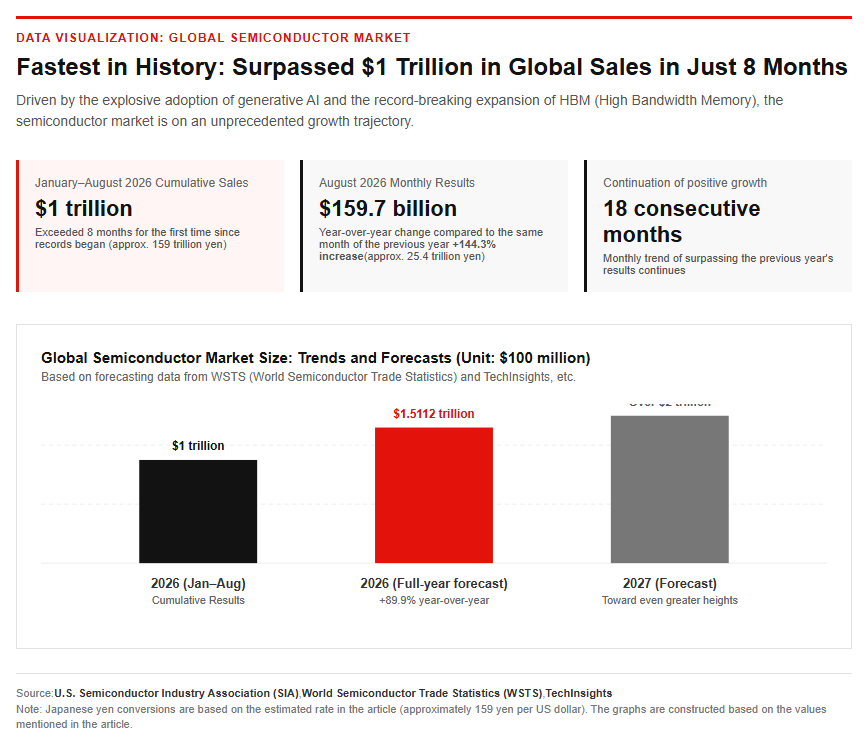
According to data released by the Semiconductor Industry Association (SIA) on October 5, 2026, cumulative global semiconductor sales from January to August 2026 surpassed the $1 trillion mark (approximately 159 trillion yen). This is the first time in statistical history that annual sales have reached the $1 trillion milestone at such an unprecedented pace in just eight months. In particular, global sales for the single month of August 2026 reached $159.7 billion (approximately 25.4 trillion yen), showing an unprecedented and staggering year-on-year increase of 144.3%. Monthly sales exceeded the previous year’s figures for the 18th consecutive month, illustrating that the pace of market expansion shows no signs of slowing down.
Driven by this momentum, World Semiconductor Trade Statistics (WSTS) significantly revised its full-year market size forecast upward in its Spring 2026 forecast to $1.5112 trillion (approximately 240 trillion yen), an 89.9% increase year-over-year. Furthermore, research firms such as TechInsights predict that with the continuation of multi-faceted investments in AI infrastructure, the global market size will exceed the $2 trillion (approximately 318 trillion yen) milestone in 2027. The market is being driven not by a single product category, but across a wide range extending from processors required for AI computing to communications and power management semiconductors. The figure below shows the rapid growth trajectory of the global semiconductor market size.
The Surge in Memory Demand and the Growth Structure Driven by HBM
The biggest driving force behind this rapid market expansion is the explosive surge in demand for memory products. According to WSTS product-specific statistics, the memory market in 2026 is projected to rapidly expand to $803.9 billion (approximately 128 trillion yen), an increase of about 250% year-over-year. According to Gartner’s analysis, memory products will account for a remarkable 54% of total semiconductor sales in 2026, and the memory market alone is projected to reach $1 trillion by 2027.
At the center of memory demand is High Bandwidth Memory (HBM), which is used in combination with advanced processing units such as GPUs. Generative AI training and inference require processing massive amounts of data at ultra-high speeds, making HBM capacity and transfer speeds the bottlenecks that determine overall system performance. For example, NVIDIA’s next-generation AI system, the Vera Rubin NVL72, is specified to feature a total of 20.7 TB of cutting-edge HBM4 across the entire system. As production capacity has rapidly been allocated to HBM for AI servers, the supply of conventional DRAM has been squeezed, tightening supply and demand and leading to rising prices and boosted profitability across the industry.
Corporate Trends and Changes in Industrial Structure Surrounding AI Infrastructure Demand
Massive Investments by Hyperscalers and Revenue Changes of Semiconductor Companies
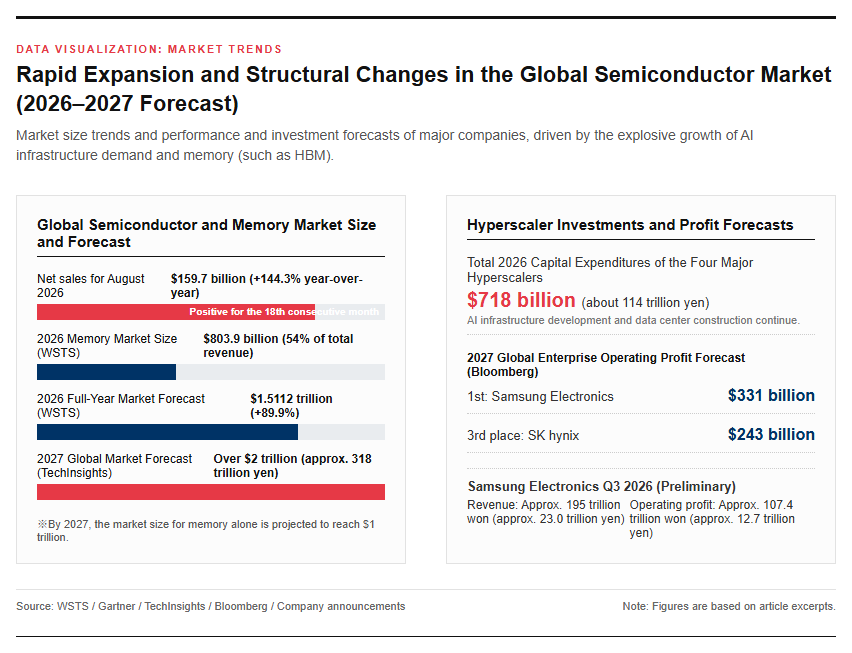
The rapid growth of the AI market is being driven by massive capital expenditures by major U.S. tech companies known as hyperscalers. According to TechInsights estimates, the total capital expenditure of the four major hyperscalers in 2026 is projected to reach $718 billion (approximately 114 trillion yen). A succession of data center construction plans and the development of AI infrastructure are significantly boosting the performance of semiconductor manufacturers.
This trend is also clearly reflected in the financial results of major memory manufacturers. In its preliminary third-quarter financial results announced in October 2026, Samsung Electronics reported sales of approximately 195 trillion won (approx. 23.0 trillion yen) and an operating profit of approximately 107.4 trillion won (approx. 12.7 trillion yen), updating its record-high performance. According to Bloomberg’s operating profit forecasts for global companies in 2027, Samsung Electronics is projected to rank first globally at 331 billion dollars, and SK hynix third at 243 billion dollars, with both expected to generate higher earnings than Nvidia. The figure below shows the capital expenditures and demand structure of major semiconductor companies.
It is clearly demonstrated that the AI industry’s revenue driver is shifting from software to physical hardware infrastructure.
The Value of In-House Design and Advanced Packaging Beyond Conventional Market Estimates
When measuring the growth rate of the semiconductor industry, it is necessary to pay attention to new structural changes that have been difficult to discern through conventional market statistics. According to a re-evaluation report published by McKinsey in 2026, it is pointed out that the value of proprietary (captive) chips developed in-house by cloud service providers, in-house designed SoCs by smartphone manufacturers and others, and advanced packaging technologies represented by CoWoS (Chip-on-Wafer-on-Substrate) has been underestimated in traditional sales-based statistics.
When McKinsey factored in these elements and the production capacity of Chinese companies to reassess the market, it estimated that the actual market size as of 2024 had already reached approximately $775 billion. Furthermore, it projects that the market size will expand to $1.6 trillion ($1.5 trillion to $1.8 trillion) by 2030. According to the analysis, cutting-edge nodes are expected to account for roughly 62% of the growth from 2024 to 2030, with memory such as HBM accounting for about 31%. A winner-take-all dynamic is increasingly solidifying, where value is concentrated in a tiny fraction of companies holding cutting-edge technology.
The Sustainability of the AI Boom and Future Focus Points & Challenges
The Reality of Corporate Profits Revealed Through Comparison with the Dot-Com Bubble
Amid the rapid market expansion, some voices in the stock market and elsewhere have expressed concern over a potential recurrence of the dot-com bubble (IT bubble) that occurred around 2000. However, many market analysts and economists point out that market fundamentals are fundamentally different today compared to back then. According to Jurrien Timmer of Fidelity, while the price-to-earnings (P/E) ratio of S&P tech stocks reached 70x around 2000, it currently remains at around 21x. NVIDIA’s forward P/E ratio is also trending at 19.1x, which is below its historical average.
According to analysis by the International Monetary Fund (IMF), whereas the stock price increases in the late 1990s were driven by the expansion of stock valuations (anticipation-led), the stock price surges in the current AI boom are strongly supported by explosive corporate profit growth (expansion of actual earnings). However, as history in the eras of the railroad, electricity, and internet revolutions has shown, even if the technology itself is genuine, the risk always exists that excessive corporate investment and oversupply could trigger a temporary correction phase, prompting close monitoring of future earnings trends.
Future Outlook on Geopolitical Risks and Ensuring Supply Chain Flexibility
Ensuring supply chain flexibility and responding to geopolitical risks hold the most crucial keys to sustaining future growth in the semiconductor market. According to a survey conducted by KPMG and GSA of 151 semiconductor company executives worldwide, 45% of executives cited making supply chains more flexible and enhancing adaptability as the top priority in their management strategies for the next three years. The tightening of US export controls against China, geopolitical friction, and tariff measures are recognized as major risk factors for the semiconductor industry.
Furthermore, the surge in power consumption accompanying the rapid increase in AI data centers, as well as capacity limits in advanced packaging and DRAM wafer production, could also become effective constraints moving forward. Major manufacturers are proceeding with the geographical diversification of production bases and the sophistication of supply and demand forecasting utilizing generative AI. As the industry aims to achieve a $2 trillion market by 2027, the biggest future focal points will be the extent to which supply systems and power infrastructure can keep pace with overheating demand, and how a global supply chain can be maintained amidst the technological hegemony race among nations.
Reference Page
- 【WSTS (World Semiconductor Trade Statistics) Official Website】[suspicious link removed]
- 【Dai-ichi Life Asset Management Economic Research Institute Research Report】[suspicious link removed]
[#Semiconductors #ArtificialIntelligence #Memory #HBM #DataCenters #Technology]


コメント