
It has been revealed that DeepSeek, a Chinese AI startup, has begun developing its own AI inference chip. With U.S. export controls restricting procurement of advanced chips from companies like NVIDIA, the aim is to dramatically improve technological independence and cost efficiency by internalizing hardware optimized for its own models.
- Strategic shift toward inference-specialized chips
- Limitations of existing chips and the inevitability of development
- Global AI Competition Through Vertical Integration
- Reducing hardware load through software technology
- Strong collaboration with Chinese semiconductor companies
- Technical Barriers and Manufacturing Risks to Be Addressed
- Diversification of Intelligent Infrastructure for AGI Realization
Strategic shift toward inference-specialized chips
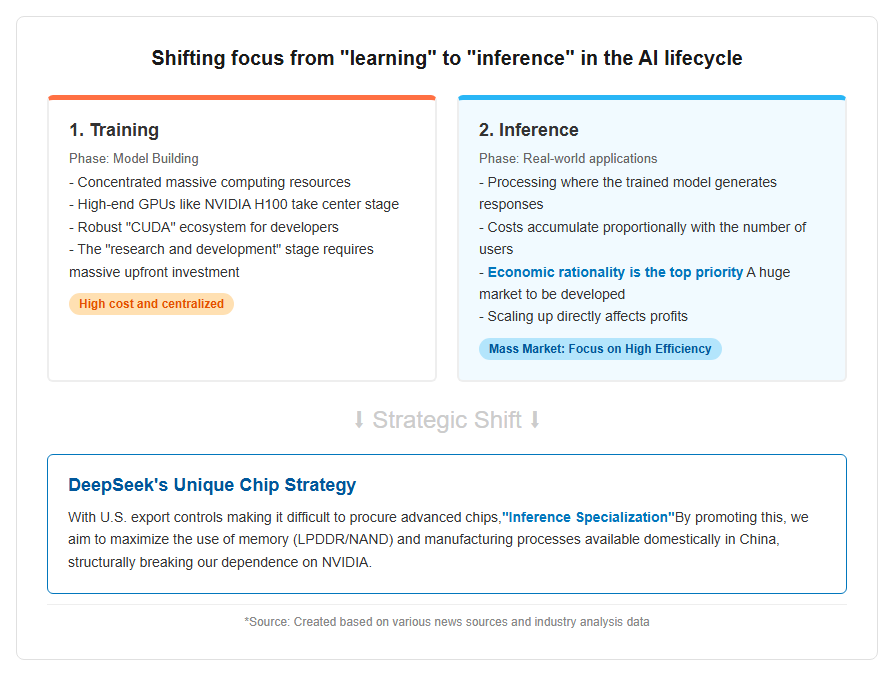
On July 7, 2026, it was reported that DeepSeek has been developing its own AI chip specialized in “inference” for about a year. Until now, the company has used NVIDIA’s low-spec H800 chips and China’s Huawei Ascend series alongside them, but chose to develop their own chips in-house to reduce dependence on specific suppliers. Development projects include consultations with chip design companies, foundries, and memory companies, and in recent months, the hiring of semiconductor design engineers has rapidly expanded in private channels. This chip is optimized for “inference” processing, where trained models generate responses, aiming to pursue economic rationality in the mass market, where demand in the AI industry will continue to grow. The diagram below illustrates the importance of inference processing in AI infrastructure.
Limitations of existing chips and the inevitability of development
DeepSeek’s acceleration in developing its own chips is driven by the technical challenges faced by existing alternative hardware. In developing the next-generation model “R2,” the company used Huawei’s Ascend 910C chip at the request of Chinese authorities, but due to chip instability and software immaturity, training was reportedly unsuccessful. Additionally, U.S. export controls have blocked access to NVIDIA’s latest H100 and H200 chips, making it increasingly difficult to maintain world-class AI performance with only low-spec and domestic chips available in China. It is urgent to break through these constraints imposed by “external pressure” and establish “technological sovereignty” to maximize the company’s software capabilities.
Global AI Competition Through Vertical Integration
The trend of model development companies internalizing their own hardware is becoming a global trend, not just for DeepSeek. OpenAI in the US has announced the inference-specialized chip Jalapeno in collaboration with Broadcom, and Anthropic is also working on similar research. By vertically integrating software (models) and hardware, it becomes possible to optimize computational efficiency that is impossible with general-purpose chips. DeepSeek’s move suggests that, apart from geopolitical divisions, the AI industry has reached a mature stage, moving toward greater optimization and cost reduction.
Integration of Algorithmic Innovation and Domestic Ecosystems
Reducing hardware load through software technology
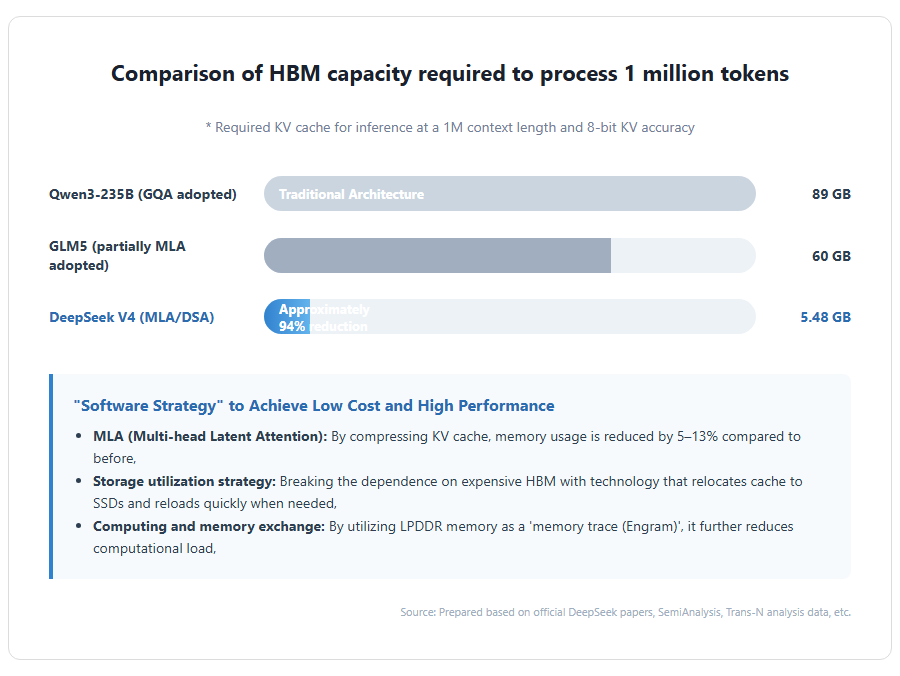
DeepSeek’s strength lies in its innovative algorithms that achieve high performance with minimal computational resources. Technologies developed by the company, such as “MLA (Multi-head Latent Attention)” and “DeepSeekMoE,” dramatically reduce memory usage (KV cache) during inference. For example, for contextual processing of 1 million tokens, DeepSeek V4 requires about 5.48GB of high-speed memory (HBM), whereas other companies’ similar-scale models require 60GB to 89GB. By lowering hardware requirements on the software side in this way, it is calculated that a sufficiently competitive system can be built even in China’s domestic manufacturing environment, where cutting-edge manufacturing processes are not available. Please refer to the diagram below.
Strong collaboration with Chinese semiconductor companies
The development of proprietary chips is also seen as part of a “$10 trillion grand strategy” to nurture China’s domestic semiconductor ecosystem. DeepSeek’s architecture is designed to reduce dependence on expensive and scarce HBM, and to smartly utilize NAND flash (SSD) and LPDDR memory. This enables the AI infrastructure to focus on components that can be stably supplied domestically in China, such as YMT’s SSDs and CXMT’s LPDDR. Additionally, through proprietary programming languages such as TileLang, we are building a development environment independent of NVIDIA’s CUDA, aiming for platform independence that makes it easier to utilize not only Chinese chips but also hardware from non-NVIDIA camps like AMD.
Future Developments and Highlights
Technical Barriers and Manufacturing Risks to Be Addressed
Successfully developing proprietary chips would mark a major turning point, but there are also tough obstacles ahead. The biggest concern is the manufacturing process, and under U.S. regulations, Chinese chip design companies cannot access cutting-edge overseas foundries, leaving domestic manufacturing technology alone with challenges in yield and performance. Additionally, access restrictions to advanced memory, such as HBM, which is essential for inference chips, persist. Among semiconductor analysts, there is a cautious view that Chinese companies will need to fully break free from dependence on NVIDIA chips over the next 3 to 5 years and massive capital investment, making how DeepSeek can shorten this timeframe a focal point.
Diversification of Intelligent Infrastructure for AGI Realization
DeepSeek’s ultimate goal is to realize “Artificial General Intelligence (AGI)” that autonomously evolves. The existence of proprietary chips that dramatically reduce computational costs is a powerful tool for accelerating large-scale reinforcement learning and automated AI research (RSI), which involve extensive trial and error. The company’s challenge goes beyond merely developing commercial chips; it is also an attempt to secure the foundation for “externalizing thinking” at the civilization level on its own. How well the company’s chips demonstrate in the next 12 to 18 months will not only determine the direction of global AI dominance but could also fundamentally shake the current AI market structure, where NVIDIA remains dominant.
[#AI #DeepSeek #半導体 #中国テック #科学技術 #推論チップ #AGI]


コメント