
SMIC’s net profit for the January–September 2026 period surged 91.6% year-on-year to 7.314 billion yuan, bringing it within 0.5 percentage points of second-place Samsung Electronics in global market share. This momentum is driven by the promotion of semiconductor localization amid the prolonged US-China conflict and surging demand for mature-node products fueled by AI infrastructure needs.
- 1-1. Overview of Financial Results Achieving a 90% Increase in Net Profit
- 1-2. Factory Utilization Rate of 97.3% and Record-Breaking Wafer Shipments
- 2-1. Narrowing the Market Share Gap with Samsung to Just 0.5 Percentage Points
- 2-2. Samsung’s Structural Stagnation Plagued by 3nm GAA Yield Issues
- 3-1. Demand-Driven Growth Brought by Over 90% Reliance on the Chinese Market
- 3-2. Strengths of Mature Processes and Peripheral Chips Supporting AI Computing
- 4-1. Target Price Upgrades by Major Securities Firms and the Division of Evaluations
- 4-2. Concerns Regarding Depreciation Burdens and Fourth-Quarter Margin Declines
- 5-1. Extreme Capacity Tightening and Prolonged Equipment Delivery Times from 2027 to 2028
- 5-2. Future Vision of Self-Sufficiency Achievement and Domestic Manufacturing Equipment in China’s Semiconductor Industry
1-1. Overview of Financial Results Achieving a 90% Increase in Net Profit
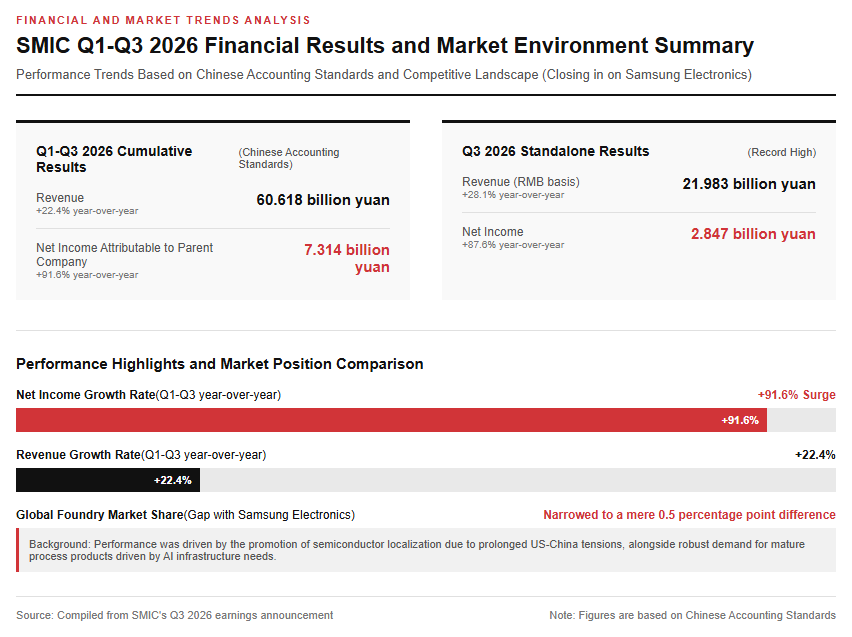
Semiconductor Manufacturing International Corporation (SMIC), China’s largest semiconductor foundry, announced its financial results for the July–September quarter (Q3) and the January–September cumulative period on November 12, 2026, sending shockwaves through the market. Under Chinese accounting standards, sales for the January–September period reached 60.618 billion yuan (approximately 1.5 trillion yen), a 22.4% increase year-on-year, while net profit attributable to the parent company’s shareholders skyrocketed by 91.6% year-on-year to 7.314 billion yuan (approximately 180 billion yen), marking a substantial profit increase of effectively over 90%. Furthermore, standalone sales for the July–September quarter rose 28.1% year-on-year to 21.983 billion yuan (approximately 530 billion yen), and net profit jumped 87.6% year-on-year to 2.847 billion yuan (approximately 68 billion yen), demonstrating continued rapid growth. Based on International Financial Reporting Standards (IFRS), third-quarter sales reached $3.19 billion (approximately 510 billion yen), up 33.9% year-on-year and setting a new all-time high on a quarterly basis. Regarding the factors driving profit growth alongside sales expansion, the company explained that an increase in wafer shipment volumes, the maintenance of high factory utilization rates, and the optimization of its product mix propelled earnings improvements. Please refer to the figure below for a graph summarizing the data that illustrates this rapid business expansion.
The company also maintains an aggressive full-year 2026 outlook, projecting revenue to exceed $12.0 billion (approximately 1.9 trillion yen), representing an increase of about 30% year-on-year.
1-2. Factory Utilization Rate of 97.3% and Record-Breaking Wafer Shipments
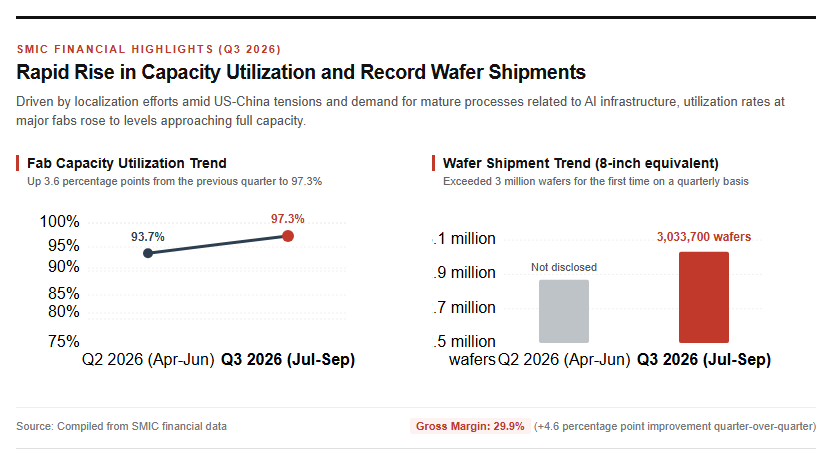
Physically underpinning SMIC’s business expansion are the extremely high utilization rates of its main manufacturing plants and the growth in wafer shipments. In the July–September 2026 quarter, the company’s factory utilization rate reached 97.3%, rising 3.6 percentage points from 93.7% in the previous April–June quarter and approaching virtually full capacity. Wafer shipments, converted to an 8-inch equivalent, recorded 3,033,700 units—a 5.7% increase quarter-on-quarter—surpassing the 3-million-unit milestone for the first time on a quarterly basis. This high utilization rate had the effect of diluting manufacturing equipment depreciation costs, significantly boosting the gross profit margin by 4.6 percentage points quarter-on-quarter to 29.9%. Co-CEO Zhao Haijun stated that customer demand for expedited deliveries was exceptionally robust, and prioritizing line allocations for mass-produced goods contributed to lifting the gross profit margin. Additionally, the average selling price of products rose by 1.8% quarter-on-quarter, confirming an improvement in pricing power driven by excess demand. Please refer to the figure below for the trends in factory utilization rates and wafer shipments.
The company expects shipments to remain solid in the fourth quarter (October–December), with revenue projected to increase by 4% to 6% quarter-on-quarter.
[Competitive Comparison] SMIC’s Fierce Pursuit of Samsung Electronics and Foundry Market Trends
2-1. Narrowing the Market Share Gap with Samsung to Just 0.5 Percentage Points
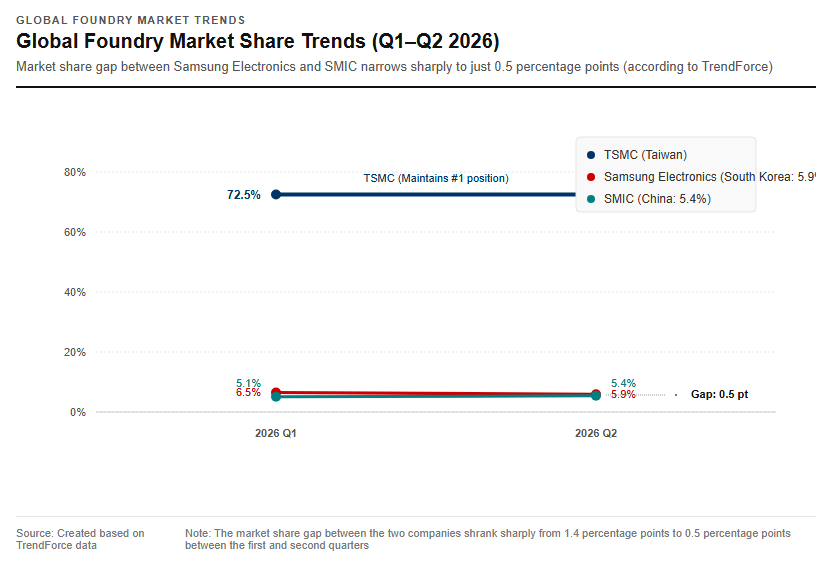
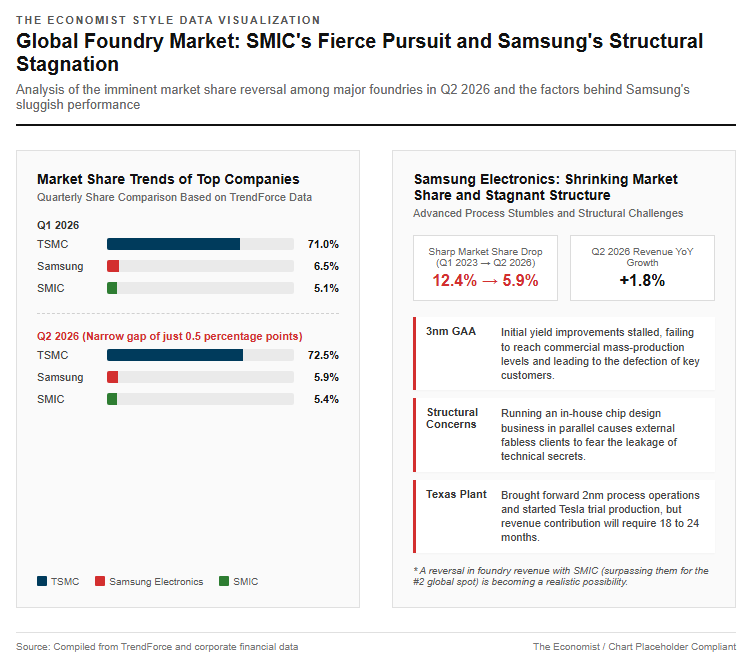
In the global semiconductor foundry market, SMIC’s rise is fundamentally shaking up the traditional two-player duopoly. According to data compiled by Taiwanese market research firm TrendForce, in the global foundry market share for the April–June 2026 quarter (Q2), while top-ranked TSMC of Taiwan maintained an overwhelming share of 72.5%, second-ranked Samsung Electronics of South Korea saw its share drop to 5.9%. In contrast, third-ranked SMIC reached a market share of 5.4%, narrowing the gap between the two companies to a mere 0.5 percentage points. Because the gap between the two companies stood at 1.4 percentage points as of the January–March 2026 quarter (Q1) (Samsung at 6.5%, SMIC at 5.1%), this means the gap has closed rapidly in just a single quarter. SMIC’s Q2 revenue surged 20% quarter-on-quarter to $3.0558 billion, topping the $3-billion quarterly milestone for the first time. Meanwhile, Samsung Electronics’ revenue stood at $3.26 billion, representing a meager 1.8% increase from the previous period, highlighting a marked slowdown in its growth rate. Please refer to the figure below for the market share trends of the top global foundries.
Within the industry, the possibility of SMIC overtaking Samsung Electronics in contract manufacturing revenue and rising to second place globally within the year is being discussed as a realistic prospect.
2-2. Samsung’s Structural Stagnation Plagued by 3nm GAA Yield Issues
Behind Samsung Electronics allowing SMIC to catch up fiercely lie missteps in cutting-edge process development and structural challenges. Samsung’s market share in the foundry business shrank by more than half, dropping from 12.4% in the first quarter of 2023 to 5.9% in the second quarter of 2026. According to expert analyst analysis, the primary factor behind the slump is that the initial yield (good product rate) of the GAA (Gate-All-Around) structure introduced prematurely in the 3nm process failed to reach commercial mass-production levels, leading to the defection of key customers. Having lost orders from large-scale clients, the company faces a vicious cycle in which the depreciation burden of its production lines increases and process improvements are delayed. Furthermore, because Samsung simultaneously runs smartphone and in-house chip design businesses, it has not been able to dispel concerns that external fabless companies like Apple and AMD will hesitate to place orders due to fears of technology secret leaks. Although the company is trying to make a comeback by accelerating the operation of the 2nm process at its Taylor, Texas plant and initiating the trial production of Tesla’s AI chips, it is estimated that it will take 18 to 24 months for this to actually contribute to earnings. Please refer to the figure below for the yield verification status of cutting-edge processes and challenges in equipment operation.
The struggle at the cutting-edge nodes highlights the contrast with SMIC, which is steadily capturing demand in mature processes.
[Background and Strategy] Acceleration of China’s Domestic Production and Exploding Demand for AI Peripherals
3-1. Demand-Driven Growth Brought by Over 90% Reliance on the Chinese Market
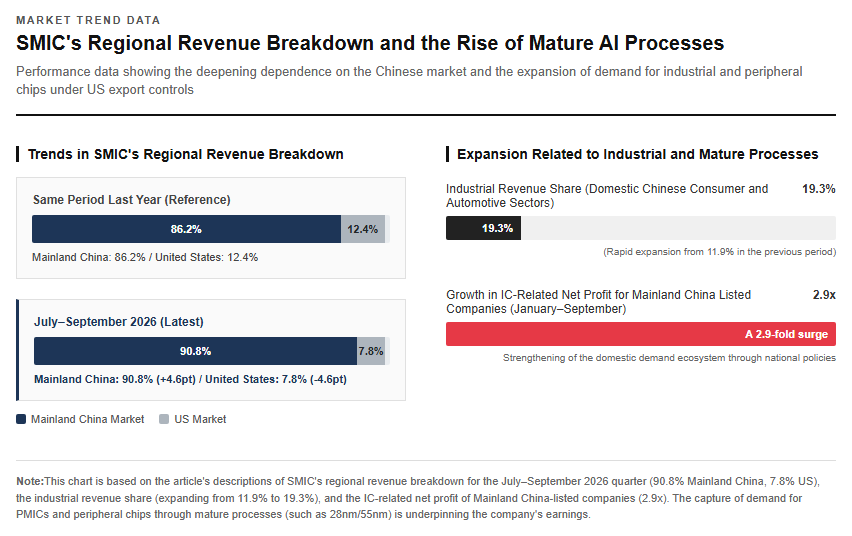
Strongly driving SMIC’s rapid revenue expansion is China’s domestic “national strategy aiming for semiconductor self-sufficiency” and the accompanying movement by local companies to adopt domestically produced chips. Looking at the regional breakdown of the company’s revenue for the July-September period of 2026, income from the mainland Chinese market accounted for 90.8% of the total, rising another 4.6 percentage points from 86.2% in the same period of the previous year. Meanwhile, the proportion of the US market dropped significantly from 12.4% to 7.8% year-over-year. This indicates a current situation where, while direct dependence on the US market is declining due to strict export controls and Entity List designations by the US Department of Commerce, Chinese electrical, automotive, and IT manufacturers wary of the prolonged US-China conflict are swiftly switching from overseas chips to SMIC-made ones in consideration of supply chain security. Amid restricted procurement overseas due to US export controls, the Chinese government’s policy to raise self-sufficiency rates is strongly boosting orders for SMIC. Net profits related to integrated circuits (ICs) for the January-September period have also jumped 2.9-fold across listed companies in mainland China as a whole, forming a strong demand-driven ecosystem backed by national policy.
3-2. Strengths of Mature Processes and Peripheral Chips Supporting AI Computing
The benefits of the AI boom have spread significantly not only to the cutting-edge computing logic chips at which TSMC excels, but also to the “mature process semiconductors” that support them from the periphery. Mature nodes such as 28nm and 55nm, in which SMIC excels, are widely used to manufacture power management ICs (PMICs), BCD process products, server network chips, analog semiconductors, and dedicated memories that are indispensable for operating AI servers and data centers. Co-CEO Zhao Haijun has explained that customer inquiries for these AI peripheral chips and automotive/industrial chips far exceeded expectations, leading to the strong performance in the third quarter. While procurement of equipment for cutting-edge nodes is restricted by US regulations, SMIC has continued focused investment in mature processes to strengthen its pricing power, achieving profit improvements that surpass its sales growth. In addition, the industrial income ratio in China’s domestic consumer and automotive sectors has expanded rapidly from 11.9% to 19.3%, aligning the expansion of the AI infrastructure market with the company’s strengths. Please refer to the figure below for the correlation between cutting-edge chips and peripheral semiconductors in the AI ecosystem.
Robust demand for mature processes is solidifying the company’s earnings structure.
[Market and Evaluation] Stock Market Reactions and Perspectives of Major Securities Analysts
4-1. Target Price Upgrades by Major Securities Firms and the Division of Evaluations
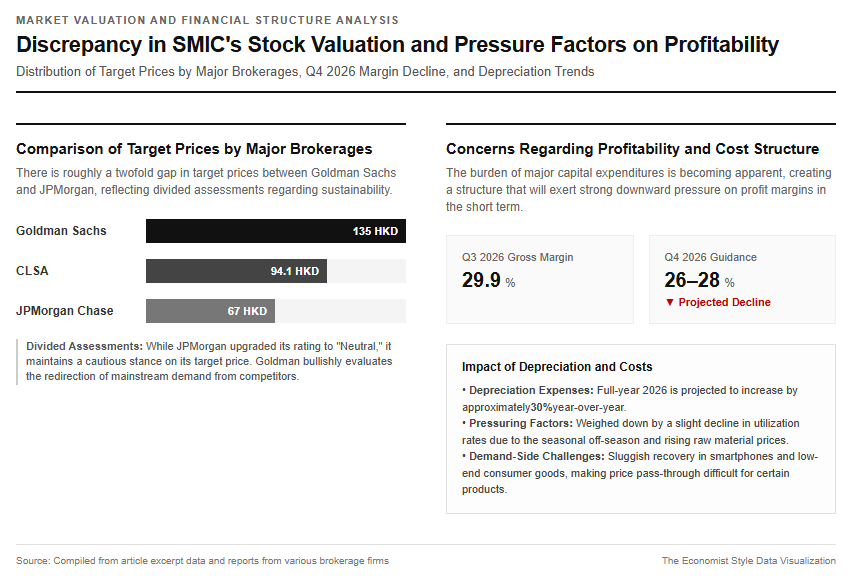
Following SMIC’s announcement of better-than-expected financial results and a strong earnings outlook, a significant shift has emerged in the views of major global brokerage firms. JPMorgan Chase upgraded its investment rating on the company’s stock from “Underweight” to “Neutral,” reversing its cautious stance held for many years. Citing the ongoing penetration of AI demand and price hikes driven by domestic Chinese supply chain reshoring (localization), JPMorgan raised its earnings per share (EPS) forecasts for 2026 and 2027 by approximately 15%. Additionally, CLSA maintained its “Outperform” rating and raised its target price to 94.1 Hong Kong dollars, while Goldman Sachs maintained its “Buy” rating with a target price set at 135 Hong Kong dollars. Goldman cited the shift in mainstream product demand to SMIC as overseas competitors concentrate their production resources on high-end AI chips as a growth driver. However, a gap of nearly twofold remains between JPMorgan’s target price (67 Hong Kong dollars) and Goldman’s bullish target (135 Hong Kong dollars), reflecting divided market assessments regarding earnings sustainability.
4-2. Concerns Regarding Depreciation Burdens and Fourth-Quarter Margin Declines
Although SMIC’s recent financial performance has been exceptionally robust, points of concern regarding mid-to-long-term profitability have also been highlighted. The company issued guidance that its gross profit margin for the fourth quarter of 2026 (October–December period) is expected to decline from 29.9% in the previous quarter to around 26% to 28%. This background includes a slight decrease in utilization rates due to entering the seasonal off-season, an increase in depreciation burdens associated with large-scale capital investments made in the past, and rising raw material prices. Total depreciation expenses for the full year of 2026 are projected to increase by approximately 30% year-on-year, acting as a constant drag on earnings. Furthermore, the demand recovery in the smartphone and low-end consumer electronics markets remains sluggish, leaving some product groups where price hikes to client companies are difficult. Among market investors, debates continue over whether the actual revenue scale of the generative AI market will keep pace with hyperscalers’ trillion-dollar-scale AI capital expenditures, which serves as a factor driving stock price volatility. Please refer to the figure below for the structural trends of large-scale capital investments and depreciation expenses.
Balancing growth potential and cost burdens will be the key to future management.
[Future Outlook and Key Points] The Semiconductor Supply Crunch and Path to Self-Sufficiency Extending Through 2028
5-1. Extreme Capacity Tightening and Prolonged Equipment Delivery Times from 2027 to 2028
Regarding the future supply and demand outlook for the semiconductor market, SMIC Co-CEO Zhao Haijun has issued a critically important warning. Speaking at the earnings briefing, he noted that global foundry supply capacity is failing to keep pace with the rapid surge in demand for AI computing power, stating that “2027 will be a year of extreme tightness in contract manufacturing capacity.” Furthermore, he predicts that this severe supply-demand imbalance is likely to persist through the middle to latter half of 2028. The primary factor causing supply bottlenecks is the global shortage of semiconductor manufacturing equipment. Currently, lead times from the new ordering to the delivery of major manufacturing equipment have extended to 16 to 24 months, with certain specific equipment cases even exceeding 24 months. This prolongation of equipment delivery times has introduced uncertainty into the execution of SMIC’s own capital expenditure plans, pushing back the operational start dates of newly expanded plants. While supply and demand for AI memory may balance out in the latter half of 2028, shortages of computing chips and power management peripheral chips are expected to remain prolonged even beyond that period.
5-2. Future Vision of Self-Sufficiency Achievement and Domestic Manufacturing Equipment in China’s Semiconductor Industry
Continuing to expand in defiance of U.S. export controls, China’s semiconductor industry is undergoing structural transformation over the mid-to-long term. According to an industry report published by French research firm Yole Group, China’s semiconductor self-sufficiency capacity—despite facing constraints in leading-edge processes—is analyzed to achieve self-sufficiency on a production volume basis, centered on mature processes, by 2027–2028 if the current pace of manufacturing capacity expansion continues. Moreover, regarding the localization rate of manufacturing equipment, which has been a bottleneck, aggressive current investments are projected to potentially raise it to 52% by 2030. Chinese foundries, including SMIC, are expanding production volumes by compensating for restrictions on procuring advanced tools such as EUV (extreme ultraviolet) lithography systems through ingenuity in multi-patterning technology, advanced packaging technology, and chiplet design. The intensification of U.S. regulations is paradoxically accelerating the establishment of China’s own independent semiconductor ecosystem, and SMIC is expected to further elevate its presence in the global market as a core enterprise moving forward.
[Reference Page]
- [36Kr Japan] https://36kr.jp/504644/
- [BigGo Finance] https://finance.biggo.jp/news/ae5ce842-cb4f-4a6f-acd6-73014f237425
[#ChinaSemiconductors #SMIC #SamsungElectronics #Foundry #AISemiconductors #SemiconductorIndigenization #SemiconductorSupplyShortage]


コメント