
A research team at the Institute of Science Tokyo has successfully synthesized and characterized “SrZn2OSe2,” a new quaternary oxyselenide capable of controlling conductivity for both p-type and n-type. This development addresses the challenge of realizing ambipolar wide-gap semiconductors, which are essential for next-generation optoelectronic devices and power semiconductors.
- Background of the successful synthesis and announcement of the quaternary oxyselenide
- Conventional challenges and breakthroughs in wide-gap semiconductors
- Crystal structures and optical properties of SrZn2OSe2 and BaZn2OS2
- The possibility of ambipolar doping revealed by first-principles calculations
- Application development for next-generation power devices and optoelectronic elements
- Future Research Challenges and the Future of Exploration Using Databases
Background of the successful synthesis and announcement of the quaternary oxyselenide
A research team led by Professors Fumiyasu Oba and Hidenori Hiramatsu, and Assistant Professor Kosuke Hanzawa of the Institute of Institute of Materials Research, Science Tokyo, announced on November 25, 2026, that they have become the first in the world to successfully synthesize the new quaternary oxyselenides “BaZn2OS2” and “SrZn2OSe2,” which are expected to serve as wide-gap semiconductors for electronic and optoelectronic devices. The research results were published in the American Chemical Society journal “Journal of the American Chemical Society” on November 24, 2026, and a related patent (Patent No. 7919695) has also been registered. In the field of semiconductor materials, there has been a strong demand for the development of new materials that possess wide bandgaps while allowing for highly efficient electrical conductivity control to realize energy-efficient power devices and driving elements for displays. This discovery is attracting significant attention as an innovative achievement that opens new paths for materials exploration in complex anion compounds.
Conventional challenges and breakthroughs in wide-gap semiconductors
While oxide semiconductors with wide bandgaps are seeing expanding applications, such as IGZO for display driving and gallium oxide for power devices, many oxides face the intrinsic challenge of difficult carrier control when attempting to create p-type semiconductors by introducing holes. To overcome this issue, oxyselenides containing oxygen and chalcogens (such as sulfur and selenium) have garnered attention. Oxyselenides possess the characteristic of being easy to turn p-type because of their high valence band edge energy. However, existing materials like copper-containing LaCuOSe are difficult to turn n-type, while non-copper-based La2SnO2S3 are difficult to turn p-type, making the realization of “ambipolar doping”—controlling both p-type and n-type—a major barrier. The research group broke through this limit by focusing on previously unreported quaternary compounds consisting of alkaline earth metals, zinc, oxygen, and chalcogens, and performing high-precision material design.
Physical properties of the new material and exploration methods using computational science
Crystal structures and optical properties of SrZn2OSe2 and BaZn2OS2
The research team performed powder X-ray diffraction on polycrystalline samples synthesized using the solid-state reaction method, clearly identifying the crystal structures of the previously unknown substances BaZn2OS2 and SrZn2OSe2. Detailed crystal structure data have been registered in the Cambridge Structural Database (CCDC 2576934 and CCDC 2576935). Optical property evaluations via diffuse reflectance measurements demonstrated that BaZn2OS2 has a direct transition bandgap of 3.51 eV, while SrZn2OSe2 has a bandgap of 2.55 eV. Please refer to the structural analysis and physical property prediction results shown in the figures below.
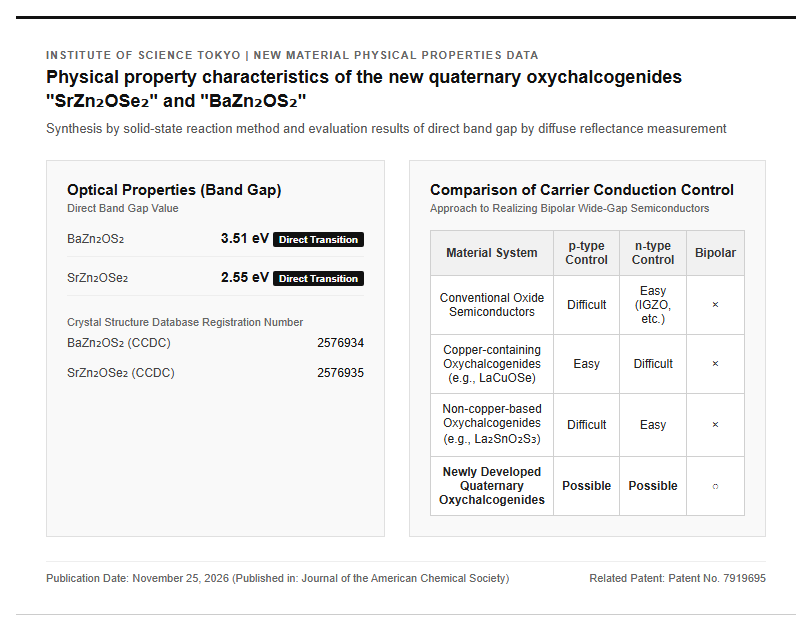
Furthermore, analysis based on first-principles calculations revealed that both substances have very small effective masses for conduction electrons and holes, suggesting they possess highly efficient carrier transport capabilities. In particular, SrZn2OSe2 exhibits extremely small hole effective mass in specific crystallographic directions, demonstrating excellent electrical properties.
The possibility of ambipolar doping revealed by first-principles calculations
To verify the carrier controllability of the new materials, a theoretical study was conducted to comprehensively calculate point defect formation energies and electronic levels. The results of the analysis predicted that BaZn2OS2 would experience significant compensation effects due to intrinsic point defects, effectively making it an insulator. On the other hand, it was revealed that for SrZn2OSe2, defect compensation can be suppressed by optimizing factors such as the synthesis atmosphere, allowing the Fermi level to be controlled throughout the entire bandgap. Furthermore, as a result of computational screening for elemental addition, it was predicted that the material could be turned into an n-type semiconductor by adding elements such as yttrium (Y), lanthanum (La), chlorine (Cl), bromine (Br), or iodine (I), and into a p-type semiconductor by adding elements such as potassium (K) or rubidium (Rb). Please refer to the theoretical prediction chart for carrier control shown in the figure below.
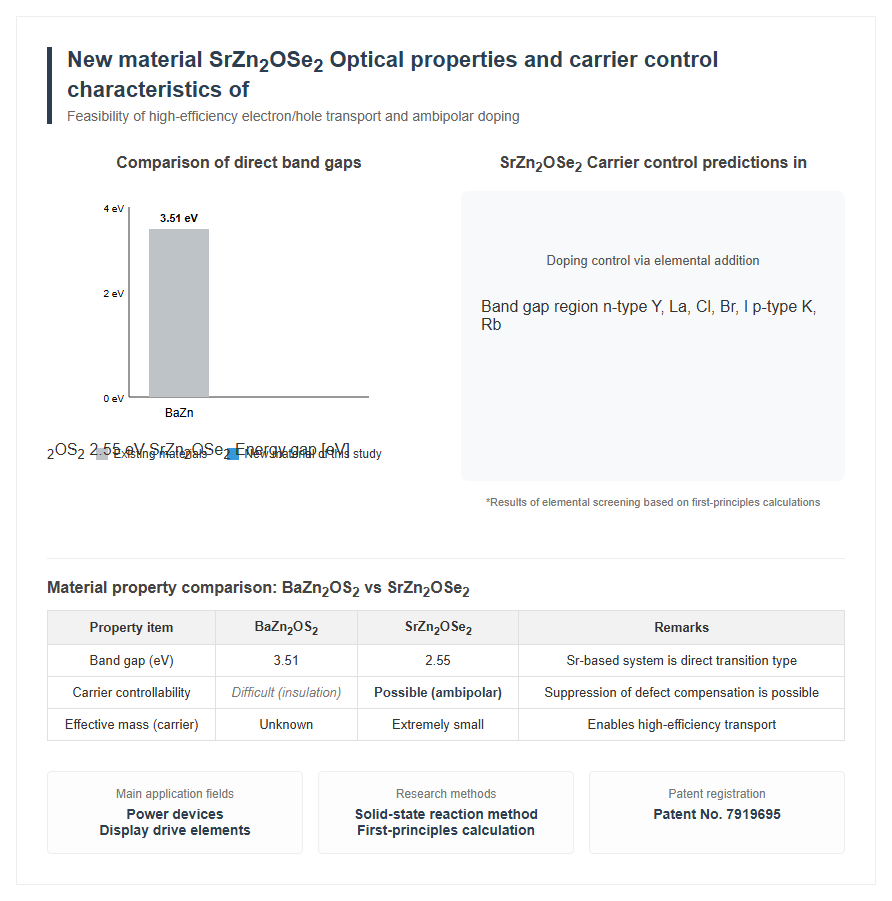
This proves that SrZn2OSe2 is a highly anticipated wide-gap material capable of ambipolar doping.
Social impact and future prospects for practical application
Application development for next-generation power devices and optoelectronic elements
The discovery of the non-copper quaternary oxychalcogenide presented this time has a significant social impact, as it dramatically expands the low degree of freedom inherent in conventional single-anion oxides and existing complex anion compounds. The excellent direct-transition optical properties and highly flexible carrier controllability of SrZn2OSe2 directly contribute to the development of optoelectronic devices such as high-efficiency light-emitting diodes and semiconductor lasers operating in the blue to ultraviolet region. Furthermore, because high mobility is expected for both electrons and holes, it holds extremely high potential as a foundational material for transparent transistors and low-loss pn-junction devices for power applications. The development of new materials leveraging the diversity of constituent elements serves as an important technological bridge that will drive the evolution of next-generation power conversion technologies and energy-saving devices toward the realization of a decarbonized society.
Future Research Challenges and the Future of Exploration Using Databases
As a future development, the research team plans to promote the high purification of SrZn2OSe2 samples and embark on experimental verification of theoretically predicted p-type and n-type doping. Furthermore, after establishing fabrication techniques for high-quality single crystals and thin films, they plan to prototype actual pn-junction diodes and light-emitting elements to verify device operation. In addition, by utilizing first-principles calculation databases for approximately 90,000 semiconductor candidate materials built by the research group and leveraging materials informatics methods integrating machine learning algorithms, they intend to accelerate the comprehensive and rapid exploration of unknown complex anion compounds. Through close collaboration between theoretical calculations and experimental evaluations, it is strongly anticipated that innovative semiconductor materials supporting next-generation industries will be continuously created.
Reference Pages
- [Institute of Science Tokyo Press Release] https://www.isct.ac.jp/ja/news/2e9igz07kvep
- [Journal of the American Chemical Society Paper Information] https://doi.org/10.1021/jacs.6c17075
[#Semiconductor #ScienceTokyo #WideBandgapSemiconductor #NewMaterials #ScienceAndTechnology]

コメント