
Calbee has announced that it will raise prices by approximately 6% for four of its major products, including potato chips, starting in February 2027. The move is driven by the ongoing surge in raw material prices, energy costs, and packaging material costs.
- Key Points of the Event and Specific Details of the Price Revision
- Rising Raw Material Costs and the Triple Burden of Cost Structures
- Price Pass-through Spreading Across the Industry, Including Competitor Koikeya
- Calbee’s Performance and the Evaluation of the Stock Market and Investors
- Consumer Tolerance and Conditions for Acceptance Regarding Price Hikes
- Future Developments and Points to Watch
Key Points of the Event and Specific Details of the Price Revision
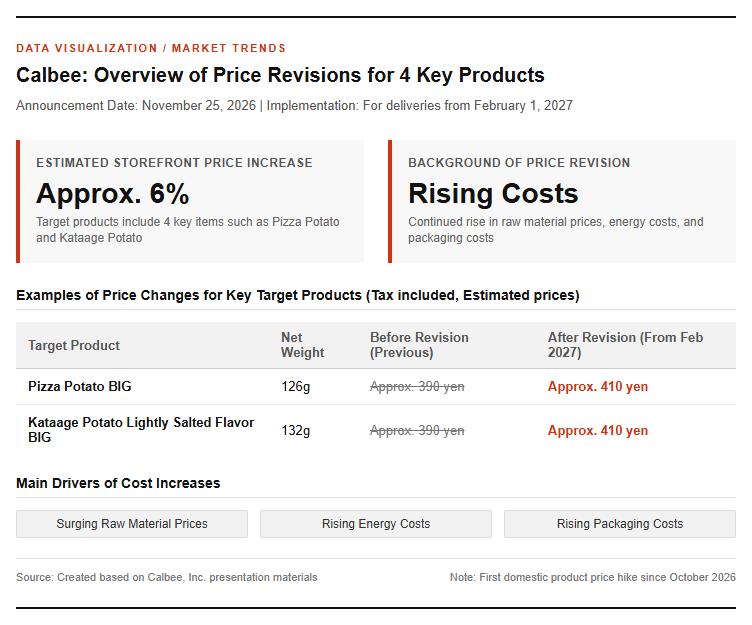
As a key point of the announcement, Calbee, Inc. officially stated on November 25, 2026, that it will raise prices for a total of four major snack products, such as “Pizza Potato” and “Kataage Potato,” effective from deliveries starting February 1, 2027. The expected increase in retail prices (tax included) will be approximately 6%. As examples of specific products and price changes, “Pizza Potato BIG” (126g) and “Kataage Potato Lightly Salted Flavor BIG” (132g) will be raised from around 390 yen to around 410 yen. This marks Calbee’s first domestic product price hike since October 2026, with the company citing rising raw material and energy costs as the primary reasons for the revision. Because these revisions involve long-selling products that are familiar to consumers, they are expected to have a significant impact on both retail sites and consumers. The image below shows the package images of the major products subject to this price revision.
Rising Raw Material Costs and the Triple Burden of Cost Structures
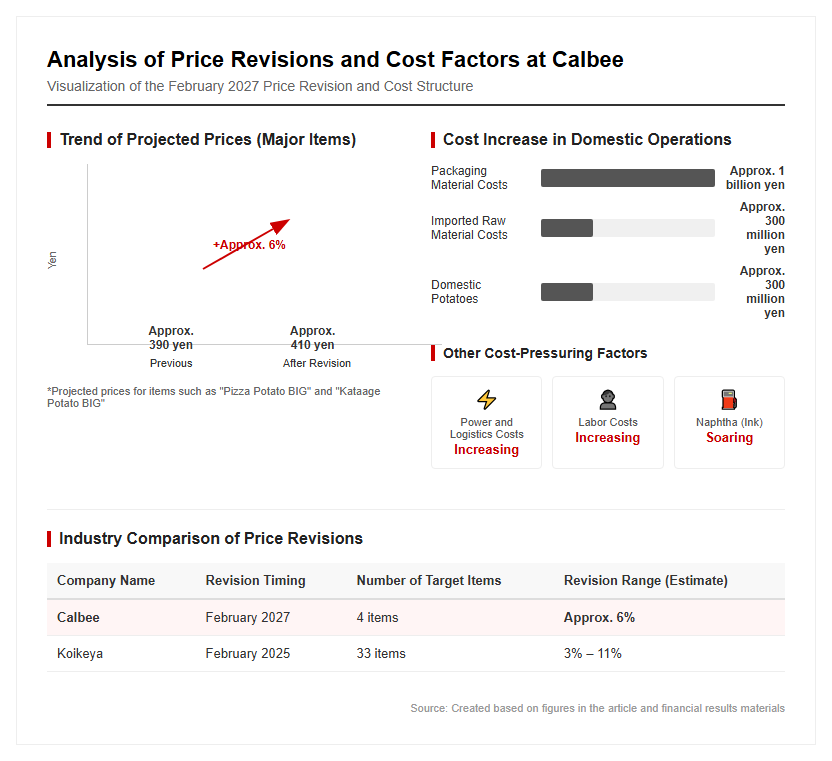
Behind this price revision lies a structural, severe cost surge affecting the entire food manufacturing industry. According to Calbee’s financial results for the second quarter of the fiscal year ending March 2027, cost increases have materialized in its domestic business, including approximately 1 billion yen for packaging materials, approximately 300 million yen for imported raw materials, and approximately 300 million yen for domestic potatoes. Furthermore, the continuous rise in power costs at manufacturing plants, as well as logistics and labor costs, is also a factor squeezing profits. In addition, supply instability for naphtha due to intensifying tensions in the Middle East has driven up the procurement prices of printing inks and solvents used for packaging film. Although the company took agile measures in May 2026, such as changing packaging to monochrome (two-color black and white) to reduce ink usage, the limits of what could be absorbed through corporate effort alone were reached, leading to this price pass-through.
Trends in the Snack Food Industry and Competitor Movements
Price Pass-through Spreading Across the Industry, Including Competitor Koikeya
Food price increases are not limited to Calbee alone; they have become a common challenge spreading across the entire snack food industry. Calbee’s rival, Koikeya Co., Ltd., also implemented price revisions of approximately 3% to 11% for a total of 33 snack products, including “Pure Potato” and “Koikeya Strong,” effective from deliveries starting February 1, 2025. Similarly, Koikeya explained that, in addition to raw material costs such as potatoes and vegetable oils, rising shipping and labor costs are significantly impacting business operations. As indicated by the Bank of Japan’s Tankan data and the National Diet Library’s research report “Trends and Related Measures Regarding Price Pass-through,” the movement to appropriately reflect rising procurement costs in selling prices has become an essential process for maintaining sustainable wage increases and corporate management. The following figure shows the trends in cost increases and price revisions within the industry.
Calbee’s Performance and the Evaluation of the Stock Market and Investors
Calbee’s consolidated business results for the first half of the fiscal year ending March 2027 (April 1, 2026 – September 30, 2026) showed an increase in both revenue and profit, with net sales rising 6.0% year-on-year to 175.698 billion yen and operating profit increasing 16.3% to 11.81 billion yen. Sales volume growth of highly unique, high-value-added brands such as “Kataage Potato” and “Pizza Potato,” combined with the effects of past price revisions, have supported profitability. Meanwhile, it was revealed on November 18, 2026, that Oasis Management, a Hong Kong-based investment fund, increased its stake in Calbee shares from 7.12% to 8.18%. As scrutiny from investors demanding shareholder returns and improved profitability intensifies, there is a strong demand for enhancing corporate value through the securing of appropriate gross margins and effective cost control.
Changes in Consumer Sentiment and Future Market Outlook
Consumer Tolerance and Conditions for Acceptance Regarding Price Hikes
Amid a series of food price increases, clear changes are also being seen in consumer purchasing awareness and selection behavior. According to a sentiment survey conducted by Nomura Research Institute (NRI) in July 2026, when the products they purchase increased in price, 41.7% of consumers responded that they would “switch to cheaper competitor products or private brands (PB).” On the other hand, regarding the acceptable margin of a price increase, “5% to less than 10%” was the most common answer at 50.7%, while the proportion of those who would tolerate a price increase exceeding 10% remained at only 32.6%. Furthermore, regarding processed foods, 24.7% of respondents said they would be satisfied with a revision “if the reason for the price hike is properly explained, even without changes to the product specifications.” Keeping the price increase margin below 10% and explaining the background of the price revision with high transparency will be crucial factors in preventing customer churn.
Future Developments and Points to Watch
Following Calbee’s recent announcement of price hikes for four products including potato chips, market interest has shifted toward post-revision consumer trends and the impact on other products. While proceeding with price revisions, Calbee has indicated its intention to simultaneously strengthen the rollout of reasonably priced products and optimize package capacities to respond to consumers’ growing frugality mindset. In addition, cost reductions leveraging the high productivity of the “Setouchi Hiroshima Factory,” which began operations in January 2025, as well as the control of geopolitical risks associated with the situation in the Middle East, will dictate future earnings performance. Key developments and points to watch moving forward include whether store sales volumes can be maintained after the February 2027 price revisions, and what kind of value propositions companies can continue to offer in response to further fluctuations in raw material costs.
References
- [Calbee Group Financial Results Briefing Materials] https://www.calbee.co.jp/ir/
- [National Diet Library, Research and Information, “Trends Surrounding Cost Pass-Through and Related Measures”] https://dl.ndl.go.jp/
- [Nomura Research Institute Report, “Consumer Awareness and Behavior Regarding Food Price Hikes”] https://www.nri.com/jp/knowledge/report/20260820_1.html
[#Calbee #PotatoChips #PriceRevision #PriceHike #FoodIndustry]


コメント