
Forty-four domestic companies, led by SoftBank, have formed a coalition and launched the development of domestic AI foundation models through the new company “Noetra.” The background is the aim of securing Japan’s technological sovereignty by leveraging the vast data from manufacturing sites to compete with US and Chinese tech companies leading in the field of “physical AI.”
- Formation of one of the largest domestic corporate alliances that transcends industrial boundaries
- The goal is to achieve a trillion-parameter scale and realize “physical AI”
- Strategies to turn ‘tacit knowledge’ and data into assets on the manufacturing floor
- Public support worth 1 trillion yen over five years and development of computing infrastructure
- Investment gap with tech giants and concerns over a ‘Galapagos style’
- Future Highlights for the 2027 Model Completion
Formation of one of the largest domestic corporate alliances that transcends industrial boundaries
In April 2026, the four core companies of the SoftBank, NEC, Honda, and Sony Group established a new company, ‘Japan AI Foundation Model Development,’ to develop foundational models for domestic AI. This new company later changed its name to “Noetra,” and has grown into one of the largest AI development alliances in Japan, with 28 manufacturing firms and 16 non-manufacturing firms, totaling 44 participating companies. Participating companies include Japan’s leading manufacturing giants such as Hitachi, Toshiba, Asahi Kasei, Fujitsu, and Yaskawa Electric, IT firms like the Rakuten Group, and major financial firms such as Mitsubishi UFJ Bank, Sumitomo Mitsui Banking Corporation, and Mizuho Bank. In terms of development structure, SoftBank and NEC lead the development of foundational models, while Honda and Sony Group handle applications in various industries such as automotive, robotics, gaming, and semiconductors, with divisions of roles. Additionally, about 100 engineers from the AI startup Preferred Networks (PFN) are also being involved, and development will proceed with a strong lineup of industry, government, and academia.
The goal is to achieve a trillion-parameter scale and realize “physical AI”
The goal of this alliance is to build one of the largest trillion-parameter foundational models in Japan by 2027. While conventional generative AI mainly focused on text and images, this project focuses on realizing “physical AI” that autonomously controls physical devices in the real world. Physical AI aims to integrate real-world sensor information such as weight, temperature, and position to highly control robots, machine tools, vehicles, and more. The diagram below shows the conceptual diagram of physical AI envisioned by the AI being developed this time.
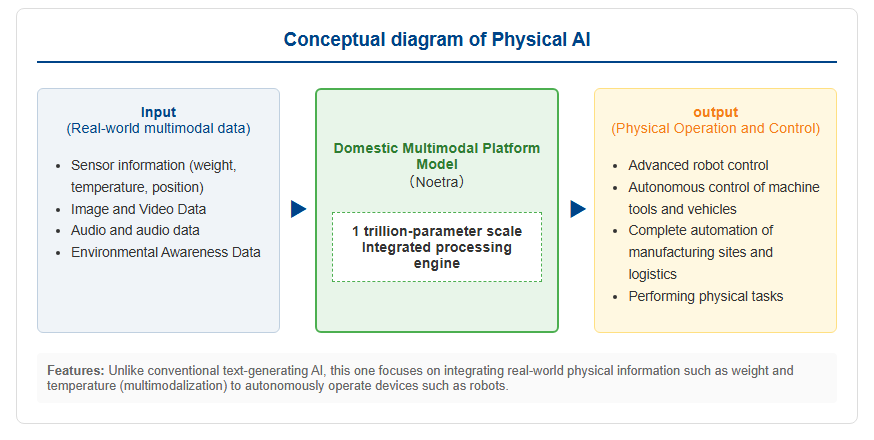
The models being developed will evolve into multimodal AI capable of processing images and audio simultaneously, and in the future, it is expected to become intelligence that supports full automation in factories and logistics sites. The developed foundational model is intended to be open not only to invested companies but to all Japanese companies, and is also considering building an ecosystem that each company can optimize (fine-tune) to suit its own needs.
Japan’s unique ‘winning streak’ and the scale of public-private partnership investment
Strategies to turn ‘tacit knowledge’ and data into assets on the manufacturing floor
While giant tech companies in the US and China are leading the way with massive capital and data from the internet, the “winning formula” advocated by the Japan Union lies in leveraging the unique industrial data accumulated in Japanese manufacturing sites and the tacit knowledge of craftsmen. It is said that about 60% of the data circulating worldwide is owned by companies, and especially data on machine tool operation and sensor information on production lines are valuable assets that U.S. IT companies cannot easily obtain. By training on this “field data,” we are developing domain-specific AI with overwhelming accuracy for specific industrial applications, adopting a strategy to overcome the disadvantages of general-purpose models. Companies that have previously been called “material manufacturers” or “machinery manufacturers” are expected to relabel themselves as “on-site data holding companies” through this alliance, transforming their data assets into added value through AI. How to safely utilize highly accurate data obtained only on site for AI training is the biggest focus determining the international competitiveness of domestic AI.
Public support worth 1 trillion yen over five years and development of computing infrastructure
The government places great importance on this project from the perspective of economic security, and through the Ministry of Economy, Trade and Industry, has announced a plan to provide public support totaling approximately 1 trillion yen over five years starting in fiscal 2026. Funding will be allocated to the “GX Economic Transition Bond,” which will especially support the development of low-power AI foundation models and the securing of computing resources. SoftBank is also responding by investing about 2 trillion yen over six years starting in fiscal 2026 to establish data centers essential for AI learning and development. Specifically, construction is underway on the site of Sharp’s former Sakai factory, one of Japan’s largest AI data centers with a capacity of 150 megawatts, aiming to begin operations within 2026. Additionally, facility development is progressing in places like Tomakomai City in Hokkaido, with total public-private investment expected to reach around 3 trillion yen. The government’s AI Strategy Headquarters has set a policy to allocate approximately 300 billion yen as related expenses in the FY2026 budget proposal to directly link high-quality industrial data to Japan’s competitiveness, and to continue investing in phases.
Challenges Faced and Medium- to Long-Term Outlook
Investment gap with tech giants and concerns over a ‘Galapagos style’
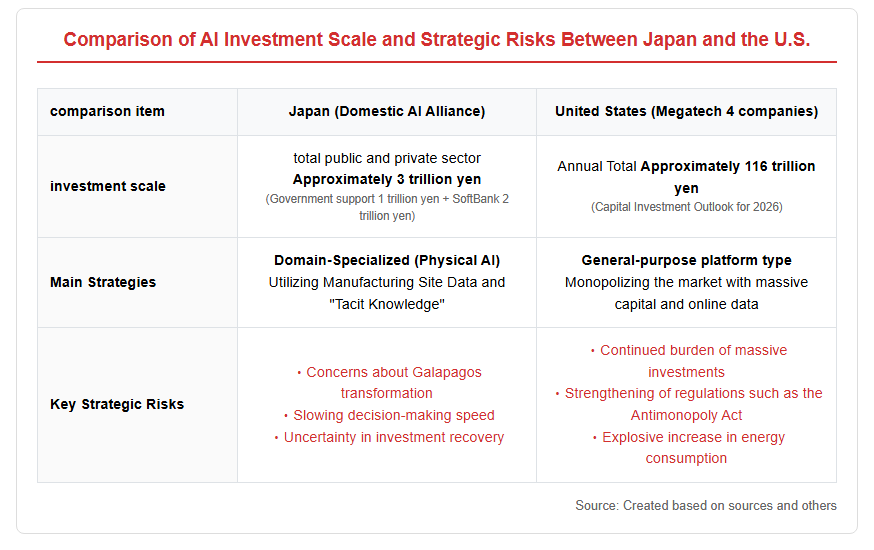
The combined investment scale of 3 trillion yen between public and private sectors is one of the largest in Japan ever, but from a global perspective, there remains a severe disparity. The four major U.S. tech giants are expected to invest over 100 trillion yen in AI capital by 2026 alone, with a gap of several dozen times in investment scale. Given this overwhelming financial gap, it is unrealistic for Japan Union to aim for a “general-purpose AI that can do anything,” and the challenge remains whether it can maintain domain-specific discipline. Additionally, from the perspective of the field, there are concerns about the possibility of a ‘Galapagos AI’ transformation. Even if a proprietary system developed with massive government funding but lacks integration with world-standard tools and platforms, it could ultimately lose market share to foreign-made AI. The table below compares the scale of investment and strategic risks between Japan and the United States.
On-site engineers point out that not only should we build high-performance foundational models, but also allocate resources to the tedious implementation support and ecosystem building of existing inexpensive AI models into our operations.
Future Highlights for the 2027 Model Completion
The biggest future focus will be the completion of the 1 trillion-parameter model by 2027 and the speed of subsequent social implementation. This project is expected to be selected for the “Multimodal Platform Model Development Project with an Eye to Physical AI” by the National Research and Development Agency NEDO, and the full-scale launch of this public-private initiative is highly anticipated. In the medium to long term, there are estimates that the physical AI market will grow to 11 trillion yen by the early 2030s, and Japan has set a goal to capture 30% of the global market in this field. This is driven by a severe labor shortage expected to reach 11 million by 2040, and as the population decreases, demand for AI capable of operating the real world is steadily rising. Whether a massive alliance of 44 companies can advance development without slowing decision-making speed, and how quickly each company’s “tacit knowledge from the field” can be transformed into working AI models, will determine the fate of Japan’s AI industry.
[#生成AI #国産AI #フィジカルAI #ソフトバンク #製造業 #経済安全保障 #Noetra #1兆円支援]


コメント