The government has approved the draft basic policy for the fiscal year 2027 (Reiwa 9) budget request standards. Behind this move is a strong intent to break away from the traditional reliance on supplementary budgets by advocating for “responsible proactive fiscal policy,” while aiming to raise the medium-to-long-term potential growth rate through the creation of a “Strong and Prosperous Japan” investment framework.
- Basic Structure of the Budget Request Standards and the Creation of a New Investment Framework
- Moving Away from Reliance on Supplementary Budgets and Shifting Toward a Primary Budget-Centric Approach
- 17 Strategic Sectors and a Roadmap for 370 Trillion Yen in Public-Private Investment
- Fiscal Sustainability and Market Confidence in the Era of 3% Long-Term Interest Rates
- Specific Impacts on Local Governments, Tax Practices, and Businesses
- Future Schedule and Key Focus Areas Leading Up to the Year-End Cabinet Decision
Basic Structure of the Budget Request Standards and the Creation of a New Investment Framework
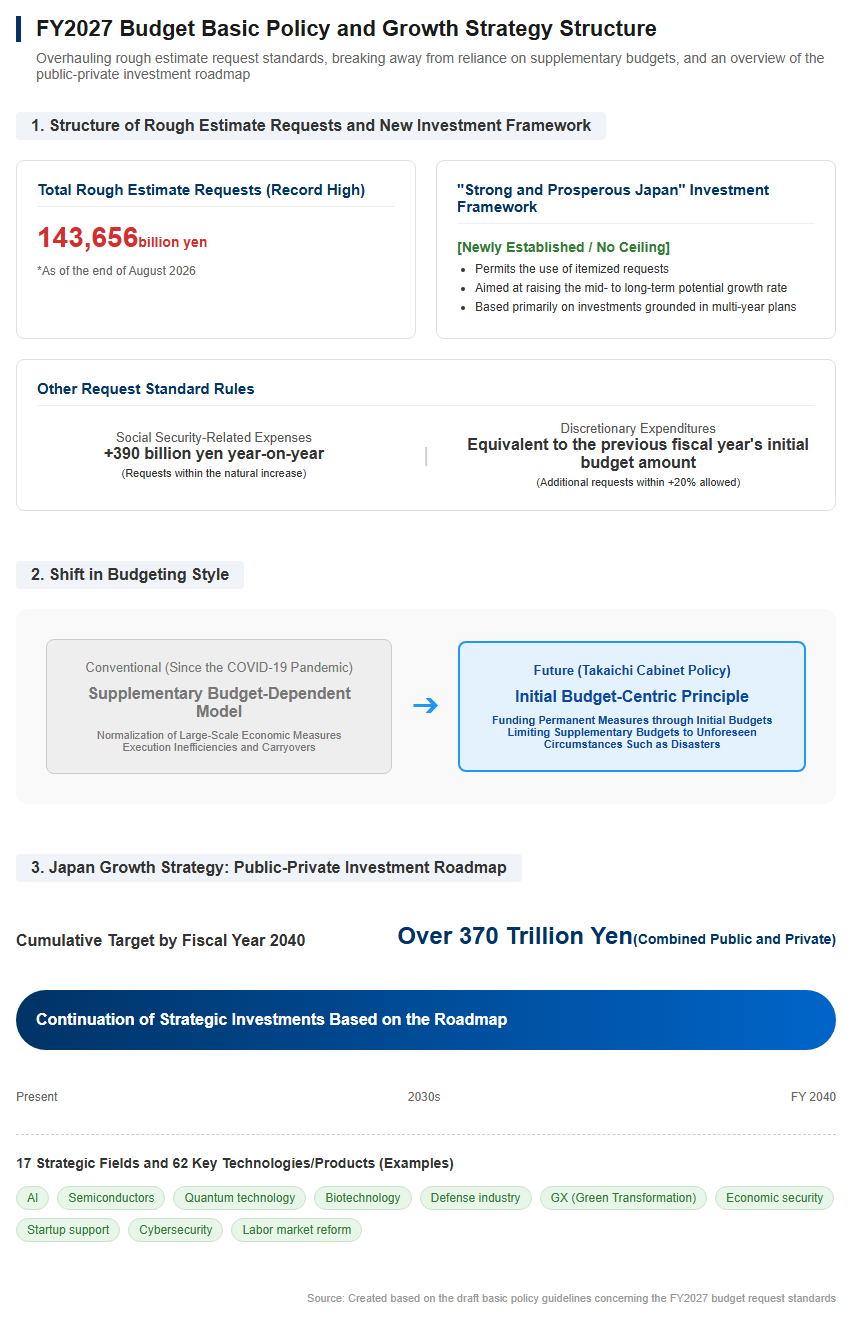
On July 30, 2026, the government approved the basic policy for the fiscal year 2027 (Reiwa 9) budget requests. The most significant point of this budget formulation policy is the establishment of the “Strong and Prosperous Japan Investment Framework” as a priority measure to raise the nation’s potential growth rate, separate from ordinary expenditures. This investment framework does not impose the request ceilings typically set in conventional budget requests, and it allows for the use of “item-based requests” where specific amounts are not explicitly stated. Requests from various ministries and agencies will be finalized by the end of August 2026, with the total budget request amount reaching a record high of 143.0656 trillion yen. Specifically, requests regarding social security expenses, such as pensions and medical care, are to be made within a range that adds a natural increase of 390 billion yen to the initial budget of the previous fiscal year. Furthermore, for other expenses categorized as discretionary spending, the system maintains that requests should be within the range of the previous year’s initial budget, while allowing for additional requests of up to 20% of that amount. As shown in the figure below, investment based on multi-year plans that transcend single-year frameworks is the fundamental principle.
Moving Away from Reliance on Supplementary Budgets and Shifting Toward a Primary Budget-Centric Approach
The most critical structural transformation in this draft basic policy is the “departure from reliance on supplementary budgets,” which has been normalized for many years. In fiscal management since the COVID-19 pandemic, massive supplementary budgets were compiled every year to implement large-scale economic measures decided around autumn, causing expenditure scales to continue expanding. However, projects funded through supplementary budgets often could not be fully executed within the fiscal year, leading to significant amounts being carried over to the next year or remaining unspent, which raised questions regarding the efficiency and urgency of budget execution. In light of these challenges, the Sanae Takaichi Cabinet has clarified a policy to provide for necessary, permanent measures within the initial budget as much as possible, limiting the formulation of supplementary budgets to unforeseen economic shocks or sudden events such as large-scale disasters. By transitioning to stable budget management centered on the initial budget, the government aims to increase the predictability of both public and private investment. Furthermore, in budget assessments, the government is shifting its stance from simple cuts to a rigorous verification of the quality and inducing effects of policies.
Promoting Growth Strategies and Fiscal Discipline Amid Rising Interest Rates
17 Strategic Sectors and a Roadmap for 370 Trillion Yen in Public-Private Investment
The “Japan Growth Strategy” promoted by the government identifies 17 strategic sectors, including AI/semiconductors, quantum technology, biotechnology, defense industry, and GX (Green Transformation). The government has formulated a public-private investment roadmap for 62 key products and technologies in these sectors, aiming to create a cumulative total of over 370 trillion yen in public-private investment by fiscal year 2040. For sectors considered particularly important for economic security, studies are underway to implement separate management via special accounts after securing funding over multiple years. For private companies to commit to medium-to-long-term capital investment and R&D, the predictability that government fiscal support will not end within a single fiscal year is essential. Cross-cutting challenges such as startup support, labor market reform, and strengthening cybersecurity are also included, unfolding a comprehensive effort where the public and private sectors work together to strengthen the industrial foundation. The following figure shows the conceptual image of public-private investment collaboration.
Fiscal Sustainability and Market Confidence in the Era of 3% Long-Term Interest Rates
While advocating for proactive investment, securing market confidence in the government bond market and maintaining fiscal sustainability have become matters of urgent concern. As the Japanese economy moves into a phase where prices, wages, and interest rates are all rising, long-term interest rates temporarily rose to the 3% range for the first time in approximately 30 years. With the outstanding balance of government bonds exceeding 1,100 trillion yen, rising interest rates increase the risk that future debt servicing costs will grow, thereby pressuring the financial resources required for policies such as social security and education. On November 20, 2026, the Fiscal System Council, an advisory body to the Minister of Finance, submitted a recommendation to Finance Minister Satsuki Katayama, expressing strong vigilance regarding the current situation where budget request amounts are expanding to the 143 trillion yen scale. The recommendation warned that if market confidence is lost, the continuous investment itself will reach an impasse, and it strongly urged for strengthened discipline on both the expenditure and revenue sides—such as reviewing low-effectiveness projects—while emphasizing a stable decline in the total national and local government debt-to-GDP ratio.
Ripple Effects on Operations and Regions and Future Outlook
Specific Impacts on Local Governments, Tax Practices, and Businesses
Changes in national budget formulation policies are having significant ripple effects on the fiscal management of local governments, corporate investment decisions, and tax practices. For example, in the FY2027 initial budget formulation policy announced by Tochigi Prefecture, a funding shortfall of approximately 11.3 billion yen is anticipated due to rising personnel and social welfare expenses, necessitating a bold review of existing projects in alignment with national policies and the securing of independent revenue. Furthermore, for private companies and tax practitioners, it is crucial to clearly distinguish between the initial request stage and the actual enactment or public solicitation stage regarding subsidies and support programs included in the budget requests of various ministries. Due to the expansion of itemized requests and new investment frameworks, it has become difficult to gauge the final fiscal scale or selection criteria based solely on the total amount of summer budget requests. Therefore, tax accountants and finance professionals must make prudent decisions regarding cash flow planning and the timing of capital investments, without being misled by mere requested budget amounts.
Future Schedule and Key Focus Areas Leading Up to the Year-End Cabinet Decision
The draft basic policy for the FY2027 budget presented by the government is moving into a stage of detailed assessment and political negotiation leading up to the end of the year. As with the budget formulation process in typical years, rigorous assessments by the Ministry of Finance will take place from September onwards, with the government’s budget proposal scheduled to be approved in a Cabinet decision in late December following coordination with various ministries and negotiations with ministers. The budget is expected to be enacted by the end of March following Diet deliberations at the beginning of the year. A major point of focus is how much the “Strong and Prosperous Japan” investment framework and itemized requests—which were requested without upper limits—will be narrowed down to effective policies through the Ministry of Finance’s assessment process. Additionally, discussions will involve the extent to which measures to secure non-tax revenue, such as the utilization of surplus funds from the Foreign Exchange Fund Special Account, and the refinement of tax revenue estimates are reflected. The government’s ability to coordinate is being tested on whether it can execute growth investments while maintaining market confidence.
Reference Pages
- [Ministry of Finance] Basic Policy Regarding the FY2027 Budget Requests
https://www.mof.go.jp/policy/budget/budger_workflow/budget/fy2027/sy260730a.pdf - [Cabinet Office] Basic Policy on Economic and Fiscal Management and Reform 2026 (Honebuto Policy 2026)
https://www5.cao.go.jp/keizai-shimon/kaigi/cabinet/honebuto/2026/2026_basicpolicies_ja.pdf
[#BudgetRequests #ActiveFiscalPolicy #HonebutoPolicy2026 #MinistryOfFinance #JapaneseEconomy #BudgetSystemReform]


コメント