OpenAI has announced that it will announce a dedicated hardware device optimized for Codex, an AI coding support tool, on July 15, 2026. This new product was developed in collaboration with Canadian keyboard manufacturer Work Louder, aiming to revolutionize the software development experience from the physical side.
- Teaser video released for July 15
- Strategic Collaboration with Keyboard Manufacturer Work Louder
- Grid-patterned illuminated keys and multifunctional sensors
- Operational Transformation Brought by Physicizing Codex Shortcuts
- Adapting to AI-native development styles
- OpenAI DevDay 2026 and Ecosystem Expansion
Teaser video released for July 15
On June 29, 2026, OpenAI released an impressive teaser video through its official developer X account, OpenAI Developers. This video partially shows a new input device with a compact square chassis, accompanied by the message: “Your favorite Codex shortcuts are getting an upgrade.”
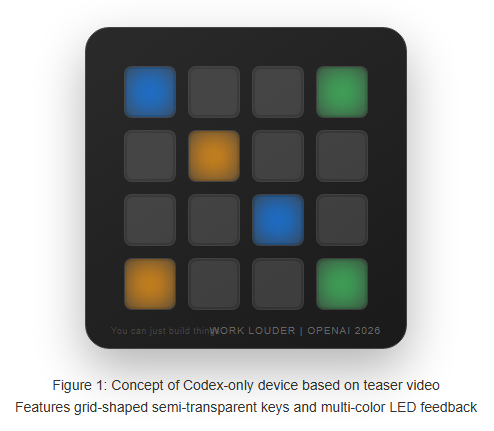
On July 15, 2026, the date designated as the stage for the announcement, details such as the device’s full features, specific features, pricing, and sales regions are expected to be revealed. It is highly unusual for OpenAI, which has continued to innovate purely in the software domain, to take the leap into offering physical devices, drawing significant attention both inside and outside the industry. The diagram below symbolizes the futuristic design of the device shown in the teaser video.
Strategic Collaboration with Keyboard Manufacturer Work Louder
For this device development, OpenAI has chosen Work Louder, a Canadian manufacturer specializing in input devices for creators and developers, as its partner. The company is known for manufacturing macro pads and highly customizable keyboards tailored for specific tasks, with design and practicality highly regarded.
On the side of the device shown in the video, there is a message reading “Work Louder | The words “OpenAI 2026” are engraved, clearly indicating that this is a joint project between the two companies. This device is believed to be specially designed to maximize the capabilities of OpenAI Codex, based on Work Louder’s popular macro pad, the Creator Micro 2. Macropads have the potential to dramatically boost coding productivity because they can consolidate multiple key inputs and complex operations into a single keystroke.
Device specifications and expectations for development transformation
Grid-patterned illuminated keys and multifunctional sensors
From the content of the released video, several specific details about the new device’s appearance have been revealed. The main body is square-shaped, with translucent keys arranged in a grid pattern in the center. These keys are designed to illuminate brightly with colorful LEDs such as blue, green, and orange, and are believed to provide visual feedback based on operation conditions and modes.
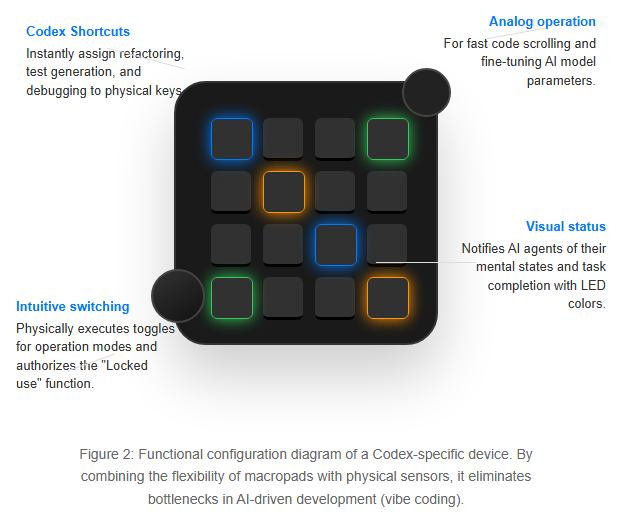
Additionally, parts resembling dials and joysticks have been identified on the edges of the device, suggesting that it continues the lineage of mechanical switches and touch sensors found in Work Louder’s “Creator Micro 2.” This is expected to transform non-intuitive operations—such as scrolling code, fine-tuning parameters, or toggling instructions to AI agents—into something that requires a physical touch, rather than just text input. As shown in the diagram below, combining multiple input methods advances developers’ desk environments to a new stage.
Operational Transformation Brought by Physicizing Codex Shortcuts
The primary purpose of this device is to assign frequent operations in OpenAI Codex to physical keys. Developers can register and call Codex-specific commands that are repeatedly executed in their workflows, such as refactoring, generating unit tests, and running debugging, using individual physical keys.
Traditional keyboard operations required memorizing complex shortcuts combining multiple modifier keys, but the introduction of dedicated devices greatly reduces the cognitive load on these tasks. Especially in today’s development style, where AI agents are frequently asked to “explain code” or “suggest optimizations,” the benefits of starting a conversation with AI with just a fingertip are immeasurable. This should work in conjunction with autonomous work styles like OpenAI’s “Locked use” feature, which allows AI to operate the actual device even when the Mac is locked, enabling more seamless human-AI collaboration.
The Evolution of Development Culture and Future Prospects
Adapting to AI-native development styles
The arrival of new devices symbolizes the maturation of a new development culture called “Vibe Coding,” where AI writes code. Vibe coding is a style where developers focus more on the “feel” and “direction” of instructions to AI rather than being conscious of logical details, but the process still involves detailed input and confirmation tasks.
As discussed in Mr. Yanagitani’s practical report, we are entering an era where even non-engineers can build apps with the help of AI, but at the same time, there are also challenges that require appropriate instructions and literacy. Physical dedicated keypads can be a physical way to eliminate the “input/output bottlenecks” in such AI-driven development. By having acceptance buttons for AI-generated code and transition switches to the next step as physical devices, developers can focus on more creative decision-making without being tied down by text on screen.
OpenAI DevDay 2026 and Ecosystem Expansion
This announcement can be seen as a stepping stone toward the developer event “OpenAI DevDay 2026,” scheduled to be held in San Francisco on September 29, 2026. The event notice includes a section titled “Tinker with what’s new,” and through this dedicated device, you can try Codex, the latest GPT-5.3, Alternatively, workshops may be held to experience the features of GPT-5.5.
In the AI coding tools market, strong competitors are fiercely contested, such as Cursor, which SpaceX has acquired as acquisition options, and Anthropic’s Claude Code. OpenAI’s introduction of its own physical devices is a strategic move that strengthens its unique ecosystem, consistently delivering hardware, software, and AI models, going beyond mere tool provision. After the official announcement on July 15, the sight of the iridescent OpenAI logo lining up on developers’ desks could mark the dawn of a new era where AI and hardware truly merge.
[#OpenAI #Codex #WorkLouder #マクロパッド #AIコーディング #バイブコーディング #DevDay2026]

コメント