The Japan Aerospace Exploration Agency (JAXA) and Idina Corporation, which works on voice AI, have begun a co-creation initiative aimed at developing an interface called “Mission Buddy,” which allows spacecraft to respond with their own voices. By combining the latest generative AI with speech synthesis technology, we aim to streamline space operations and create a new model of scientific public relations.
- Overview of the next-generation interface “Mission Buddy”
- Personality Design and Dialogue System as the Technical Foundation
- Knowledge management that inherits the tacit knowledge of experienced professionals
- Renewing Science Communication and Experiencing “Personalization”
- Ensuring reliability and technical hurdles
- The future indicated by the arrival of the Mercury probe Mio in autumn 2026
Overview of the next-generation interface “Mission Buddy”
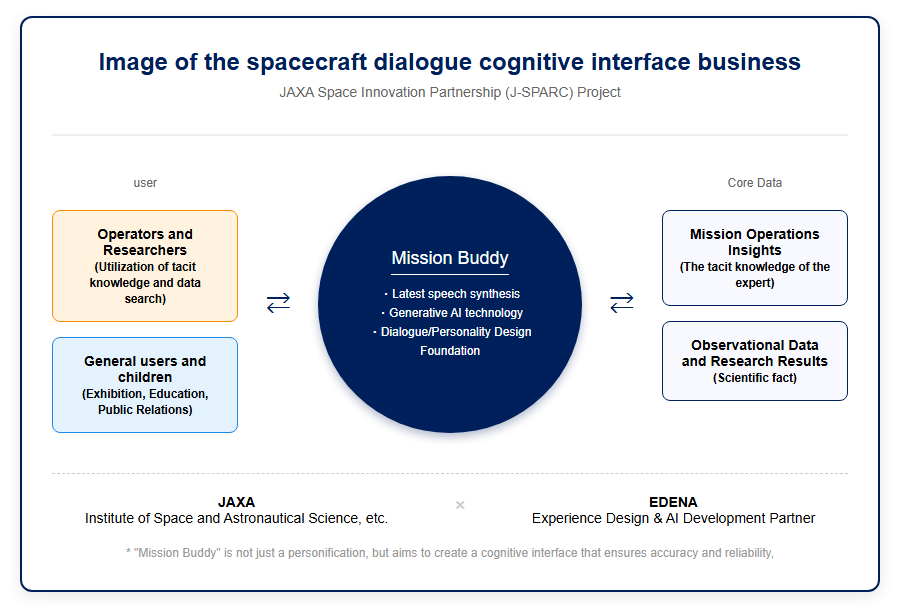
On July 3, 2026, the Japan Aerospace Exploration Agency (JAXA) announced that it will begin co-creation activities in June 2026 in collaboration with IDINA Inc., a company that designs experiences utilizing voice AI and XR technologies, regarding the “Spacecraft Dialogue Cognitive Interface Project.” This project is carried out within the framework of the “JAXA Space Innovation Partnership (J-SPARC),” where private companies and JAXA collaborate to create new space-related businesses. At the core of development is the interactive cognitive interface program “Mission Buddy.” This system allows spacecraft such as probes and satellites to respond to questions with their own voices, utilizing the latest speech synthesis and generative AI technologies, as well as Idina’s dialogue and personality design infrastructure. This co-creation activity is scheduled to be carried out from fiscal 2026 to 2027 as part of the business concept co-creation phase. The development team aims not just to anthropomorphize machines but to establish a “cognitive interface” based on mission information, observation data, and years of operational expertise. The diagram below illustrates the image of this project.
Personality Design and Dialogue System as the Technical Foundation
The technology used in this project goes beyond simply reading text aloud. Idina’s “Dialogue Platform” is an advanced system that responds to users’ questions with accurate information and context, using voice and text. Additionally, by using the “Personality Design Platform,” it becomes possible to organize the characteristics, roles, and unique narratives of each probe and mission, and respond with consistency. This aims to provide a heartfelt interactive experience as if the spacecraft itself possesses a will. Specifically, we are building dialogue models that reflect the unique characteristics of each mission for currently operational or future probes and satellites. By building a system where researchers, operators, and even general users can interact with spacecraft tailored to their needs, an environment where specialized information can be understood more intuitively is created. JAXA expects this technology to establish a foundation for delivering information in an accessible way while maintaining accuracy and safety.
Two Purposes Connecting Space Development Sites and Society
Knowledge management that inherits the tacit knowledge of experienced professionals
In spacecraft operations, there are unique challenges that have been difficult to solve until now. In long-term missions such as probes and the International Space Station (ISS), the “tacit knowledge” in the minds of veteran operators—such as the vast amounts of past data and response measures in case of abnormalities—becomes extremely important. However, until now, operational data has relied on visual information such as numbers, documents, and graphs, making it a major challenge to pass on tacit knowledge like the experience and intuition of experienced professionals to the next generation. Mission Buddy has the aspect of being a powerful tool to support this “inheritance of knowledge.” If operators can access past insights by talking to the probe, the burden of searching for information is greatly reduced, helping to lessen the operator’s cognitive burden. By enabling the use of operational insights in a dialogue format under appropriate authority management, we aim to strengthen the knowledge management foundation across the organization and reduce long-term operational risks. In this way, interactive interfaces go beyond merely personifying and serve as practical business support systems.
Renewing Science Communication and Experiencing “Personalization”
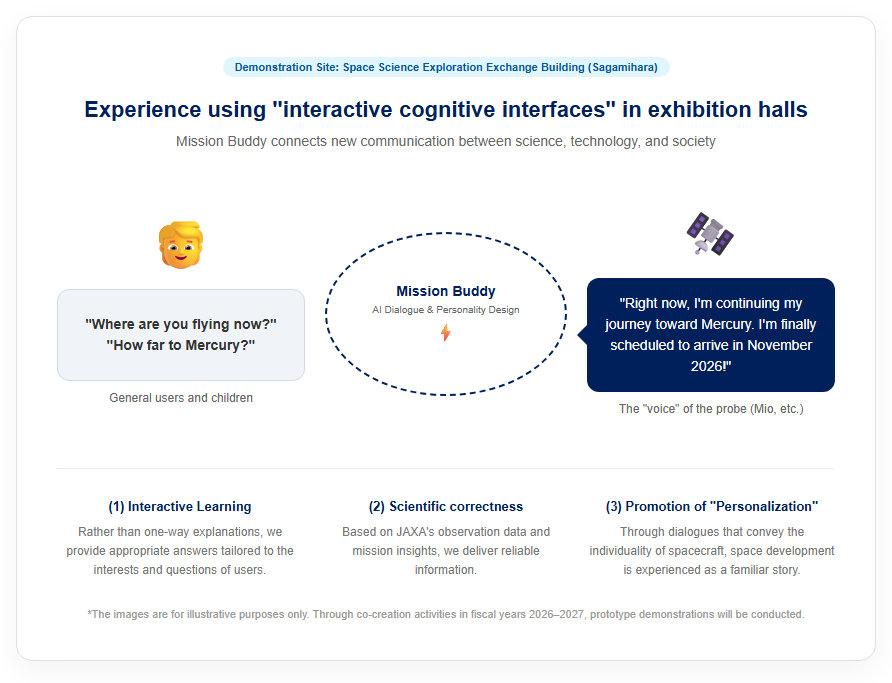
Another important goal is to renew scientific communication for the general public. Traditionally, public relations related to space development mainly relied on one-way information dissemination centered on text and videos. Through Mission Buddy, JAXA and Idina are working to transform this one-way experience into a two-way dialogue. Specifically, demonstrations are planned at venues such as the “Space Science Exploration Exchange Building” at the JAXA Sagamihara Campus. For example, when a child visiting the exhibition asks, “Where are you flying now?”, the probe will respond with its own voice about its current location and mission objectives. By maintaining scientific accuracy and responding to users’ knowledge and interests, the spacecraft can make complex scientific and technological information feel more accessible. Such dialogue experiences are expected to evolve space missions from mere “information” into “entities that nurture relationships together,” prompting many people to view missions as their own. The diagram below shows the usage in the exhibition hall.
Challenges in implementation and future outlook
Ensuring reliability and technical hurdles
There are several challenges to overcome in realizing interactive spacecraft. One of the biggest issues is the design of information accuracy and reliability. Generative AI always carries the possibility of “hallucination,” where information that is inconsistent from the facts is produced. When a probe speaks with its own voice, those words are taken as authoritative facts, so the output of misinformation can undermine the very foundation of scientific communication. Therefore, it is necessary to build technical guardrails and implement mechanisms to block legal compliance just before production runs. Additionally, the operational costs of AI are an issue that cannot be ignored. As the shift from traditional flat-rate systems to pay-as-you-go based on consumption tokens progresses, there is a risk of unexpected large costs, necessitating cost management for sustainable operations. Furthermore, careful discussions are underway from a governance perspective, such as the legal responsibility for damages caused by autonomous AI. In Japan, it is essential to ensure accountability and transparency in development in accordance with guidelines such as the “AI Act,” which was fully enforced in September 2025.
The future indicated by the arrival of the Mercury probe Mio in autumn 2026
The significance of this project is symbolized by the existence of the Japan-EU joint Mercury exploration program “Bepicolombo.” The Mercury magnetosphere probe ‘Mio,’ managed by JAXA, is scheduled to arrive at Mercury in November 2026 after a long journey of about eight years since its launch in October 2018. In this memorable year, scientists involved in the mission are participating in this project with the hope that the probe itself will become part of the team and attract many people to the mission. This can be seen as the first step in a sci-fi movie-like world that views probes not just as observational instruments but as partners in overcoming difficulties. Furthermore, the scope of this conversational cognitive interface technology extends beyond space development. As a foundation for accurately and multilingually conveying complex specialized knowledge, it is expected to be applied in a wide range of fields requiring advanced technology inheritance, such as healthcare, manufacturing, and learning support. Through prototype construction and demonstration experiments to be conducted from fiscal year 2026 to fiscal year 2027, a new communication model connecting science, technology, and society is being established.

コメント