_en.png)
The Bank of Japan Review published by the Bank of Japan on July 10, 2026, has revealed detailed realities regarding foreign currency deposits at major Japanese banks. Following the unrest of U.S. and European banks in 2023, ensuring the stability of the foreign currency procurement base has become an urgent issue.
- Background of the Bank of Japan Review Publication and Evolution of Analytical Methods
- Growth Trends of Existing Customers Driving Foreign Currency Deposit Balances
- High interest rate sensitivity shown by non-Japanese companies and financial institutions
- The effect of settlement-type deposits on suppressing customer exit
- Mechanisms for Controlling Procurement Costs from the Perspective of Deposit Spreads
- Lessons Learned from U.S. and European Bank Concerns on Liquidity Risk Management
- Preparation for Digital Bankrun and Advanced Early Warning Management
- Global expansion of monitoring systems including local currencies
- The evolution of autonomous risk management required of major banks
Background of the Bank of Japan Review Publication and Evolution of Analytical Methods
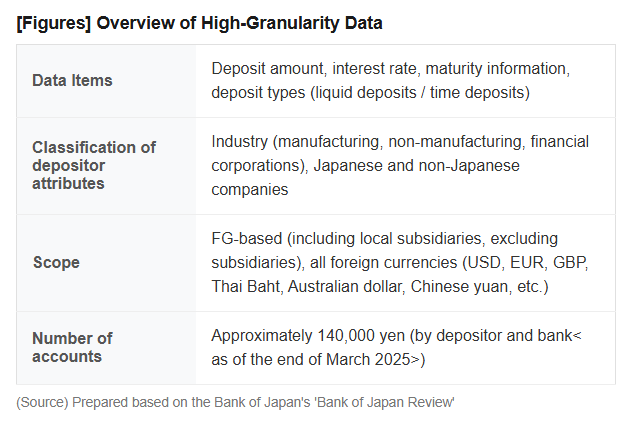
On July 10, 2026, the Bank of Japan released its review titled “Considerations of Customer Dynamics and Deposit Spreads of Major Banks’ Foreign Currency Deposits Using High-Granularity Data.” This report is a further development of the previous analysis released on June 11, 2025, and utilizes highly detailed, high-granularity data from individual foreign currency deposit transaction statements for three megabanks in Japan. The analysis involved an enormous amount of data covering approximately 140,000 accounts as of the end of March 2025.
The background is the bankruptcy of Silicon Valley Bank (SVB) in the United States that occurred in March 2023. In this case, due to the spread of information via social media and the spread of online banking, a digital bank run occurred, where deposits flowed out at a speed far exceeding previous expectations. Based on this lesson, the Bank of Japan decided it was necessary to carefully examine what kind of customers actually make up the majority of foreign currency deposits at major banks, and how sticky (less likely they are to withdraw) they have. This analysis includes quantitative analysis that delves into deposit amounts, interest rates, and maturity information, as well as attribute information such as depositors’ industries and whether they are Japanese or non-Japanese. Please refer to the diagram below.
Growth Trends of Existing Customers Driving Foreign Currency Deposit Balances
One of the most notable findings from this analysis is the factor behind the increase in foreign currency deposit balances at major banks. Customer dynamics analysis using high-granularity data confirmed that the current increase in balance was not driven by acquiring new customers, but was mainly driven by the accumulation of balances by non-Japanese existing customers. This suggests that major banks are pursuing strategies to deepen relationships with existing customers as a stable procurement method to support their overseas lending operations.
Specifically, when tracking the movements of “exits” and “new entrants” that indicate the turnover of depositors, the amount deposited by customers who had previously traded with them was overwhelmingly greater than the amount deposited by customers who opened new accounts. Especially for non-Japanese companies, as the high interest rate environment continues, major Japanese banks are chosen as the main outlet for managing surplus funds. However, such accumulations by existing customers may be sensitive to changes in interest rate trends and market conditions, and it has been concluded that evaluating deposit stability requires not only balance trends but also continuous monitoring of individual customer dynamics.
High interest rate sensitivity shown by non-Japanese companies and financial institutions
The BOJ review also quantitatively showed that behavior in response to interest rate changes varies significantly depending on the deposit attribute. Analysis results show that deposits by non-Japanese companies and financial institutions have significantly higher interest rate sensitivity compared to Japanese companies and business corporations. This means that when the deposit spread—the difference between policy rates and the deposit rates offered by banks—widens, the deposit outflow rate from customers of these attributes tends to rise.
In particular, regarding deposits at financial institutions, as pointed out during the turmoil in March 2023, the company has been statistically proven to have low stickiness because it enables flexible fund movements with a focus on profitability. Comparing the maximum outflow rates, while business corporations reach around 20 percent, financial corporations have been found to reach around 40 percent. On the other hand, Japanese companies tend to prioritize long-standing relationships with their main banks, and the movement to withdraw deposits immediately based solely on interest rate conditions is relatively limited. For major banks, balancing funding costs and liquidity risk requires understanding the behavioral characteristics of these attributes and accurately determining how much their deposit portfolio consists of “run-out” deposits, which is key to advancing foreign exchange liquidity risk management.
[Management and Strategic Background] The Strategic Value of Transaction Banking
The effect of settlement-type deposits on suppressing customer exit
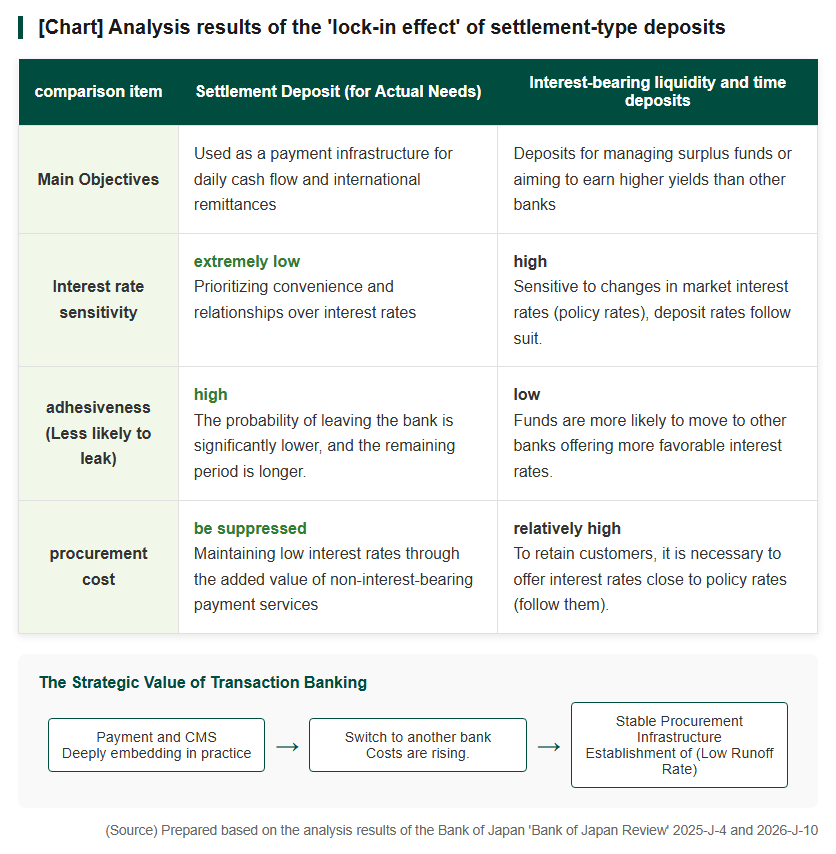
This survey confirmed that the strategic expansion of transaction banking services by major banks has greatly contributed to improving the stickiness of foreign currency deposits. Transaction banking is a business model that integrates daily working capital receipt and payment, international remittances, and cash management services (CMS). Analysis shows that customers with a higher proportion of settlement deposits (deposits used for settlement with almost no interest rate) in total deposits are significantly less likely to exit the bank and tend to have longer remaining periods.
This is because once a settlement account is deeply integrated into practice, there is a “lock-in effect” that increases the cost of switching to another bank. For companies with settlement deposit accounts, the bank is positioned not merely as a place to store funds but as an essential partner (main bank) in daily business operations. By leveraging the strength of these relationships, major banks are able to suppress the risk of rapid deposit outflows even during times of stress. This trend is especially pronounced among non-Japanese customers, and strengthening touchpoints through transaction banking has proven to be an effective strategy to stabilize the often unstable overseas deposit infrastructure. Please refer to the diagram below.
Mechanisms for Controlling Procurement Costs from the Perspective of Deposit Spreads
This review also presented interesting analytical results on how the depth of customer relationships affects banks’ procurement costs. Analysis of the determinants of deposit spreads, which influence the cost of acquiring deposits, confirmed that customers with a high settlement deposit ratio have statistically significantly reduced deposit interest rates (acquisition costs) paid by banks. This means that by providing customers with the added value of non-interest-bearing payment services, they can maintain their deposits without excessive interest rate benefits.
In other words, major banks strengthening investments in CMS and remittance infrastructure will directly lead to future reductions in foreign currency procurement costs. Relying on high-interest time deposits for financing may seem easy to build up at first glance, but during periods of rising interest rates, the burden of interest payments surges, squeezing profits. On the other hand, deposit acquisition centered on transaction banking enables the securing of “high-quality deposits” at low cost and stability. The BOJ review points out that this strategic advantage is reflected in concrete figures in the management of certain banks, and it is expected that infrastructure investment and service competition among major banks will intensify further in the future.
Lessons Learned from U.S. and European Bank Concerns on Liquidity Risk Management
The SVB collapse in March 2023 and the Credit Suisse bailout merger fundamentally overturned traditional assumptions of liquidity risk management. Until then, deposits were considered the “most stable means of fundraising,” but with digitalization and the spread of social media, that common sense no longer applies. Major Japanese banks have taken this lesson seriously and have been rapidly advancing the strictness and refinement of foreign currency liquidity stress tests.
As a concrete initiative, there is a growing trend to break down deposit outflow rate assumptions by customer attributes and set more conservative figures (high outflow rates). Additionally, some companies are incorporating external data published by overseas authorities and reflecting them in scenarios to respond to risk events they have not directly experienced. The Bank of Japan and the Financial Services Agency are also supporting these efforts through joint surveys, steadily strengthening the stress tolerance of major banks to foreign currency liquidity risks. Currently, even under severe stress scenarios, a system has been established to secure surplus funds for several months, but the Bank of Japan Review also points out “room for further advancement,” and that rapid data capture and decision-making mechanisms suited to the digital age remain the top management challenges.
[Future Developments & Points of Interest] The Next Generation of Foreign Currency Cash Flow Management
Preparation for Digital Bankrun and Advanced Early Warning Management
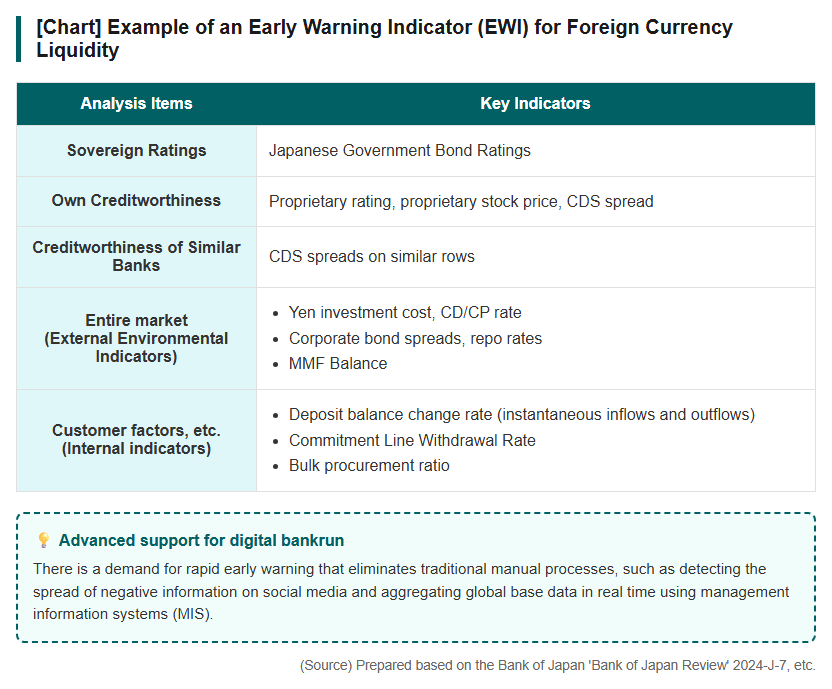
Going forward, the biggest focus for major banks will be how to stay ahead of the new threat of digital bank runs. As mentioned in the BOJ review, the spread of online banking has made it possible for depositors to move their funds instantly, 24/7, 365 days a year. To address this, major banks are expanding Early Warning Indicators (EWI) and reviewing thresholds.
Specifically, in addition to external indicators such as the overall market yen investment cost and CDS spread, a system is being established to monitor internal capital dynamics in real time, including instantaneous changes in deposit balances and withdrawal rates at commitment lines. Furthermore, the introduction of a system that automatically detects the spread of negative information on social media, allowing management to immediately assess the level of cash flow strain, is being considered. The advancement of management information systems (MIS) for fast and accurate data acquisition is not merely improving administrative efficiency, but is becoming a very important security factor that determines the survival of banks. The completeness of the system that eliminates manual aggregation processes and collects data in a timely manner from all global locations will determine future competitiveness. Please refer to the diagram below.
Global expansion of monitoring systems including local currencies
As major banks expand overseas beyond the dollar zone, especially into Asian markets expected to have high growth, liquidity management for local currencies other than the US dollar has become a key theme. As pointed out in the BOJ Review BOX article, for currencies such as the Thai baht, Indonesian rupiah, and Chinese yuan, there are cases where the loan-to-deposit ratio is well above 100 percent, resulting in a state of “excess lending.”
These currencies often lack a market as thick as the dollar, and carry the risk of liquidity drying up during stress. Major banks are required to utilize highly granular data for these local currencies as well, understand local deposit characteristics and business practices (seasonality), and conduct individual stress tests. Especially in Asia, local regulatory restrictions on fund transfers (rebound limits) must also be taken into account. The Tokyo headquarters oversees the entire group, accurately grasps the regulations and liquidity status of each overseas office, and establishes a governance framework to ensure optimal capital allocation — this will determine the success or failure of future global strategies.
The evolution of autonomous risk management required of major banks
Finally, the future vision for major banks is to establish a resilient management structure that autonomously manages liquidity risks without overly relying on support from central banks or other authorities. The BOJ Review evaluates the flexible responses by major banks in previous interest rate hike phases by curbing unprofitable high-interest deposits and optimizing funding costs by adjusting deposit interest rates.
However, the real test comes at a time when the financial environment changes rapidly. Going forward, it is expected that major banks will actively incorporate the insights gained from this high-granularity data analysis of “differences in stickiness by customer attributes” not only for risk management (defense) but also into deposit acquisition strategies (offense). It is necessary to shift from making precise decisions such as which customers should offer what interest rates and which services to include to stabilize deposits, instead of data-driven “data-driven cash flow management.” The Bank of Japan also plans to use the results of this analysis to deepen discussions with major banks and overseas authorities, and to lead the improvement of the overall stability of Japan’s financial system. Amid the major wave of returning to a world with interest rates and advancing digitalization, foreign exchange liquidity management by major Japanese banks is entering a new stage.
[#日本銀行 #外貨預金 #流動性リスク #メガバンク #金融ビジネス #経済レポート #トランザクションバンキング #リスク管理]


コメント