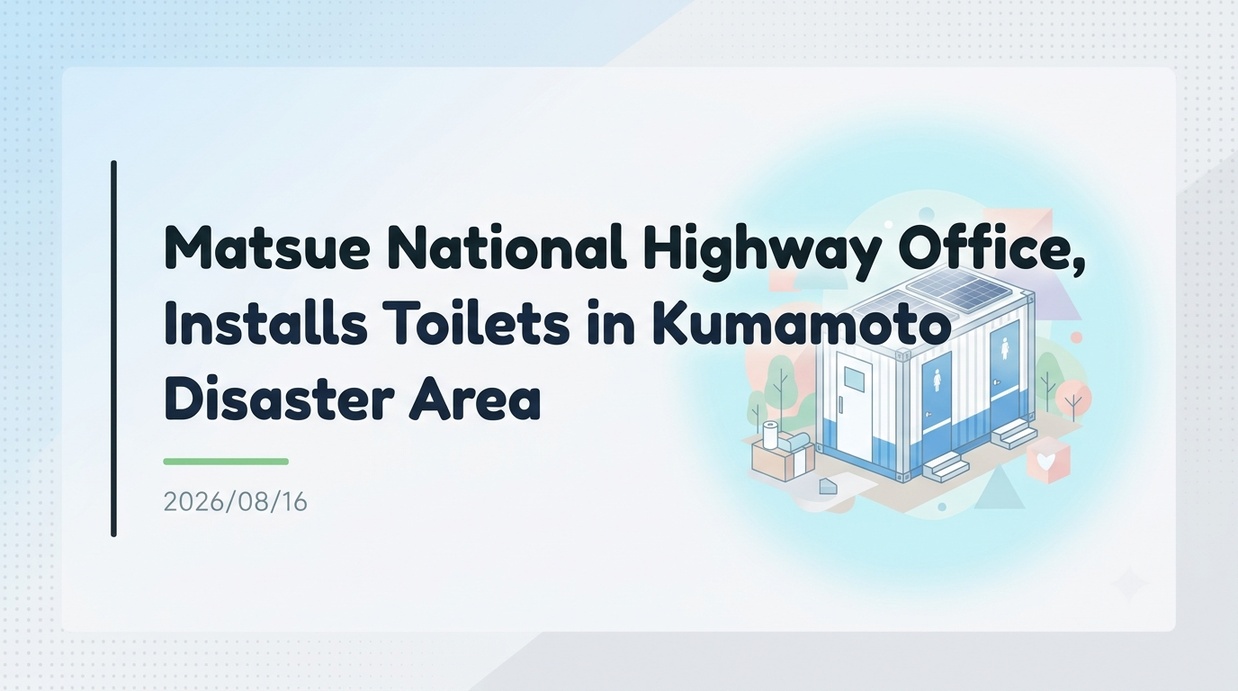
The Matsue National Highway Office in Shimane Prefecture, Japan, has dispatched and completed the installation of a disaster prevention container-style toilet in Hikawa Town, Kumamoto Prefecture, following the 2026 Kumamoto Earthquake. This support aims to drastically improve the sanitary environment of evacuation centers where water and electricity services are suspended, thereby reducing the physical and mental stress of disaster victims.
- Dispatching toilets from Matsue to Kumamoto as push-type support
- Timeline from departure to commencement of on-site operations
- Technical specifications resilient to power and water outages
- Comfortable environment protecting the dignity of evacuees
- Regional disaster support network based on disaster prevention roadside stations
- Severity of toilet issues in evacuation centers and progress in improvements
- Future challenges and strengthening regional cooperation systems
Dispatching toilets from Matsue to Kumamoto as push-type support
On July 28, 2026, at 4:27 PM local time, an earthquake with a magnitude of 7.1 occurred with its epicenter in the Kumamoto region of Kumamoto Prefecture, Japan. In response to this disaster, the Matsue National Highway Office, which is part of the Chugoku Regional Development Bureau under the Japanese Ministry of Land, Infrastructure, Transport and Tourism (MLIT), decided to provide rapid assistance using advanced equipment stationed at its Disaster Prevention Roadside Stations,. Specifically, one disaster prevention container-style toilet unit was dispatched from the “Kakeya-no-Sato” Roadside Station in Unnan City, Shimane Prefecture, to Hikawa Town, Kumamoto Prefecture, which suffered significant damage.
In Hikawa Town, the earthquake reached a maximum intensity of 7 on the Japanese seismic scale, and the town’s own Roadside Station, “Ryuhoku,” suffered damage to its facilities, including its toilets. Consequently, securing sanitary toilet environments at evacuation centers became an urgent priority. This response by the Matsue National Highway Office was implemented as part of “push-type” support, where essential supplies are sent immediately without waiting for specific requests from the affected local governments,. By utilizing the framework for wide-area dispatch, which allows disaster prevention functions held by regional development bureaus outside of the Kyushu region to be deployed to the disaster zone, it was possible to finalize the decision and move the unit within just a few days of the earthquake’s occurrence,. Please refer to the following chart.
Timeline from departure to commencement of on-site operations
The specific schedule for dispatching the container-style toilet proceeded with extreme speed to ensure completion before conditions in the disaster area worsened. On July 31, 2026, the Matsue National Highway Office issued a press release announcing the dispatch decision, and action was taken the very next day,. On August 1 at 9:30 AM, a departure ceremony was held at the “Kakeya-no-Sato” Roadside Station in Shimane Prefecture, attended by officials from the Matsue National Highway Office, Unnan City, and the cooperating transport contractor.
After the ceremony, the toilet unit was loaded onto a large vehicle and departed from Shimane, arriving in Hikawa Town, Kumamoto, within the same day,. Subsequently, installation work was completed on the following day, August 2, at Ryuhoku Junior High School, which was serving as an evacuation center, and operations began immediately,. This remarkable speed was made possible by the characteristics of the container-style toilet, which is designed and maintained for mobility during normal times, the coordination system existing between the various regional development bureaus of the Japanese Ministry of Land, Infrastructure, Transport and Tourism, and the strong network with private sector contractors.
Advanced functions and roles of disaster prevention container toilets
Technical specifications resilient to power and water outages
The most significant feature of the disaster prevention container-style toilet dispatched this time is its ability to provide the same convenience as during normal times, even in harsh environments where public infrastructure has completely stopped. The top of the container is equipped with a solar power generation system and a large-capacity storage battery, making connection to a commercial power supply entirely unnecessary,. This ensures that lighting at night and flushing functions can be maintained even in areas experiencing widespread power outages.
Furthermore, innovative technology has been applied to secure the water environment. This unit utilizes a water-circulating self-treatment system with a built-in purification system, meaning that once water is supplied at the start of operation, no connection to water or sewage lines is required,. Additionally, the self-treatment function eliminates the need for waste collection for a certain period. Being able to provide a clean flush toilet with just this single container unit in an evacuation center where water pipes are ruptured and power is out is extremely significant for maintaining hygiene in disaster-affected areas.
Comfortable environment protecting the dignity of evacuees
This toilet meets the high standards of the “Comfortable Toilet” (Kaiteki Toilet) specifications recommended by the Japanese Ministry of Land, Infrastructure, Transport and Tourism,. Each container unit houses a total of two clean Western-style toilets, one each for men and women. Many conventional temporary toilets used in Japan are Japanese-style (squat) toilets, which can be difficult for elderly people with weak legs to use, or they may involve mental distress due to darkness, odors, or concerns about locking the door.
However, these container-style toilets are designed to significantly reduce the mental stress of disaster victims living in evacuation centers by featuring bright LED lighting, strong locking mechanisms such as double locks, and functions to prevent the backflow of odors,,. Please refer to the following chart.
Regional disaster support network based on disaster prevention roadside stations
The dispatch source, “Kakeya-no-Sato,” is a facility of national importance designated as a “Disaster Prevention Roadside Station” (Bosai Michi-no-Eki) by the Japanese Ministry of Land, Infrastructure, Transport and Tourism,. Disaster Prevention Roadside Stations are those positioned as regional disaster prevention hubs in prefectural regional disaster prevention plans, receiving prioritized support from the national government to strengthen their roles during emergencies,.
In addition to container-style toilets like the one used here, these stations are equipped with emergency power supplies and stockpiling warehouses,. While they function as rest areas and tourism hubs for their communities during normal times, they become bases for recovery support or dispatch their equipment to other regions during a disaster. The ability of the Matsue National Highway Office to promptly extend a helping hand from Shimane to Kumamoto is a result of the steady progress being made in establishing such a nationwide disaster prevention network,.
Lessons from the past and future focus of disaster response
Severity of toilet issues in evacuation centers and progress in improvements
Toilet issues at evacuation centers emerged as a top-priority challenge in many past disasters in Japan, particularly the 2016 Kumamoto Earthquake. Investigations at that time reported that long lines for toilets occurred at schools used as evacuation centers, and the need to travel back and forth to outdoor toilets placed an excessive burden on the elderly,. Furthermore, physical and mental stress from evacuation life was identified as a major cause of “disaster-related deaths”—which accounted for about 80% of the total deaths in that earthquake—and an unsanitary toilet environment was a significant factor in that stress.
Based on these serious experiences, there has been an increase in cases where local governments in Japan enter into rental agreements for temporary toilets in accordance with guidelines from the Cabinet Office, and the Ministry of Land, Infrastructure, Transport and Tourism has strongly promoted the spread of Western-style toilets with flushing functions,. The dispatch of the container-style toilet by the Matsue National Highway Office is the result of efforts to solve these issues with concrete technology and systems, serving as a symbolic example of raising the baseline for the living environment of disaster victims,.
Future challenges and strengthening regional cooperation systems
A focus for the future is how to deploy high-quality support like this more widely and on a larger scale throughout Japan. While container-style toilets are extremely effective, the number currently deployed is still limited,. Therefore, there will likely be discussions regarding further prioritized deployment to Disaster Prevention Roadside Stations and the promotion of equipment stockpiling through cooperation with private companies,.
In addition to hardware improvements, an operational system for maintaining and managing the dispatched equipment on-site is also crucial. Just as the Kyushu Regional Development Bureau has begun its own operations of container-style toilets, there are high expectations for strengthening regional cooperation systems where different regional development bureaus complement each other,. The actions of the Matsue National Highway Office during the 2026 Kumamoto Earthquake demonstrate that a “mutual support network” spanning across prefectural borders can function effectively in practice, serving as a model case for Japan’s future disaster prevention and mitigation measures,.
Reference pages
-
[On the damage situation, etc. caused by the 2026 Kumamoto Earthquake (Report 40) – Ministry of Land, Infrastructure, Transport and Tourism] https://www.mlit.go.jp/common/001479860.pdf
-
[Press Release Materials | Matsue National Highway Office, Chugoku Regional Development Bureau, Ministry of Land, Infrastructure, Transport and Tourism] http://www.cgr.mlit.go.jp/matsukoku/information/pressrelease.html
-
[Dispatch of container-style toilet from Disaster Prevention Roadside Station “Kakeya-no-Sato”] http://www.cgr.mlit.go.jp/matsukoku/information/pressrelease/2026/5_1387.pdf
-
[Recent natural disasters and initiatives for disaster prevention and mitigation] https://www.mlit.go.jp/common/001150419.pdf
【#2026KumamotoEarthquake #DisasterPreventionRoadsideStation #ContainerToilet #MatsueNationalHighwayOffice #HikawaTown #DisasterSupport #MinistryOfLandInfrastructureTransportAndTourism #ComfortableToilet】


コメント