Konoe Intelligence has secured a patent for a high-speed, high-precision LLM guardrail technology leveraging mechanistic interpretability. This innovation addresses critical challenges in conventional generative AI evaluation, such as inspection latency and the opacity of internal model mechanisms.
- Announcing an Innovative LLM Guardrail Built on Mechanistic Interpretability
- The Mechanism of Geometry-Guided Constraint Learning in Hidden State Space
- The Limitations of LLM-as-a-Judge Guardrails and the Power of Internal Inspection
- Superior Accuracy and 330x Faster Processing Than NVIDIA’s Industry Benchmark
- Regulatory Enforcement and Enterprise Governance Requirements in 2026
- Deployment Prospects Across High-Risk Sectors: Healthcare, Finance, and Public Services
Announcing an Innovative LLM Guardrail Built on Mechanistic Interpretability
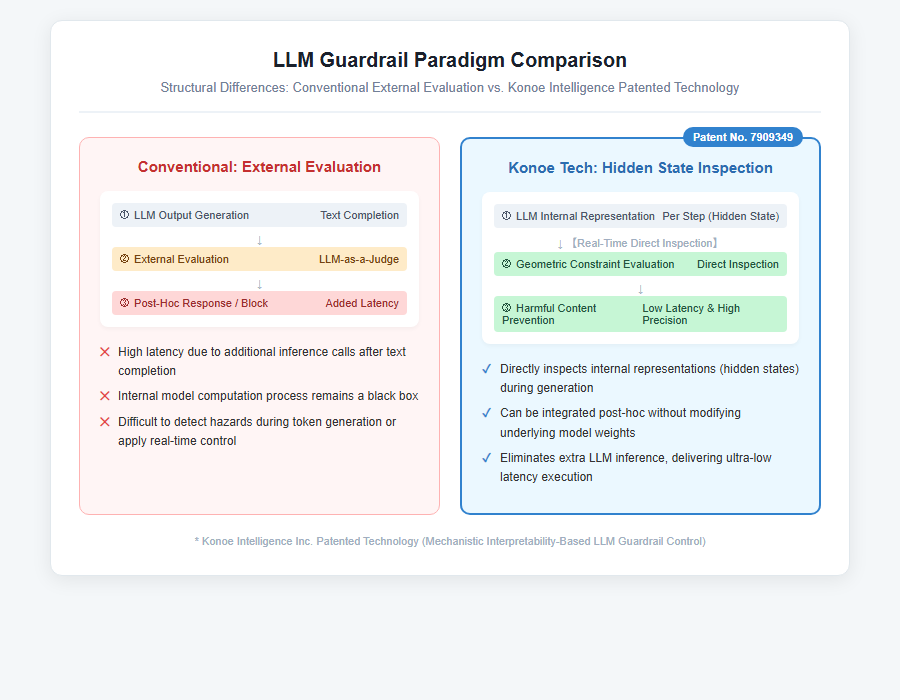
Konoe Intelligence Inc. (formerly Aladdin Security Inc., renamed in July 2026), an R&D company specializing in AI safety and security, announced that it obtained a key patent (Patent No. 7909349) in September 2026 for a guardrail technology that directly controls the behavior of Large Language Models (LLMs). This technology directly inspects a model’s hidden states—the internal representations generated during inference—in real time to prevent the generation of harmful content before it occurs.
Traditional AI guardrails typically rely on evaluating LLM output text using external classifier models or secondary LLMs. However, this approach introduces significant practical drawbacks, including added latency and increased computational costs from extra inference steps. In contrast, Konoe’s patented technology can be integrated post-hoc without altering the model’s underlying weights, establishing an innovative safety boundary directly within the generation process itself.
The diagram below illustrates the concept of analyzing internal hidden states to evaluate safety in real time.
As enterprise adoption of generative AI accelerates, this patented breakthrough is garnering global attention as a highly effective defense against critical security risks, including misinformation, inappropriate content generation, and prompt injection attacks.
The Mechanism of Geometry-Guided Constraint Learning in Hidden State Space
At the core of the patented technology lies a framework that establishes geometric constraint boundaries within a trained LLM’s hidden state space, directly monitoring and controlling internal representations at every generation step. The theoretical foundation for this approach is detailed in the company’s published paper, “Geometry-Guided Constraint Learning for LLM Safety Classification” (arXiv:2607.19366).
Specifically, by leveraging a feature extraction technique known as Sparse Autoencoders (SAE), the system automatically extracts the necessary geometric constraints for each harmful content category. While conventional methods required exhaustive, computationally expensive parameter sweeps to define safety boundaries, this approach dramatically reduces computational load while achieving exceptional classification accuracy.
Refer to the conceptual diagram below for the structural overview of safety constraints within the model’s geometric space.
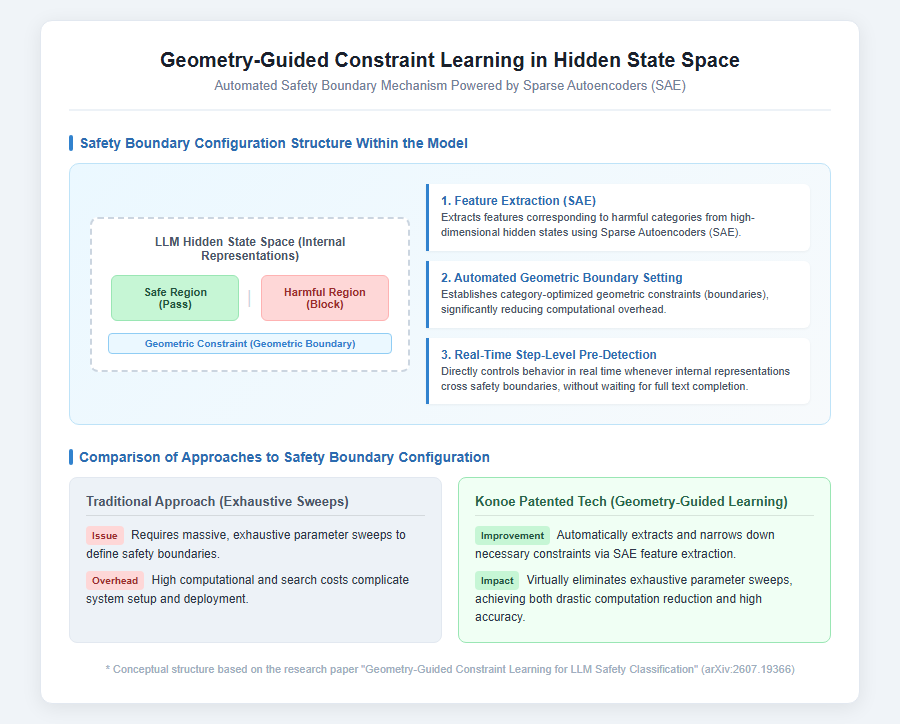
Through geometry-guided constraint learning, the system captures potential risk behaviors inside the model early while maintaining extremely high classification accuracy across categories. This represents a landmark technological achievement in bringing transparency to LLM internal mechanisms, which have long been treated as opaque black boxes.
Overcoming Conventional Limitations: Konoe’s Unmatched Performance
The Limitations of LLM-as-a-Judge Guardrails and the Power of Internal Inspection
Currently, the most common line of defense for securing LLM applications relies on “LLM-as-a-Judge” frameworks or external post-hoc classifiers that evaluate output text from the outside. However, because these methods observe the text only after it has been fully generated, they suffer from inherent structural limitations.
First, calling an additional LLM inference every time text is produced leads to severe response latency and inflated operational costs. Second, because external classifiers only monitor input-output pairs, they cannot observe the internal computational steps that led to a hazardous output. Consequently, subtle circumventions, clever rephrasing, or sophisticated evasion attacks often go undetected.
Konoe Intelligence’s patented technology fundamentally resolves these bottlenecks. By bypassing external observation and directly accessing the hidden states within the model, it detects risk indicators at the earliest stages of token generation. This ensures safe output without wasting redundant computational resources.
Superior Accuracy and 330x Faster Processing Than NVIDIA’s Industry Benchmark
The efficacy of this technology is backed by rigorous benchmark evaluations against NVIDIA’s state-of-the-art safety evaluation model, “Llama-3.1-Nemotron-Safety-Guard-8B” (NemoGuard). In experimental results, Konoe’s guardrail outperformed existing solutions in both safety detection and processing speed.
In terms of harmful content blocking, Konoe achieved an industry-leading block rate of 84.1%, outperforming NemoGuard’s 83.0%. Even more striking is the processing speed: while NemoGuard recorded an inspection latency of 59.5 milliseconds, Konoe’s technology achieved a latency of just 0.18 milliseconds—approximately 330 times faster.
Unlike traditional methods that repeatedly re-read full generated text strings, Konoe’s approach performs a near-instantaneous scan of the internal hidden states, realizing ultra-low latency. Furthermore, it exhibits a conservative bias that strictly blocks edge cases while minimizing false positives on benign inputs, making it ideal for real-time, mission-critical systems.
Escalating AI Security Demands and Real-World Impact
Regulatory Enforcement and Enterprise Governance Requirements in 2026
The year 2026 marks a historical turning point in global AI regulation and governance. In the European Union, formal enforcement of General-Purpose AI (GPAI) model obligations under the EU AI Act begins in August 2026, backed by stringent penalties of up to €15 million or 3% of global annual turnover. In Japan, the Ministry of Economy, Trade and Industry (METI) and the Ministry of Internal Affairs and Communications (MIC) released Version 1.2 of the “AI Business Guidelines” in March 2026, establishing robust safety controls and accountability as the de facto enterprise standard.
Meanwhile, the market for LLM inference guardrails is projected to exceed \$6 billion by 2030, growing at an extraordinary Compound Annual Growth Rate (CAGR) of 28%. As companies rapidly integrate generative AI and autonomous AI agents into core business workflows, building secure, controllable AI infrastructure has become a top executive priority.
Achieving compliance while mitigating operational risk requires more than paper policies; it demands technical governance mechanisms that operate reliably at the system level.
Deployment Prospects Across High-Risk Sectors: Healthcare, Finance, and Public Services
Konoe Intelligence’s guardrail technology offers a decisive advantage in high-risk sectors where safety is paramount. In medical diagnostic support, financial credit evaluation, automated trading, and public sector customer response, even minor hallucinations or data leaks can lead to catastrophic damage—making compromise-heavy traditional safeguards impractical.
Because Konoe’s guardrail operates under strict safety-first parameters, it is ideally suited for enterprise environments and critical infrastructure where output errors cannot be tolerated. Furthermore, because it can be integrated post-hoc without retraining or modifying model weights, it provides a powerful plug-and-play solution for existing production systems.
Looking ahead, Konoe Intelligence plans to deepen its collaborations with government agencies and leading enterprises to establish sovereign AI safety evaluation capabilities originating from Japan. As AI systems gain greater autonomy, control technologies rooted in mechanistic interpretability will serve as a foundational pillar for humanity to harness AI safely and sustainably.
Reference Pages
- [Konoe Intelligence Obtains Patent for LLM Guardrail Implementation Using Mechanistic Interpretability] https://www.konoe-intelligence.net/posts/press/guardrail-patent
- [Geometry-Guided Constraint Learning for LLM Safety Classification] https://www.konoe-intelligence.net/posts/research/geometry-guided-constraint-learning
- [Geometry-Guided Constraint Learning for LLM Safety Classification (arXiv)] https://arxiv.org/abs/2607.19366
【#GenerativeAI #LLMSecurity #AIGovernance #MechanisticInterpretability #PatentedTechnology #AISafety #KonoeIntelligence #SparseAutoencoders】

コメント