The Keio Electric Railway Group suffered a ransomware attack, and it was revealed that personal information belonging to a total of approximately 10.63 million individuals, including customers and business partners, may have been leaked. As the group-wide promotion of digital transformation and infrastructure sharing progresses, questions are being raised about the ideal approach to cybersecurity measures and risk isolation.
- Occurrence of Ransomware Attack and Discovery of Scale of Damage Involving 10.63 Million Individuals
- Details of Confirmed Leak Information and Diverse Target Data
- Contrast Between the Continuation of Train Operations and the Occurrence of Failures in Retail, Hotels, etc.
- Exposure of Structural Risks Associated with Integrated ID and Common Point Infrastructure
- Future Response Schedule, Including Postponement of Financial Results and Individual Notifications
- Supply Chain Defense and BCP in the Era of Mass Data Breaches
Occurrence of Ransomware Attack and Discovery of Scale of Damage Involving 10.63 Million Individuals
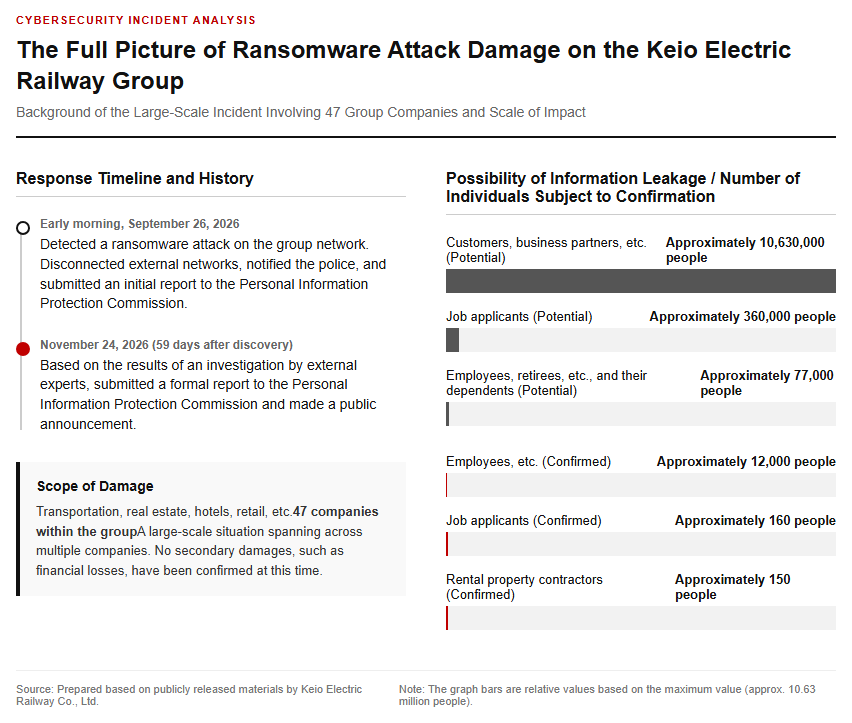
In the early hours of September 26, 2026, Keio Electric Railway Co., Ltd. detected a ransomware attack on the group’s network. The company immediately implemented measures to disconnect external networks, reported the incident to the police, and submitted an initial report to the Personal Information Protection Commission. Subsequently, with the help of external experts, the company conducted detailed investigations, submitted a final report to the Commission on November 24, 2026—the 59th day since the attack was discovered—and made the investigation results public.
According to the published results, the individuals whose information may have been leaked total approximately 10.63 million, including group customers and business partners. Furthermore, the possibility of leakage was indicated for about 360,000 job applicants and approximately 77,000 employees, retirees, and their dependents. On the other hand, actual information leakage was confirmed for about 150 rental property contractors, approximately 160 job applicants, and about 12,000 employees and others. This became a large-scale incident spanning 47 companies within the group, covering transportation, real estate, hotels, and retail.
At the time of the investigation, secondary damages such as financial losses have not been confirmed, but the company is providing individual guidance to affected individuals and establishing a dedicated inquiry counter to handle the response.
Details of Confirmed Leak Information and Diverse Target Data
The types of data potentially leaked are diverse and vary depending on the category of the individual and the service used. Data related to customers and business partners includes basic information such as names, addresses, phone numbers, and email addresses, as well as highly confidential information. The image placeholder below shows an illustration of the target categories in this incident.
Particularly notable items include approximately 1.6 million passport images of foreign customers who stayed at Keio Presso Inn, Keio Plaza Hotel, and other locations. Also included are about 20,000 credit card numbers dedicated to Keio Department Store, approximately 46,000 identity verification documents received during real estate transactions, and copies of My Number cards. The credit card information also includes old data applied for between 2012 and 2018, which has brought to light the management system for past retained data.
Keio Electric Railway is urging customers to check their statements for any unrecognized card usage and to refrain from opening links in suspicious emails or SMS messages disguised as the company group.
Group Common Infrastructure and Impact on Business
Contrast Between the Continuation of Train Operations and the Occurrence of Failures in Retail, Hotels, etc.
What stands out in this incident is that the core business of train operations experienced no disruptions whatsoever. Systems controlling train operations were physically and logically separated and protected from the information network, which is considered the result of traditional security design functioning as intended.
However, at the same time, a major impact spread across the businesses of various group companies supporting the daily lives along the railway lines. At Keio Store and Kitchen Court, credit card payments and electronic money became temporarily unavailable at some stores, and the awarding and use of Keio Points were suspended. At Keio Presso Inn, the acceptance of new reservations and the operation of self-check-in machines were halted, forcing a switch to telephone support and manual over-the-counter processing.
The phenomenon where trains keep running while cash registers and hotel reservations stop aptly illustrates the duality of system separation that prioritizes safety as social infrastructure and the integration of information systems that pursues customer convenience.
Exposure of Structural Risks Associated with Integrated ID and Common Point Infrastructure
In recent years, major railway companies have actively promoted the introduction of common IDs and integrated apps connecting railways, hotels, shopping, and point services with a single ID, aiming to strengthen the economic zones along their railway lines. The Keio Group had also been advancing the centralization and mutual use of customer data through “Keio ID” and “Keio Points.”
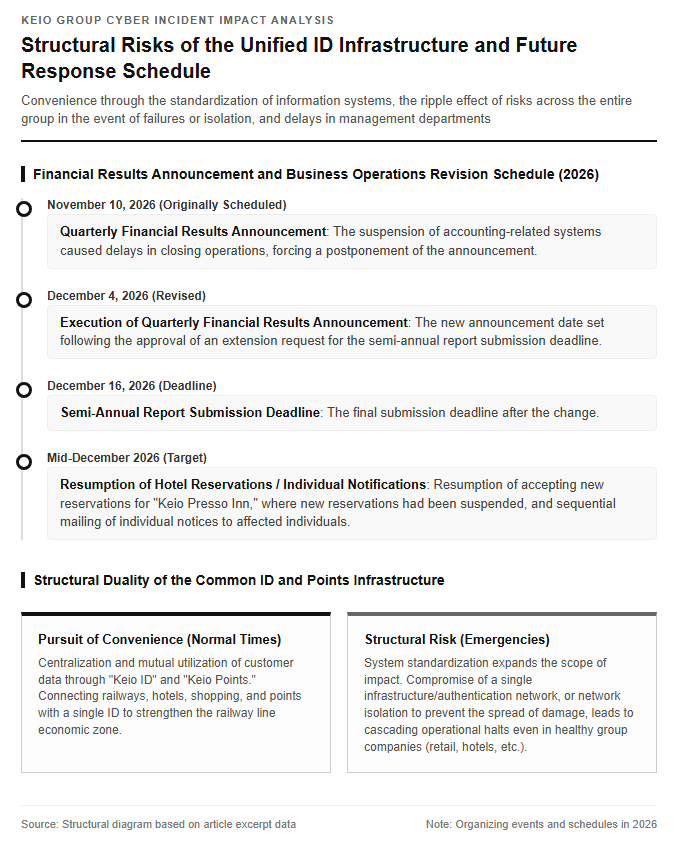
While improving convenience through digital transformation (DX), the sharing of systems inherently carries structural risks that expand the scope of impact when failures or security breaches occur. If a single common infrastructure or authentication network is attacked—or if the network is disconnected to prevent the spread of damage—even healthy group companies get dragged in and have their operations halted.
The damage this time goes beyond a single system failure, demonstrating to society how crucial it is to manage security at the “joints” when diversified companies advance shared infrastructure, and how important it is to calculate the scope of impact during a disconnection.
Future Outlook and Challenges for Corporate Defense
Future Response Schedule, Including Postponement of Financial Results and Individual Notifications
The impact of the system shutdown caused by the cyberattack extended beyond field operations to the company’s management and administrative functions. Due to the failure of accounting-related systems at Keio Corporation and its consolidated subsidiaries, delays occurred in financial closing processes, prompting an announcement regarding the postponement of the quarterly earnings release originally scheduled for November 10, 2026. Subsequently, an application to extend the filing deadline for the semi-annual report was approved, rescheduling the earnings release to December 4, 2026, and the filing deadline to December 16.
On the business front, Keio Presso Inn, which had suspended new bookings, aims to resume accepting reservations by around December 2026. Furthermore, individual notifications will be sent out sequentially to those affected by the data leak, or those for whom a potential leak has been identified, as soon as the facts are confirmed.
Centered around a task force, the company intends to identify IT governance issues and implement thorough measures to prevent recurrence, while receiving advice from legal professionals and external experts.
Supply Chain Defense and BCP in the Era of Mass Data Breaches
In 2026, personal information breaches involving listed companies have been occurring at an unprecedentedly high rate, creating an abnormal situation where large-scale leaks affecting millions of individuals are frequent. Common attack methods include exploiting vulnerabilities in VPN equipment, intrusions targeting supply chain weaknesses, and the widespread use of ransomware for extortion and data exposure.
Companies are required to do more than simply “prevent unauthorized intrusion”; they must also formulate Business Continuity Plans (BCP) to ensure rapid recovery of operations in the event of a breach. Specifically, it is essential to unify security standards across group companies and external contractors, implement the principle of least privilege for access rights, review data retention periods, and delete unnecessary data.
Building resilience—specifically, “how to contain and stop the impact when an incident occurs”—has become the most critical management challenge in the upcoming AI and digital era. The following image placeholder illustrates the concept of organizational security measures.
Reference Page
- [Keio Corporation] Notice and Apology Regarding Personal Information Leak Due to Ransomware Attack (November 24, 2026) https://www.keio.co.jp/news/update/news_release/news_release2026/pdf/nr20261124_newsrelease.pdf
- [Keio Corporation] Notice and Apology Regarding System Failure Due to Ransomware Attack (September 26, 2026) https://www.keio.co.jp/news/update/announce/nr260926v13404/
- [National Police Agency] Threat Situation in Cyberspace Surrounding the First Half of 2026 https://www.npa.go.jp/publications/statistics/cybersecurity/data/R7kami/R07_kami_cyber_jyosei.pdf
- [Ministry of Economy, Trade and Industry] Policy Guidelines (Draft) on the Establishment of a Security Measure Evaluation System for Strengthening Supply Chains https://www.meti.go.jp/press/2025/12/20251226001/20251226001.html
[#KeioCorporation #PersonalInformationLeak #Ransomware #Cybersecurity #DXStrategy #RiskManagement #BCP #DataGovernance]
コメント