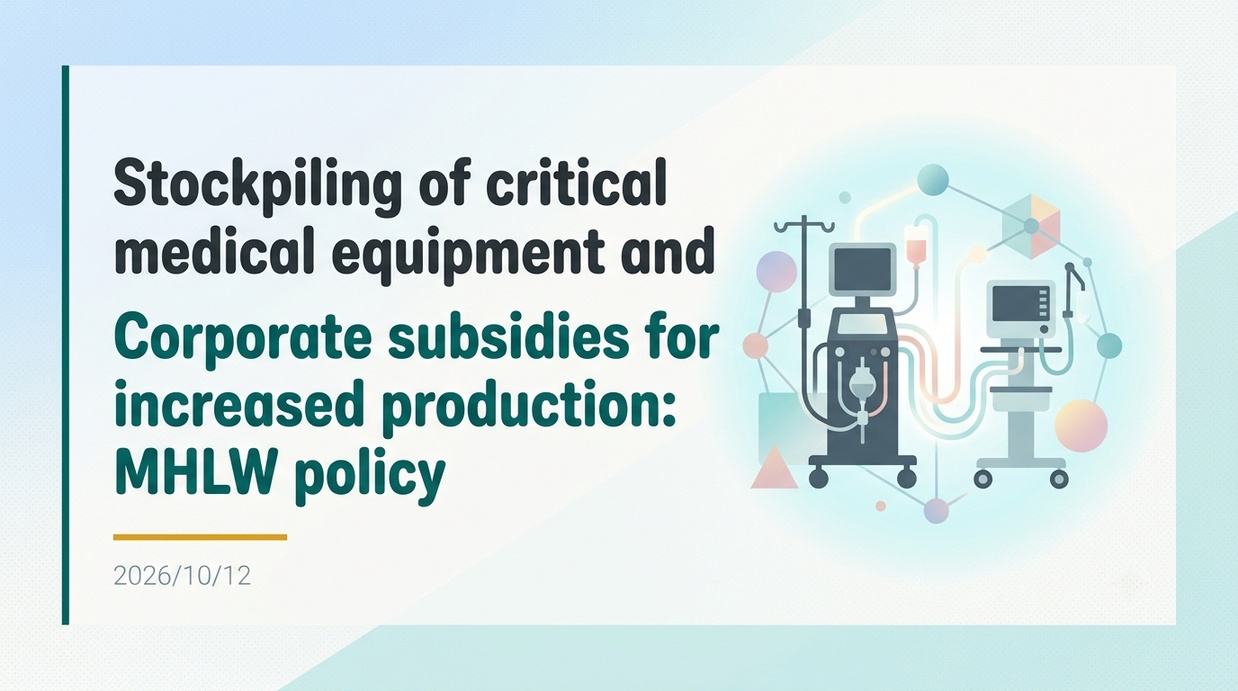
The Ministry of Health, Labour and Welfare (MHLW) has formulated a new policy to subsidize costs incurred by private companies for increasing domestic production and stockpiling essential life-support medical devices, such as extracorporeal membrane oxygenation (ECMO) systems and ventilators, to ensure a stable supply. Amid growing risks of overseas reliance for medical devices and export restrictions on raw materials, the move aims to promote the resilience of the domestic supply chain from the perspective of economic security.
- Key Policy Points and Support Measures for Increased Production and Stockpiling
- Designation and Selection Criteria for Medical Devices for Ensuring Stable Supply
- High Overseas Dependency in Medical Devices and the Rare Earth Issue
- Manifestation of Geopolitical Risks and Strengthening of Domestic Supply Chains
- The Impact of Capital Investment and BCP Formulation by Medical Device Manufacturers
- Upcoming Schedule and Challenges Closely Watched by the Market and the Field
Key Policy Points and Support Measures for Increased Production and Stockpiling
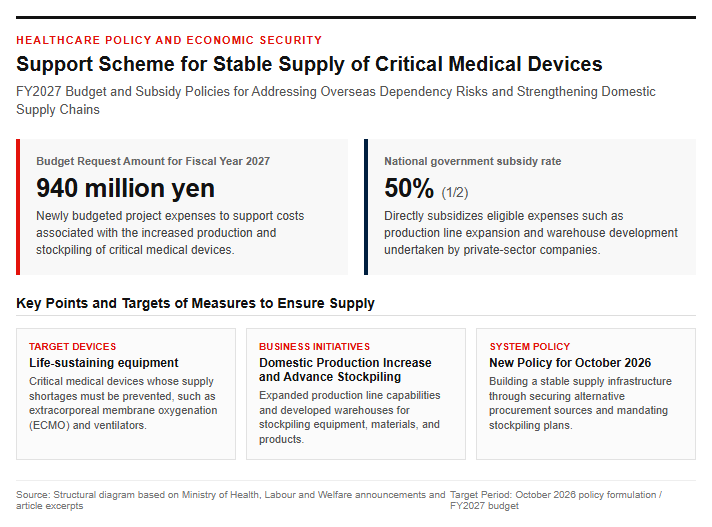
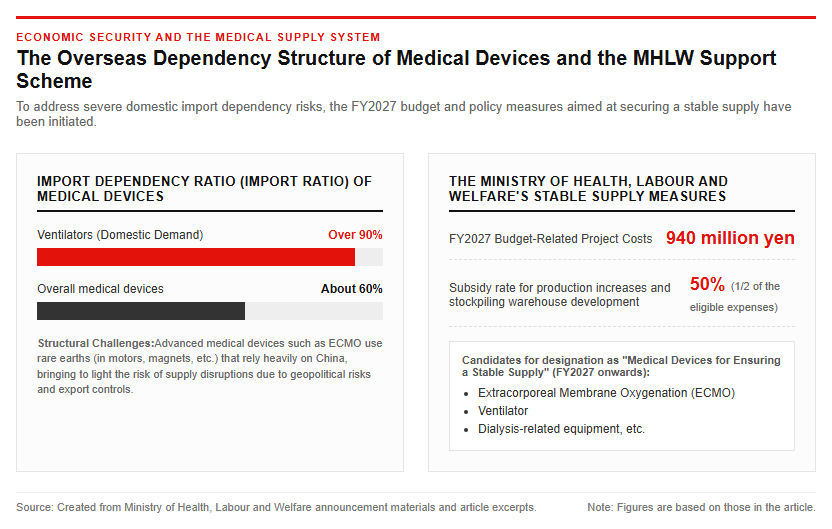
In October 2026, the Ministry of Health, Labour and Welfare (MHLW) set out to establish a comprehensive, stable supply system to prevent shortages of medical devices directly linked to people’s lives and health. To ensure that demand can be met even during infectious disease pandemics or sudden changes in the international situation, the ministry plans to require businesses to secure alternative procurement sources and formulate stockpiling plans during normal times, while publicly supporting their initiatives. Specifically, if domestic manufacturers and distributors expand the capabilities of their production lines for increased output or develop warehouses necessary for the advance stockpiling of equipment, materials, and products, the government will establish a mechanism to directly subsidize half (50%) of the eligible costs. To launch this initiative, the MHLW newly requested 940 million yen in related project expenses in its fiscal year 2027 budget request. The measure is attracting widespread attention as a policy to prevent supply bottlenecks in medical settings and build a stable provision foundation.
Designation and Selection Criteria for Medical Devices for Ensuring Stable Supply
Under this new initiative, a system will be newly established to designate items with a high risk that a supply disruption could lead to the worsening of a patient’s condition or death as “Medical Devices for Ensuring Stable Supply” (tentative name). The Ministry of Health, Labour and Welfare plans to establish an expert review committee consisting of academics and medical professionals in fiscal 2027, and to select specific items for designation through hearings and other surveys of manufacturers and distributors. When making designations, objective criteria will be used for judgment, such as the severity and impact of a supply shortage on patients and whether alternative products exist domestically. Prominent candidates for designation include extracorporeal membrane oxygenation (ECMO) systems, referred to as the “last resort” in the treatment of patients with severe respiratory failure, ventilators essential for life support, and dialysis-related equipment that supports dialysis treatment. Following designation, plans are in place to sequentially promote the development of alternative procurement routes and the compilation of alternative product lists.
Structural Risks of Foreign Dependence and Economic Security
High Overseas Dependency in Medical Devices and the Rare Earth Issue
Medical devices used in Japanese medical settings suffer from a structural vulnerability, relying on overseas imports for approximately 60% of the total. In particular, the reality is that for ventilators, which are highly urgent in treatment settings, over 90% of domestic demand depends on imports from overseas. Furthermore, in advanced medical devices such as ECMOs used for treating severely ill patients, rare earths are used in critical components inside the devices, such as motors and magnets. The global supply chain for these rare earths has a high degree of dependence on China, and the structure of relying heavily on specific countries or regions for raw material procurement significantly increases the risk of disruption during a crisis. From raw materials to finished products, the impact that the fragmentation of the international supply chain has on national healthcare is extremely large.
Manifestation of Geopolitical Risks and Strengthening of Domestic Supply Chains
Due to recent increases in geopolitical risks and uncertainty in the international situation, the risk of export controls on specific equipment and materials is becoming a reality. In addition to China’s moves to tighten export controls on rare earths, there are multifaceted concerns, such as supply instability for petroleum-related chemical products and medical supplies due to the intensifying situation in the Middle East. Furthermore, there is the bitter lesson from the past global COVID-19 pandemic, when protectionist measures in various countries prioritized domestic supply, resulting in export restrictions to importing countries and a fierce scramble for resources. Linking with the framework of the Economic Security Promotion Act advanced by the government, establishing “health security” that does not rely excessively on specific countries or specific raw materials, alongside maintaining and strengthening domestic production capacity, has become an urgent priority.
Ripple Effects on Corporate Management and Future Outlook
The Impact of Capital Investment and BCP Formulation by Medical Device Manufacturers
The creation of a government subsidization program covering half of the costs will strongly drive medical device manufacturers and related suppliers to expand their production capacity and rebuild their Business Continuity Plans (BCPs). Since the burden of initial investment—such as the automation of production lines, the construction and renovation of domestic plants, and the securing of stockpiling warehouses—will be significantly reduced, it is expected to spur not only existing manufacturers but also market entry from other industries and technological collaborations. Additionally, operators will be required to make strategic shifts, such as multi-sourcing raw material and component suppliers, increasing the ratio of production at domestic manufacturing facilities, and securing optimal inventory levels for emergencies. This is projected to advance a shift from conventional cost-prioritized supply chains to security-oriented management models with enhanced risk resilience.
Upcoming Schedule and Challenges Closely Watched by the Market and the Field
The Ministry of Health, Labour and Welfare plans to establish an expert review committee and conduct fact-finding surveys through fiscal 2027 to finalize specific target devices and the details of subsidy conditions. Moving forward, in addition to direct budgetary measures such as production increase support and stockpile subsidies, the government will simultaneously implement visualization measures for demand and inventory utilizing data infrastructure such as the Emergency Medical Information System (EMIS) and the G-MIS (Gathering-based Medical Information System). Meanwhile, adjusting for increased product costs associated with returning to domestic production and maintaining excess inventories in relation to the public medical insurance system and insurance reimbursement prices is emerging as a medium- to long-term management challenge. A key point to watch will be whether medical institutions, businesses, and the administration can work together to harmonize stable supply with economic efficiency and build a sustainable medical delivery system.
Reference page
- [Ministry of Health, Labour and Welfare] Ensuring the Stable Supply of Medical Devices, etc. and Supply Chain Measures https://www.mhlw.go.jp/
- [Cabinet Office] Stable Provision of Specified Critical Infrastructure Services under the Economic Security Promotion Act [suspicious link removed]
【#EconomicSecurity #MedicalDevices #MinistryOfHealthLabourAndWelfare #SupplyChain #ECMO #Ventilators #MedicalBusiness #StockpilingSupport】

コメント