Dell Technologies has expanded its collaboration with AMD, introducing the new “Dell PowerEdge M8825” AI server, which scales from a single node to a full-rack size. The background to this includes a surge in computing demand driven by the proliferation of autonomous AI agents, as well as the need to optimize deployment costs and operational design in on-premises environments.
- Key Takeaway: An AI server infrastructure scaling from a single node to rack scale
- Technological Advancements of the PowerEdge M8825 Brought by Air-Cooled High-Density Design
- An Approach to Incremental Scaling via Modular Configurations and Pre-Validated Infrastructure
- Market Realities Surrounding Memory Price Surges and AI Data Center Construction
- The Impact of the Large-scale Rack Configuration Helios and Context Optimization
- Future Outlook and Points of Interest: Production AI Operations in In-House Environments and a Multipolar Future
Key Takeaway: An AI server infrastructure scaling from a single node to rack scale
On November 18, 2026, coinciding with SUPERCOMPUTING 2026 (SC26) held in the United States, Dell Technologies announced a major expansion of its AI infrastructure solutions in collaboration with AMD. The newly introduced offerings include the air-cooled high-density server “Dell PowerEdge M8825,” the expanded modular configuration “Dell AI Platform with AMD,” and the “AMD Helios Rack-scale Solution from Dell,” designed for large-scale AI processing.
In conventional AI infrastructure deployments, it has frequently been necessary to re-design infrastructure between small-scale single-node configurations for Proof of Concept (PoC) and large-scale cluster configurations used in production. With this announcement, enterprises gain a comprehensive deployment path that allows them to start from a single compute node and scale up incrementally to a full-rack size under the same design philosophy, without wasting their investments or configuration assets. The diagram below shows an example configuration of an infrastructure platform that continuously expands from a small start to a rack scale.
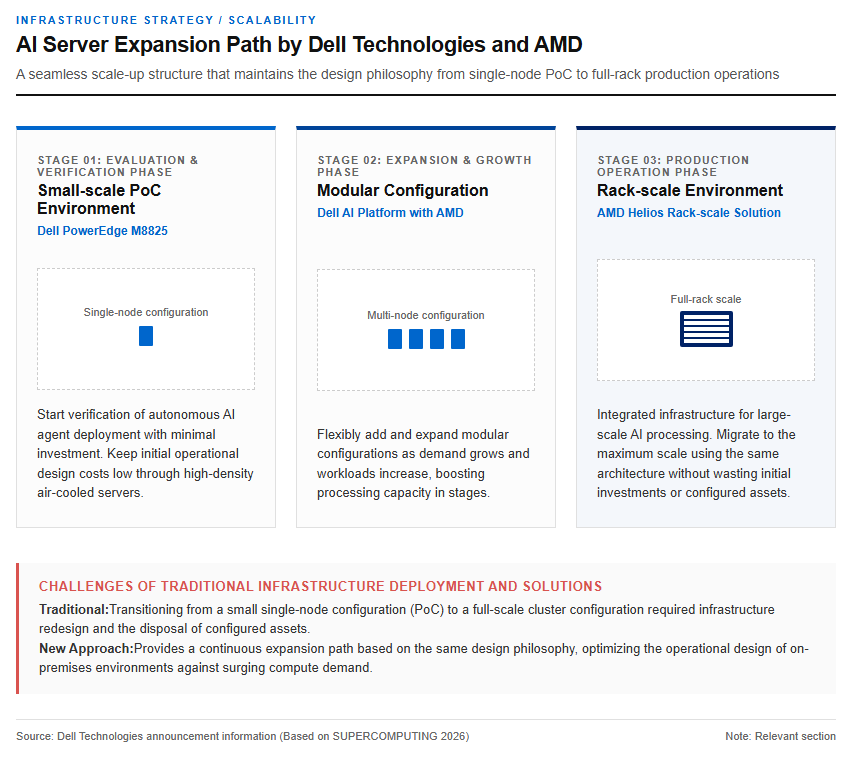
Going beyond a mere component-spec competition for individual CPUs or GPUs, Dell and AMD are delivering servers, networking, storage, and AMD’s open software platform ROCm as an integrated, pre-validated infrastructure. This aims to dramatically eliminate the complexity of procurement and operations, significantly shortening the time it takes for enterprises to put AI into production.
Technological Advancements of the PowerEdge M8825 Brought by Air-Cooled High-Density Design
The newly introduced “Dell PowerEdge M8825” is an air-cooled server powered by AMD EPYC processors, achieving both high-density computing performance and practical data center operations. A major feature of this product is its extremely high CPU density of up to 512 cores and 1,024 threads per node, enabling deployment without major renovations to existing server rack environments.
As the use of generative AI evolves from simple chatbots to agentic AI that autonomously executes tasks, the computing load on general-purpose CPUs—responsible not only for GPU-based inference processing but also for task interpretation, external tool invocation, and data formatting—is increasing remarkably. The PowerEdge M8825 features highly optimized internal airflow, power delivery, and thermal design, supplying enterprises with high-density CPU processing capabilities within an air-cooled environment.
For many enterprises, the introduction of liquid cooling facilities presents high hurdles, such as plumbing work and water usage management. However, the provision of a high-density air-cooled platform enables a smooth transition leveraging existing facility conditions. Amid limitations on data center floor space and power, this machine, which increases processing density per unit, serves as a powerful option for simultaneously achieving infrastructure consolidation and operational cost reduction.
Evolution and Challenges of Infrastructure Demanded by Agentic AI
An Approach to Incremental Scaling via Modular Configurations and Pre-Validated Infrastructure
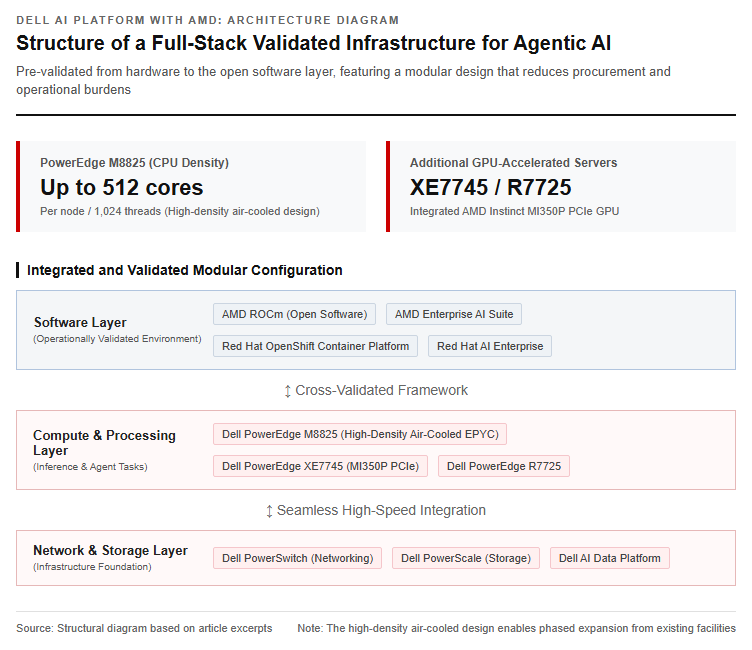
The “Dell AI Platform with AMD” is a full-stack, pre-validated solution integrating Dell PowerEdge servers, Dell PowerSwitch networking, Dell PowerScale storage, and the Dell AI Data Platform. In this enhancement, “Dell PowerEdge XE7745” and “R7725” servers equipped with AMD Instinct MI350P PCIe GPUs have been newly added, enabling even more flexible modular configurations.
The strength of this platform lies in the completion of mutual validation spanning not only the hardware but also the software layer. Operational validation with the AMD Enterprise AI Suite, Red Hat OpenShift Container Platform, and Red Hat AI Enterprise has already been completed, helping to prevent troubles caused by driver or library mismatches. Enterprises can selectively add GPUs, compute nodes, storage, and networking as needed while maintaining the exact same operational framework.
In conventional AI development, every time the scale expanded, an individually optimized siloed environment was formed, leading to operational complexity. By adopting a pre-tested modular foundation, it is possible to avoid rebuilding from scratch and safely and rapidly scale to production operational scale. The following architectural diagram shows the overall picture of a modular design where compute and storage work together seamlessly.
Market Realities Surrounding Memory Price Surges and AI Data Center Construction
While the demand for AI infrastructure is rapidly surging worldwide, the procurement environment and cost burdens surrounding enterprises are becoming increasingly severe. In the server market, severe supply-demand imbalances for DRAM and NAND flash memory have emerged, and memory prices have risen by over 400% since early 2024. As a result, server manufacturers have requested price increases of up to 45% from customers at the delivery stage after contracts were signed, creating major uncertainties in the procurement costs of AI servers.
Particularly in CPU-based server nodes, where the cost ratio of memory is high, cases have been reported where prices have jumped to more than three times original estimates. Price increases of 20% to 30% are also becoming established for GPU servers, creating a situation where large-scale buyers such as major financial institutions, quantitative trading firms, and telecommunications companies are forced to secure additional funding and review their investment plans.
In such an era of price surges and supply constraints, cost management becomes difficult with methods that simply buy up individual semiconductors and servers. Pre-tested infrastructure foundations and aggregation via high-density servers promoted by Dell and AMD are attracting strong attention as realistic solutions to suppress footprint and power costs while optimizing application licensing costs and operational efforts.
Ecosystem and Deployment Strategy Supporting Corporate AI Utilization
The Impact of the Large-scale Rack Configuration Helios and Context Optimization
Provided for organizations requiring the highest-end large-scale computing environment is the “AMD Helios Rack-scale Solution from Dell.” This solution is equipped with 72 AMD Instinct MI455X GPUs and boasts overwhelming computational performance of up to 2.9 exaflops. Integrated with Dell PowerRack and cutting-edge networking and storage technologies, it enables all-in-one deployment from a single vendor.
Furthermore, in terms of software and data management, integration with the “Dell AI Data Platform” plays a crucial role. When agentic AI performs complex reasoning, the use of technologies such as the “Agentic Data Gateway”—which unitarily processes unstructured data scattered within the company—has been proven to reduce token consumption by up to 76% and significantly improve response accuracy.
The combination of Instinct GPUs featuring high-capacity and high-bandwidth HBM3E memory and an optimized data foundation significantly shortens the “Time to First Token” from when a user sends a request until the first generated result is returned. In internal business automation and real-time customer service, this improvement in response speed becomes a factor that greatly enhances the experiential value of services and operational efficiency.
Future Outlook and Points of Interest: Production AI Operations in In-House Environments and a Multipolar Future
The future enterprise AI market will fully transition from an oligopoly by specific accelerator vendors to a multipolar era where optimal hardware and software are combined according to application and cost requirements. The expansion of collaboration between Dell and AMD is an important initiative that simultaneously provides customer companies with flexible choices unconstrained by a single specification and enterprise-grade reliability.
As corporate AI utilization shifts from experimental PoCs to production operations handling actual business processes, the importance of on-premises and local environments capable of ensuring data confidentiality, security, and data sovereignty is further increasing. Full-scale implementations in academic institutions and infrastructure companies are following one after another, such as the establishment of the “Sovereign AI Innovation Lab (SAIL)” with the University of Cambridge in the UK, and its adoption by major telecommunications carrier AT&T for a model training infrastructure exceeding 1 trillion tokens.
When Japanese companies procure and build AI infrastructure moving forward, it is essential to pre-verify four conditions: peak CPU and GPU loads, the memory bandwidth required by the model, the time to first token, and power and cooling capacity per rack. Combining an approach of a small start from a single node and the phased expansion of a verified foundation will be a sure path to gaining sustainable competitive advantage in the volatile AI era.
Reference Page
- 【Dell Technologies Official Blog】https://www.dell.com/en-us/blog/dell-technologies-and-amd-offer-more-ways-to-deploy-ai-from-first-node-to-full-rack
- 【Dell Technologies Press Release】https://prtimes.jp/main/html/rd/p/000000442.000025237.html
【#Dell #AMD #AIServer #AIInfrastructure #DataCenter #PowerEdge】


コメント