Reiwa Accounting Holdings has announced an upward revision of its full-year ordinary profit forecast for the fiscal year ending March 2027 by 13%, increasing it to 2.44 billion yen and marking a new record high. This is driven by a significant improvement in project completion speed due to the promotion of operational efficiency compared to the previous year, as well as a shift toward a high-gross-margin business structure.
- 13% increase in ordinary profit and 7th consecutive year of record-high profits
- Dividend increase announcement and achievement of a high annual dividend yield of over 4.4%
- Acceleration of Project Processing Through Operational Efficiency and AI Tool Adoption
- A Subscription-Based Business Model Boasting a Contract Renewal Rate Exceeding 99%
- The Roadmap to 100 Billion Yen Market Capitalization Outlined in the Medium-Term Management Plan
- Stock Price Trends, Risks, and Outlook for Mid-to-Long-Term Investment
13% increase in ordinary profit and 7th consecutive year of record-high profits
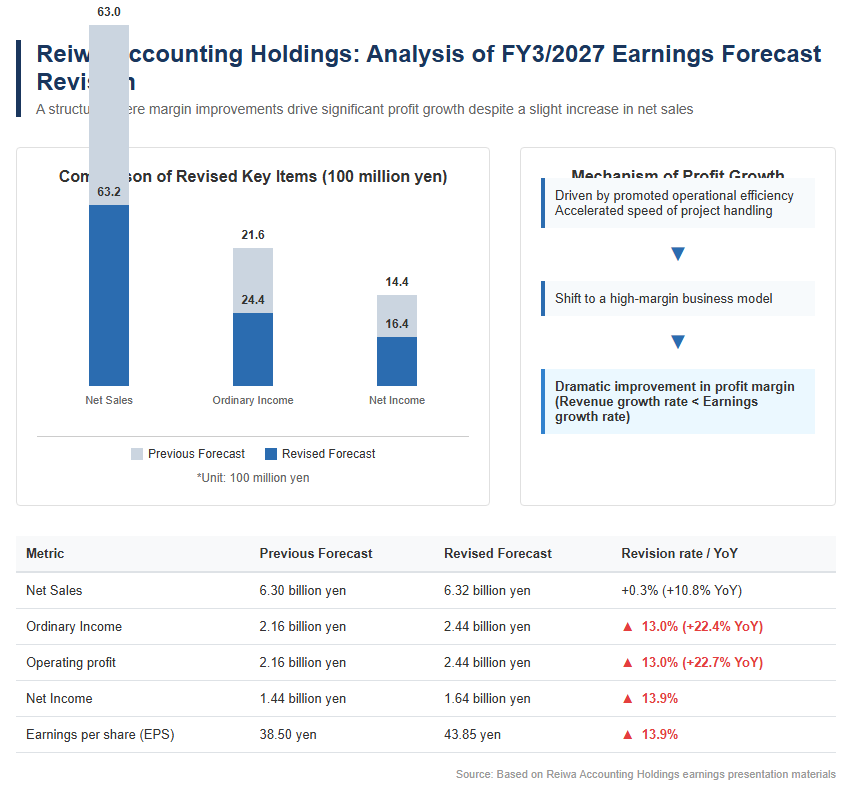
At 11:30 AM on November 24, 2026, Reiwa Accounting Holdings (Ticker: 296A), listed on the TSE Growth Market, announced an upward revision to its consolidated full-year earnings forecast for the fiscal year ending March 2027. The consolidated ordinary profit forecast, previously projected at 2.16 billion yen, has been raised by 13.0% to 2.44 billion yen, and is highly likely to result in a 22.4% increase compared to the previous year. This achievement further extends the company’s record of breaking its own record-high profits for seven consecutive periods. Simultaneously, consolidated operating profit was also revised upward by 13.0% from the previous forecast of 2.16 billion yen to 2.44 billion yen, with a projected double-digit increase of 22.7% over the previous year.
On the other hand, the sales forecast saw only a slight upward revision from the previous 6.3 billion yen to 6.32 billion yen (a 10.8% increase year-on-year, with a revision rate of 0.3%), making it clear that this revision is driven more by improved profit margins than by sales growth. Net income attributable to owners of the parent was also raised by 13.9% from 1.44 billion yen to 1.64 billion yen, and earnings per share (EPS) expanded from 38.50 yen to 43.85 yen. According to the company’s estimates, consolidated ordinary profit for the second half (from October 2026 to March 2027) is calculated to be 1.37 billion yen (a 17.3% increase year-on-year), indicating that the momentum for profit expansion is expected to strengthen even further heading into the second half. The following figure shows the trends in the key figures for this earnings forecast revision.
Dividend increase announcement and achievement of a high annual dividend yield of over 4.4%
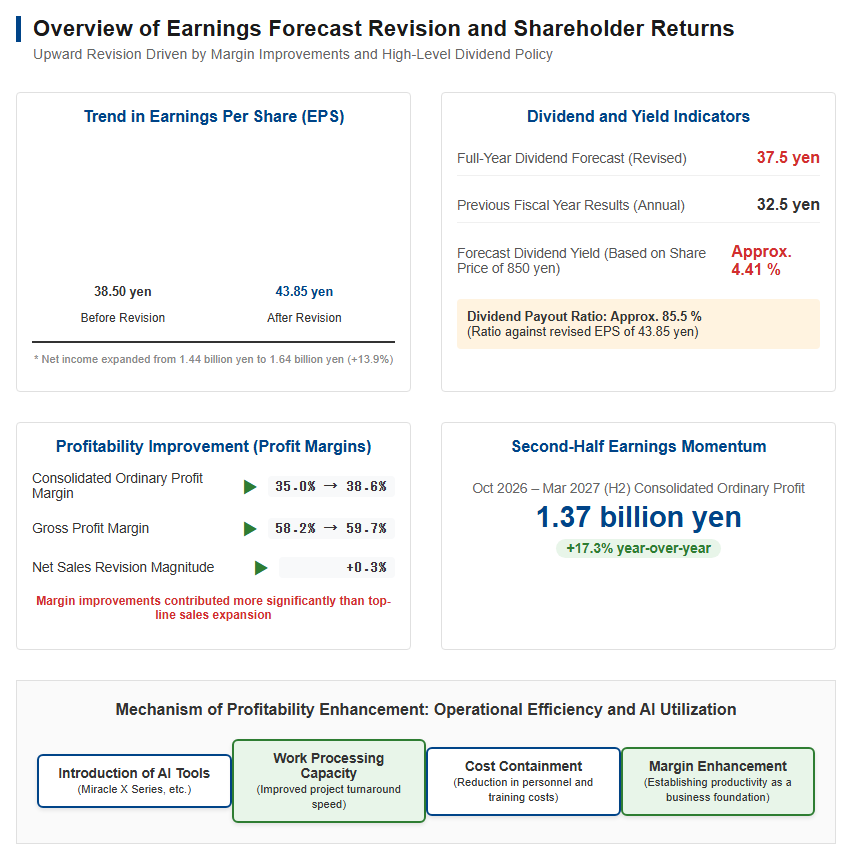
Against the backdrop of strong earnings trends, the company also announced an upward revision to its dividend forecast based on its shareholder return policy. The year-end dividend forecast for the fiscal year ending March 2027 was raised by 1.0 yen from the previous 20.0 yen to 21.0 yen, bringing the total annual dividend forecast to 37.5 yen when combined with the 16.5 yen interim dividend for which rights have already been established. This is a 5.0 yen increase compared to the previous year’s annual dividend of 32.5 yen (which included a 30.0 yen ordinary dividend and a 2.5 yen commemorative dividend), clearly signaling the company’s stance on shareholder returns. The company has established a policy of a basic dividend payout ratio of approximately 80% of consolidated net income, with an additional 1% to 10% added upon consideration of financial status and other factors; the dividend payout ratio against the revised EPS of 43.85 yen reaches approximately 85.5%.
On the stock market on November 24, 2026, when the announcement was made, the company’s closing share price rose by 28 yen (3.41%) from the previous day to 850 yen. Based on this closing price of 850 yen, the projected dividend yield is approximately 4.41%, making it even more attractive compared to approximately 4.29% based on the previous forecast. The company transitioned to a twice-yearly dividend system (interim and year-end) starting from the fiscal year ending March 2026, and its continuous trend of dividend increases backed by solid financial results has been highly praised, particularly by individual investors. Supported by a robust business model largely immune to fluctuations in the external environment, the company has clearly demonstrated a stance of returning the majority of its profits to shareholders.
Background of Management and Business Structures Enabling Earnings Outperformance
Acceleration of Project Processing Through Operational Efficiency and AI Tool Adoption
What is particularly noteworthy about this upward revision in earnings is that while the upward revision in net sales remained modest at 0.3%, the forecasts for operating income and ordinary income were raised by a significant 13.0%. The primary factor cited by management for this surge in profit margins is the company-wide operational efficiency initiatives promoted since the previous year. As a result of boosting potential operational processing capacity on the front lines, project processing speed has dramatically improved, establishing a system capable of processing and recording operations—including short-term projects—at a pace exceeding expectations. Consequently, the consolidated ordinary income margin is projected to rise significantly from the previous 35.0% to 38.6%, and the gross profit margin from 58.2% to 59.7%.
Furthermore, the active use of AI tools within the group has been a driving force in improving profitability. The introduction of automation tools, starting with the AI asset judgment solution “Miracle X Series” developed by the subsidiary Miracle Accounting Inc. established in April 2025, has successfully curbed labor and training costs and reduced working hours in the group’s consulting operations. A major strength is that this goes beyond mere cost reduction, functioning instead as a growth foundation for business expansion driven by productivity improvements. The diagram below outlines the mechanism of the company’s operational efficiency and margin improvement.
A Subscription-Based Business Model Boasting a Contract Renewal Rate Exceeding 99%
Reiwa Accounting Holdings was established in August 2004 and is an accounting and professional services firm headquartered in Nihonbashi, Chuo-ku, Tokyo. The company’s greatest strengths lie in its robust customer base, centered on large enterprise groups, and its extremely high stability of earnings. In its core consulting business, “Long-term services”—the continuous undertaking of clients’ routine accounting practices and financial closing operations—account for more than 80% of net sales (80.7% for the fiscal year ended March 2026), establishing a stock-type revenue structure with automatically renewing contracts. The churn rate remains at an extremely low level, with a contract retention rate exceeding 99%.
The company follows a strategy of expanding its scope of services and horizontally deploying them to other departments and affiliates within a group after initiating business with a single large enterprise group. As of April 2026, the number of client groups has reached 179, building high barriers to entry in the highly specialized, brainpower-intensive service sector. By serving as “corporate soft infrastructure” that is resistant to external environmental factors such as rising crude oil prices, exchange rate fluctuations, and economic recessions, the company supports its sustainable high profit margins and stable cash generation capabilities.
Mid-to-Long-Term Growth Strategy and Key Points for Investors
The Roadmap to 100 Billion Yen Market Capitalization Outlined in the Medium-Term Management Plan
The company announced an ambitious medium-term management plan in August 2026, setting clear growth targets aimed at enhancing mid-to-long-term corporate value. For the final fiscal year ending March 2031, it aims to achieve consolidated net sales of 30 billion yen (compared to 5.75 billion yen for the fiscal year ended March 2026) and net income of 10 billion yen (compared to 1.421 billion yen for the same period). The market capitalization target has drawn particular attention from the stock market, with the company setting a leapfrog growth line of 100 billion yen by the fiscal year ending March 2029 and 200 billion yen by the fiscal year ending March 2031. As of November 2026, market capitalization was approximately 30.6 billion yen, which is perceived as an indicator of significant future potential for stock price growth.
To realize these goals, the company is looking toward a future market segment change to the Tokyo Stock Exchange Prime Market and an initial public offering (IPO) for its subsidiary, Miracle Keiri, which provides AI solutions. Furthermore, the company will strengthen its external system sales business—combining the knowledge gained through consulting operations with its in-house developed AI products—and pursue business synergies with Reiwa Human First Co., Ltd. (RHF), which provides payroll and human resource services. The company aims to build a cyclical revenue model that balances aggressive growth investment while maintaining a high dividend payout ratio.
Stock Price Trends, Risks, and Outlook for Mid-to-Long-Term Investment
Looking at the company’s stock price trends in the equity market, the price has been on a downward trend since recording a 52-week high of 1,248 yen on September 18, 2026, adjusting to 822 yen by November 20. Because the upward revision and dividend increase announced on November 24 occurred at 11:30 AM during trading hours, a certain degree of the positive news has already been priced into the day’s closing price of 850 yen. In the short term, the focus will be on recovering to the 900-yen threshold and confirming business progress heading into the second-half financial results. Regarding valuation, the forecasted PER relative to the revised earnings per share is approximately 19.4x, and the PBR is at a high level in the 11x range, indicating a stock price level that incorporates high market expectations for growth.
Future considerations and risk factors include the procurement and retention of specialized personnel. The company’s highly profitable structure depends on the productivity of highly skilled professionals, including certified public accountants; any slowdown in recruitment or outflow of talent could impact the speed of project execution. On the other hand, the revision of accounting rules scheduled for 2027 and the expanding demand for accounting DX (digital transformation) within corporations will serve as significant tailwinds for the company. Against the backdrop of a highly profitable structure characterized by a high dividend yield exceeding 4.4% and continuous record-high profits, the company is expected to strengthen its mid-to-long-term growth foundation and see a resurgence in market valuation.
Reference Pages
- [Reiwa Accounting Holdings Timely Disclosure Documents] https://www.release.tdnet.info/inbs/140120260421507584.pdf
- [Reiwa Accounting Holdings Company Profile] https://rw-ah.net/
[#ReiwaAH #EarningsUpwardRevision #RecordHighProfits #HighDividendStocks #AccountingConsulting]


コメント