Mitsubishi Motors has partnered with the University of Tokyo-based startup Highlanders to begin mass production of humanoid robots starting in 2027. Behind this lies a serious sense of labor shortage and a strategy to redefine Japanese manufacturing technology.
- Vertical integration of automotive technology and AI
- Performance of the 4th Generation Humanoid “N”
- The Challenge of Labor Shortages Facing Japan
- Mass production system based at the Kyoto factory
- Digitizing the “tacit knowledge” of skilled workers
- Big Tech and the Challenge of Chinese Players
- Transformation into a Service Robot Powerhouse
Vertical integration of automotive technology and AI
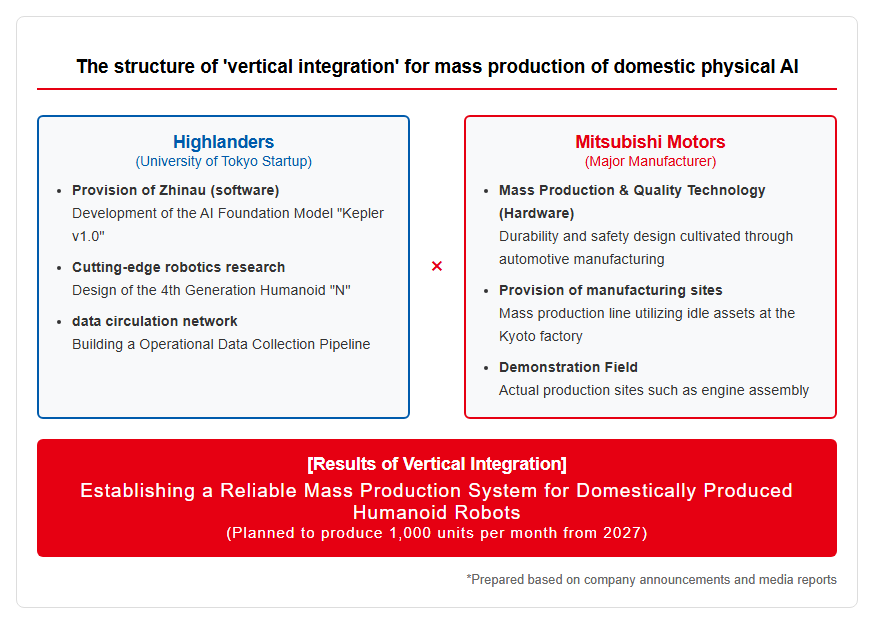
Mitsubishi Motors (7211. On July 9, 2026, T) signed a basic agreement (MOU) with Highlanders, a robotics startup originating from the University of Tokyo, regarding the joint development and mass production of AI-powered humanoid robots. The biggest feature of this partnership is the “vertical integration” between a startup conducting cutting-edge AI research and a major manufacturer with long-cultivated automotive mass production technology and quality control know-how. Chairman and CEO Takao Kato stated at a press conference that while overseas players such as the US and China are leading, he intends to accelerate the business with a sense of speed as the “first step” to achieve mass production in Japan. Specifically, starting with a small investment in May 2026, a strong cooperative framework will be built going forward, including additional investments. By applying advanced durability and safety design expertise cultivated in automobile manufacturing to robots, the company aims to establish domestic robots with “product reliability” that go beyond mere prototyping. Please refer to the diagram below.
Performance of the 4th Generation Humanoid “N”
At the core of the joint development is the fourth-generation humanoid robot “N” developed by Highlanders. This name carries meanings such as “Japan (Nippon),” “Humans (Ningen),” and “Wishes (Negai).” Its height and weight are designed to be close to those of humans, equipped with five-fingered hands, multiple vision systems, and the latest generation GPU. On the software side, it adopted its proprietary AI foundation model, ‘Kepler v1.0,’ as its brain. This model centers on a “world model” with 10 billion parameters, controlling joints about 100 times per second while predicting what will happen next in the real world. Notably, it is highly versatile enough to handle tools and pedals intended for humans as is. Furthermore, the implementation of a proprietary data pipeline called “Artery,” which collects anonymized data from mass-produced individuals and continuously smartens AI, is also underway.
The Challenge of Labor Shortages Facing Japan
Behind this grand project lies the serious social challenge Japan faces: an annual workforce reduction of about 900,000 people. According to recommendations from Mitsubishi Research Institute, although the macro labor shortage will be resolved by AI implementation through 2040, labor shortages will continue in fields involving “physical labor,” such as production and service jobs. CEO Kato pointed out that the shortage of workers at production sites is an “urgent issue,” and he has high expectations for the use of robots in complex manual processes where replacement with automated machines is difficult. Highlanders CEO Hiroya Masuoka set a vision to supply 900,000 robots annually to supplement Japan’s production capacity. This localization project includes not only efficiency improvements but also economic security significance for protecting Japan’s industrial base and technological sovereignty in a declining population.
A New Form of Management Strategy and Technological Succession
Mass production system based at the Kyoto factory
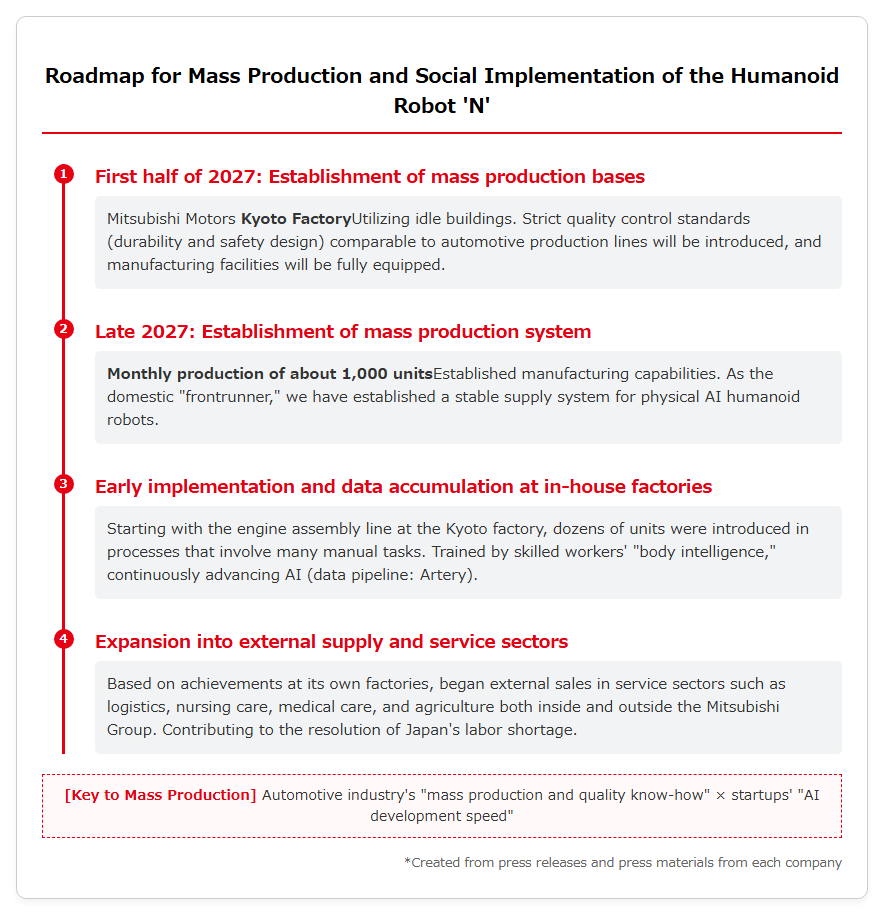
The two companies plan to use idle buildings at Mitsubishi Motors’ Kyoto Plant (Ukyo Ward, Kyoto City) to launch mass production lines for humanoid robots. The company aims to complete production facility setup in the first half of 2027 and establish a manufacturing capacity of about 1,000 units per month in the latter half of the same year. First, several dozen units will be trial-introduced in relatively small processes such as engine assembly lines within the company’s own factory, which involve a lot of manual work. Based on the operational data and know-how gained there, the company is considering expanding to several hundred units and supplying it externally outside the group. By applying the same strict quality control standards as automotive production lines to robot manufacturing, the aim is to achieve a low-cost, high-quality mass production system. Please refer to the diagram below.
Digitizing the “tacit knowledge” of skilled workers
Another major goal of this project is to efficiently pass on the “skilled craftsman’s know-how” that Japanese manufacturing is proud of. While conventional industrial robots excelled at simple, programmed repetitive tasks, the “N” equipped with physical AI can acquire the subtle movements of skilled workers through imitation and reinforcement learning. This means that ‘tacit knowledge’ and ‘body knowledge’ from the field, which were difficult to formalize, can be integrated into robots. Masuoka, CEO of Highlanders, points out that AI training requires vast real-world data and the sites where it can be operated, and by designating Mitsubishi Motors’ factories as ‘demonstration sites,’ he aims to drive rapid AI growth. Digitizing Japan’s high service quality and precise skills into data and reflecting them in robots will be key to building a unique competitive advantage that other countries find difficult to imitate.
Competitive Landscape and Japan’s Future
Big Tech and the Challenge of Chinese Players
Currently, the competition to develop humanoid robots is intensifying worldwide. In the US, big tech companies like Tesla and Nvidia, and in Europe, big tech companies and leading startups such as 1X Technologies, backed by OpenAI, are leading the way. In particular, China’s Unitree Robotics has begun to dominate the global market by launching robots priced as low as about 800,000 yen through in-house production of key components, leveraging overwhelming price competitiveness. In Japan, Japan Airlines (JAL) is also piloting Unitree’s products in airport operations, and the adoption of foreign-made hardware is progressing. In response, CEO Masuoka expressed confidence, saying, “The quality of Japanese manufacturing is our strength, and we can compete with the world’s big tech companies.” By combining the high reliability honed in the automotive industry with Japan’s unique detailed data, we aim to differentiate ourselves from leading overseas players.
Transformation into a Service Robot Powerhouse
Mitsubishi Motors’ initiative goes beyond mere factory automation and serves as a touchstone for Japan’s evolution from an “industrial robot powerhouse” to an “AI robot powerhouse.” According to estimates by Mitsubishi Research Institute, the global AI robotics market is expected to grow to a scale of 90 trillion yen by 2050, with the main focus shifting from traditional industrial to service-oriented applications. Mitsubishi Motors’ new medium- to long-term vision announced in May 2026 also highlights productivity improvement and structural transformation through AI/DX utilization, making the robotics business one of its symbolic projects. Going forward, based on the results at its own factories, the company plans to consider external sales across a wide range of service areas such as logistics, nursing care, and medical care. Whether Japan can once again build a world-leading industrial ecosystem by leveraging its cultivated high-quality manufacturing environment will be a key focus in the medium to long term.
[#三菱自動車 #ハイランダーズ #フィジカルAI #人型ロボット #ものづくり #経済安全保障 #スタートアップ #日本再興]


コメント