Japan Petroleum Exploration Corporation (JAPEX) has announced an ambitious management plan to quadruple U.S. crude oil and natural gas production over the next decade and also consider supplying it to Japan. Against the backdrop of rising geopolitical risks, we are entering a new phase toward stable energy supply.
- 1.1 Growth Targets and Massive Investments through Fiscal Year 2035
- 1.2 Largest Acquisition Ever and Entry of Operating Entities in the U.S.
- 2.1 Middle East Crisis and the Impact of the Strait of Hormuz Blockade
- 2.2 Transformation from Domestic Infrastructure Companies to Overseas Growth
- 3.1 The 2026 Midterm Elections and the Politics of Gasoline Prices
- 3.2 Supply Paradox: Crude Oil Quality and Infrastructure Constraints
- 4.1 Strengthening CCUS Business and Achievements by 2035
- 4.2 Management with Awareness of Capital Costs and Improvement of ROE
1.1 Growth Targets and Massive Investments through Fiscal Year 2035
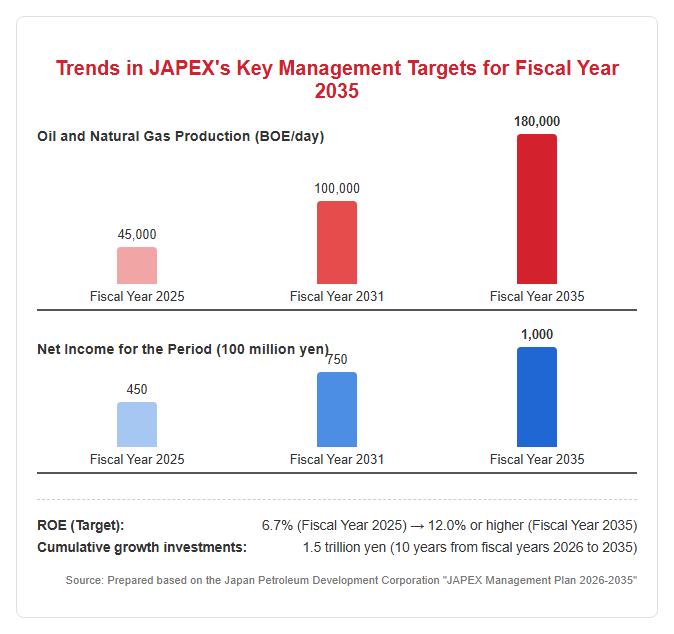
Japan Petroleum Development Corporation (JAPEX) announced its overwhelming growth scenario for the next decade in its “JAPEX Management Plan 2026-2035,” formulated in April 2026. The highlight of this plan is the ambitious goal to quadruple oil and natural gas production, currently around 45,000 barrels per day (oil equivalent), to 180,000 barrels per day by fiscal year 2035. To achieve this goal, the company has decided to make a massive growth investment totaling 1.5 trillion yen over the ten years from fiscal 2026 to 2035. Of this investment, more than half of the overseas oil development budget is expected to be allocated to the United States, making it clear that the U.S. will be the pillar of future revenue. The company positions fiscal year 2026 through fiscal year 2030 as a period for building its “core asset group” through a focus on overseas E&P (exploration, development, production) and CCUS (carbon capture and storage). From fiscal 2031 onward, we will actively contribute revenue from these assets, aiming for a net profit of 100 billion yen by fiscal 2035. Please refer to the diagram below.
1.2 Largest Acquisition Ever and Entry of Operating Entities in the U.S.
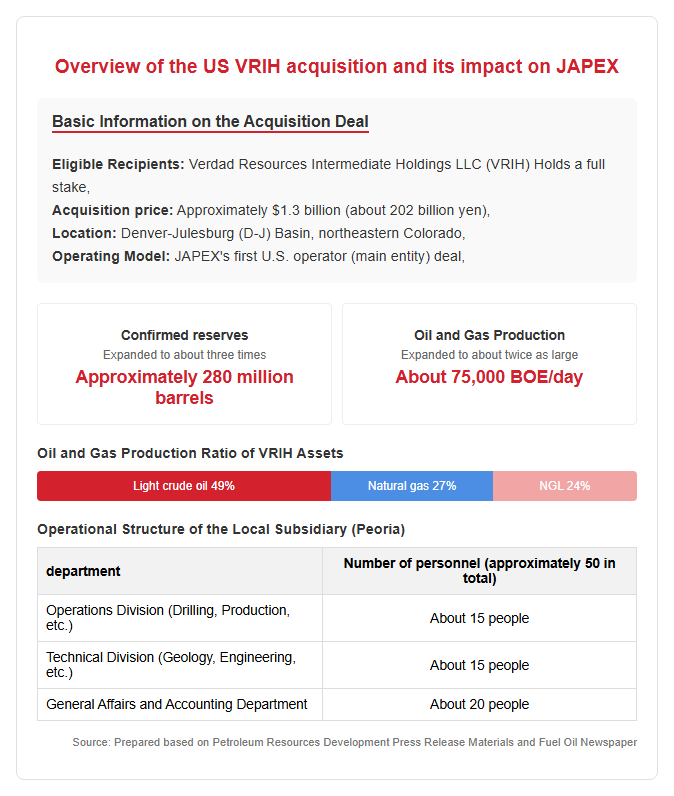
The foundation of this production increase plan is asset acquisition in the United States. JAPEX has decided to acquire a full stake in Burdad Resources Intermediate Holdings (VRIH), a U.S. tight oil and gas development company, for approximately $1.3 billion (approximately 202 billion yen). This acquisition amount will be the largest ever for the company. With this acquisition, the total proven reserves of JAPEX are expected to increase to approximately 280 million barrels, roughly tripling. Notably, JAPEX is participating in the project as an “operator” for the first time in the United States. Unlike previous participation as a non-operator (non-operator), by leading development and production in-house, it becomes possible to directly accumulate technology and expertise. VRIH’s assets are located in the Denver-Julesburg Basin in northeastern Colorado, with production ratios of 49% light crude oil, 27% natural gas, and 24% natural gas liquids (NGL). The company plans to take over development and operations through its local subsidiary, Peoria Resources, with a team of about 50 people, including the selling company’s operating staff. Please refer to the diagram below.
2. Background of the U.S. Shift: Energy Security and Geopolitical Risks
2.1 Middle East Crisis and the Impact of the Strait of Hormuz Blockade
Behind JAPEX’s accelerated expansion in the U.S. lies the growing geopolitical risks in the Middle East. The blockade and difficult passage of the Strait of Hormuz caused by the Iran crisis have reaffirmed the dangers of Middle East dependence on the global energy market, including Japan. Currently, the global market is rapidly increasing its reliance on U.S.-produced energy, with U.S. crude oil and petroleum product exports reaching a record high in April 2026. JPEX President Yamashita stated that the importance of ensuring a stable supply of fossil fuels for national security has been reaffirmed. The United States has transformed into the world’s largest oil producer following the shale revolution, playing a role in filling the gap in Middle Eastern energy supply. However, the U.S. supply capacity also relies on inventory reduction, raising concerns about sustainability. Under such circumstances, it is highly significant for Japanese companies to secure U.S. interests and participate in operations in terms of energy security. The company positions its latest strategy as reflecting a global shift to decarbonize while addressing realistic energy demands.
2.2 Transformation from Domestic Infrastructure Companies to Overseas Growth
Compared to its competitor INPEX, JAPEX has traditionally been a resource-driven company with a domestic gas supply network, focusing more on infrastructure. Our domestic foundation, including oil and gas fields in Niigata and Hokkaido, as well as high-pressure gas pipeline networks, has supported our earnings, but we faced the challenge of having limited growth in the domestic market alone. Previously, we were involved in an oil sands project in Canada, but due to low oil prices and strengthened resistance to decarbonization, we ended the business in 2021 and were forced to restructure our portfolio. Currently, JAPEX is undergoing a major transformation from a “domestic-focused company” to a “company strengthening overseas growth.” The core regions are designated as the United States, Norway, and Indonesia, with the U.S. particularly aiming to acquire future gas assets and collaborate with freeport LNG projects based on revenues from tight oil development. Leveraging domestic expertise in gas infrastructure and underground storage, the core of the company’s new growth strategy is to strengthen its overseas E&P (exploration and development) business.
3. Barriers to Japanese Supply: U.S. Export Controls and Political Uncertainty
3.1 The 2026 Midterm Elections and the Politics of Gasoline Prices
While ramp-up production in the U.S. appears to be progressing, political risks are casting a shadow. Ahead of the U.S. midterm elections scheduled for November 2026, the surge in gasoline prices has become a serious political issue in the United States. For the U.S. government, suppressing fuel prices directly benefits voter support, so some lawmakers and media have called for a “halt on exports” and “total volume controls” of crude oil and petroleum products to lower domestic prices. In 2022, under the Biden administration, similar export controls were considered, and in times of crisis, political decisions may take precedence over economic rationality. The Trump administration is centering on “energy dominance,” which aims to increase domestic fossil fuel production and expand exports, but if domestic inventory declines and price surges are not curbed, pressure to prioritize domestic protection over supplying allies is expected to intensify. Even if JAPEX secures its interests, the risk of supply to Japan being restricted due to the U.S. state of emergency or regulatory enforcement is an uncertainty that investors and policymakers must closely monitor.
3.2 Supply Paradox: Crude Oil Quality and Infrastructure Constraints
There are also physical constraints when supplying U.S. crude oil to Japan. First, crude oil (shale oil) produced in the United States is mainly “lightweight,” but U.S. refineries and many facilities in Asia are designed to process Middle Eastern “medium and heavy” oil. This quality mismatch has led the U.S. to have a unique structure where it exports light oil while importing heavy oil. Additionally, logistics costs are a major hurdle. Under the U.S. law known as the “Jones Act,” transportation between U.S. ports is limited to U.S.-flagged vessels, and this high shipping cost hinders domestic supply, creating a paradox where exporting abroad is actually cheaper. Regarding supply routes to Japan, challenges include congestion and draft restrictions in the Panama Canal, as well as insufficient export infrastructure from the West Coast. In various West Coast states, strict environmental regulations have made it virtually impossible to build new export facilities. Even if JAPEX increases production in the United States, overcoming logistical and regulatory barriers to transport it cheaply and stably to Japan will require significant effort and strategic responses.
4. Future Developments and Focus: Aiming for Balance Between Decarbonization and Profitability
4.1 Strengthening CCUS Business and Achievements by 2035
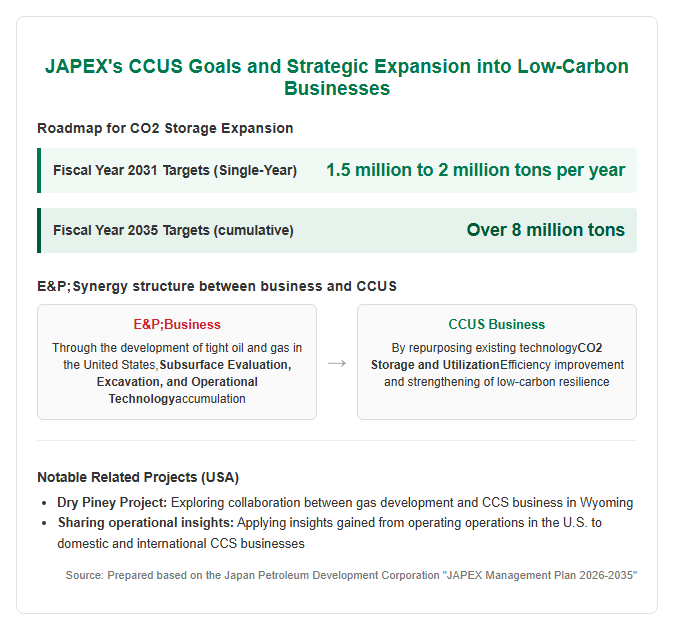
ZIPEX’s vision for fiscal year 2035 goes beyond being just an oil and gas company. The company is taking a realistic approach of “meeting energy demand while advancing decarbonization,” with CCUS (Carbon Capture, Utilization, and Storage) at its core. By fiscal year 2035, we aim to accumulate over 8 million tons of CO2 storage, which is one of the pillars of our growth investments. The technology and expertise gained from tight oil and gas development in the United States are planned to be returned to the CCUS business as well. For example, by linking E&P businesses with CCS (CO2 Capture and Storage) operations, such as projects in Wyoming, we aim to enhance resilience to a low-carbon environment. To continue operations amid strict environmental regulations, it is essential to advance fossil fuel production and the advancement of emission reduction technologies together. The progress of CCS projects both domestically and internationally will become an important indicator that will determine the company’s long-term corporate value. Please refer to the diagram below.
4.2 Management with Awareness of Capital Costs and Improvement of ROE
For investors, the key point is how this massive investment will translate into returns. The capital market strongly demands management with an awareness of capital costs, and JAPEX is responding to this with a new management plan. As a management goal, we have set a goal to raise the return on equity (ROE), which is expected to be around 6.7% in fiscal year 2025, to over 12% by fiscal year 2035. Net profit for the period is also planned to double from the current 45 billion yen to 100 billion yen. The company positions fiscal year 2030 as the period for building the “core asset group,” and the period after which revenue contributions will become more substantial. Whether the company, which has been valued for its “stability through domestic infrastructure,” can transform into an “international resource stock” with higher profitability and growth potential through its success as an operator in the U.S. will determine its future stock price and market evaluation. The main focus is on managing financial risks associated with massive investments while achieving planned ramp-up and monetization.
[#石油資源開発 #JAPEX #エネルギー安全保障 #シェールオイル #米国経済 #中間選挙 #CCUS #経営計画]


コメント