On July 9, 2026, Anthropic in the US launched a beta release of a new feature called “Reflect,” which visualizes the usage of the AI assistant “Claude” and allows users to objectively reflect on their usage habits. This feature goes beyond mere statistical display; it includes a unique framework and well-being features designed to enhance the quality of use while maintaining an appropriate distance from AI.
- 1-1. Key Points of the Event: The Emergence of New Features to Visualize AI Habits
- 1-2. Development Background: Consideration for Digital Well-being
- 2-1. Optimization of Utilization Using the 4D Framework
- 2-2. Self-Assessment of Tasks Based on Statistical Data
- 3-1. Strict Data Exclusion and Protection of Confidential Information
- 3-2. Future Outlook: Time Management and Enterprise Impact
1-1. Key Points of the Event: The Emergence of New Features to Visualize AI Habits
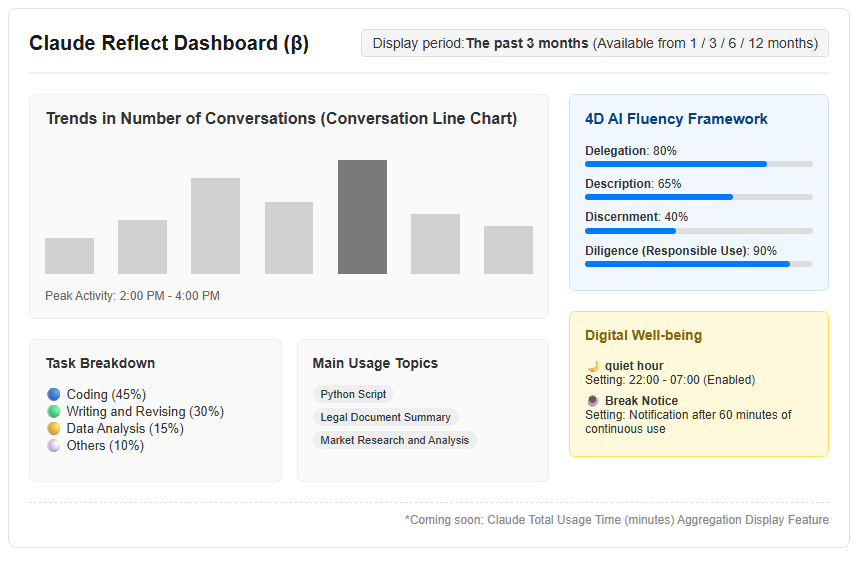
On July 9, 2026, Anthropic launched a beta version of its AI chatbot “Claude,” offering a dashboard feature called “Reflect” that analyzes and visualizes user interaction patterns. This feature selects multiple timeframes such as the past 1 month, 3 months, 6 months, and 12 months, showing detailed graphs showing what topics users are using AI on and how frequently they access it. Until now, interactions with AI tended to be black boxes, but with the introduction of Reflect, key usage topics, usage frequency, and task classifications are now presented as summaries. Users will be able to objectively grasp their activity status with numerical data and self-evaluate the efficiency of AI utilization. The diagram below shows the basic structure of the dashboard provided by Reflect.
1-2. Development Background: Consideration for Digital Well-being
In developing Reflect, Anthropic has been working closely with digital media and wellbeing experts. Specifically, prominent institutions such as the MIT Media Lab’s “Advancing Humans with AI” program, the Digital Wellness Lab at Boston Children’s Hospital, and the Family Online Safety Institute collaborated on the development process. This was driven by strong user demand to know how often AI should be used in daily workflows or which tasks should be kept by humans. A major feature is that it not only maximizes productivity but also encourages users to ask, “Even if AI can process faster, what do I want to keep doing on my own?” to explore a healthier relationship between technology and humans.
Analytical features and frameworks that promote skill improvement
2-1. Optimization of Utilization Using the 4D Framework
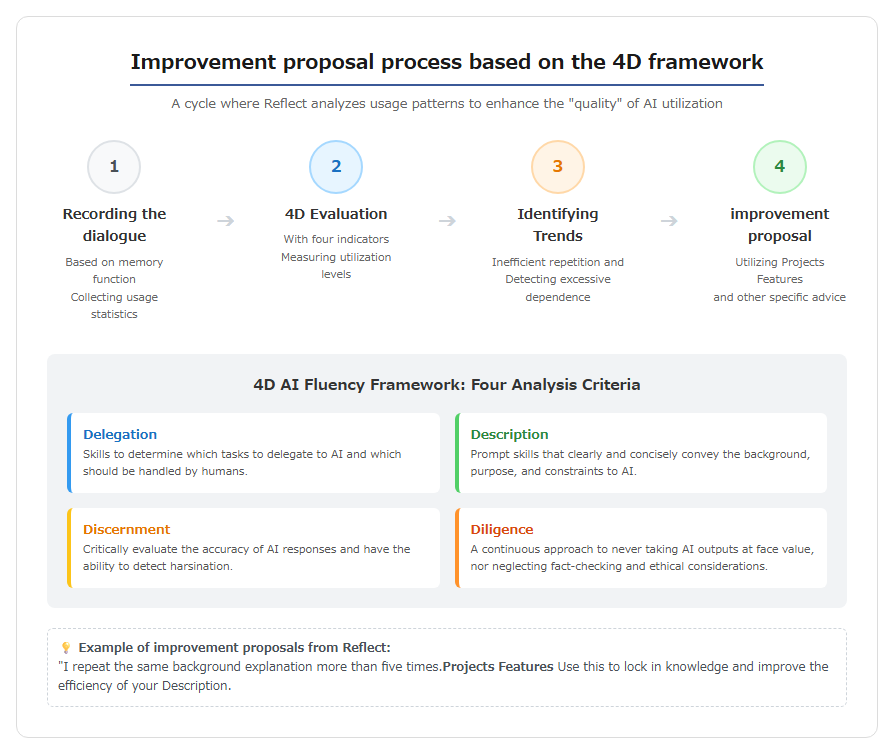
Reflect is not just a statistical tool; it also has an educational aspect to improve users’ AI literacy. Specifically, analysis is conducted based on the “4D AI Fluency Framework,” which consists of four elements: Delegation, Description, Discernment, and Diligence. On the dashboard, users are evaluated to see which of these four pillars their usage fits and suggestions for more advanced usage are displayed. For example, if it detects a pattern of repeating similar background explanations, it can advise using Claude’s “Projects” feature to fix the context. This allows users to understand how their workflows connect with AI, leading to skill improvements. The diagram below illustrates the improvement proposal process based on the 4D framework.
2-2. Self-Assessment of Tasks Based on Statistical Data
The Reflect dashboard displays not only overall usage frequency, but also a line graph showing peak activity and conversation progress, as well as a pie chart categorizing the types of tasks being tackled. This allows users to visually determine whether they are relying too much on AI during their most creative time and how well routine tasks have been automated. According to TechCrunch’s analysis, this kind of visualization is a method similar to Google’s “Gmail Meter” launched in 2012, and it also holds strategic significance for retaining users on the platform. Additionally, it is possible to set “quiet hours” to specify unused time periods and schedule nudge notifications to encourage breaks after a certain period of continuous use, functioning as a guardrail to prevent users from becoming overly dependent on AI.
Strategies for Privacy Consideration and Adoption
3-1. Strict Data Exclusion and Protection of Confidential Information
In Reflect’s operations, Anthropic prioritizes privacy protection above all else. This feature is intended for users on Free, Pro, and Max plans who have enabled the “Memory” feature in user settings, but strict limits are imposed on the data that can be applied. Specifically, exchanges via secret chat (Incognito Chat) or original file contents linked from external tools are not included in the retrospective data. For example, when requesting an inbox summary, the fact that the summarization task was performed is recorded, but the specific content of the email itself is not extracted. Additionally, highly confidential conversations linked to health-related collaboration tools are completely excluded from analytical insights.
3-2. Future Outlook: Time Management and Enterprise Impact
Reflect is currently available in beta, but Anthropic has already announced future updates. Upcoming features include aggregating and displaying Claude usage time in minute-by-minute terms, enabling more precise time management. Currently, the focus is on personal use, but conversations on “Cowork” are planned to be included in the review soon. This visualization capability could serve as an important indicator for Japanese companies advancing large-scale Claude deployments, such as Hitachi’s approximately 290,000 and NEC’s about 30,000, to understand the status of AI utilization within their organizations from a governance perspective. As AI agents become more autonomous in 2026, “Reflecting” one’s own usage habits is expected to become an essential process for both individuals and organizations.
[#AI #Anthropic #Claude #Reflect #AI活用 #DX #デジタルウェルビーイング]

コメント