As a new approach to watching videos without ads, the “YT-DLP Web Player” has been released. As YouTube’s measures against ad blockers are further strengthened, this method, based on powerful download tools, symbolizes the endless technical confrontation between users and platforms.
- The introduction of the “YT-DLP Web Player,” which offers a new viewing experience.
- The lineage and development philosophy of the powerful engine “YT-DLP”
- YouTube’s Tightening Regulations and User Resistance
- Security Threats Hidden in Widespread Ad-Blocking Extensions
- Status of Compliance with the Latest Regulations “PoToken” and “SABR”
- The Importance of Vulnerability Management and Using Official Sources
- Legal Status in Various Countries and the Future of Ad Avoidance Technologies
The introduction of the “YT-DLP Web Player,” which offers a new viewing experience.
On July 12, 2026, the “YT-DLP Web Player,” which replaces content on video sharing platforms with ad-free streams for playback, was released, attracting attention. This tool replaces video elements displayed in the browser in real time into an ad-free stream via the command-line-based powerful downloader “yt-dlp.”
The background to this development is the strengthening of enforcement against ad blockers that Google’s YouTube channel began in earnest around May 2023. Traditional ad-blocking extensions have used methods such as hiding elements within pages or cutting off communication, but YouTube has detected these attempts and taken strong countermeasures such as restricting video viewing.
YT-DLP Web Player operates as a browser extension while leveraging a powerful external engine to avoid detection by YouTube while aiming to provide a comfortable viewing environment. Please refer to the diagram below.
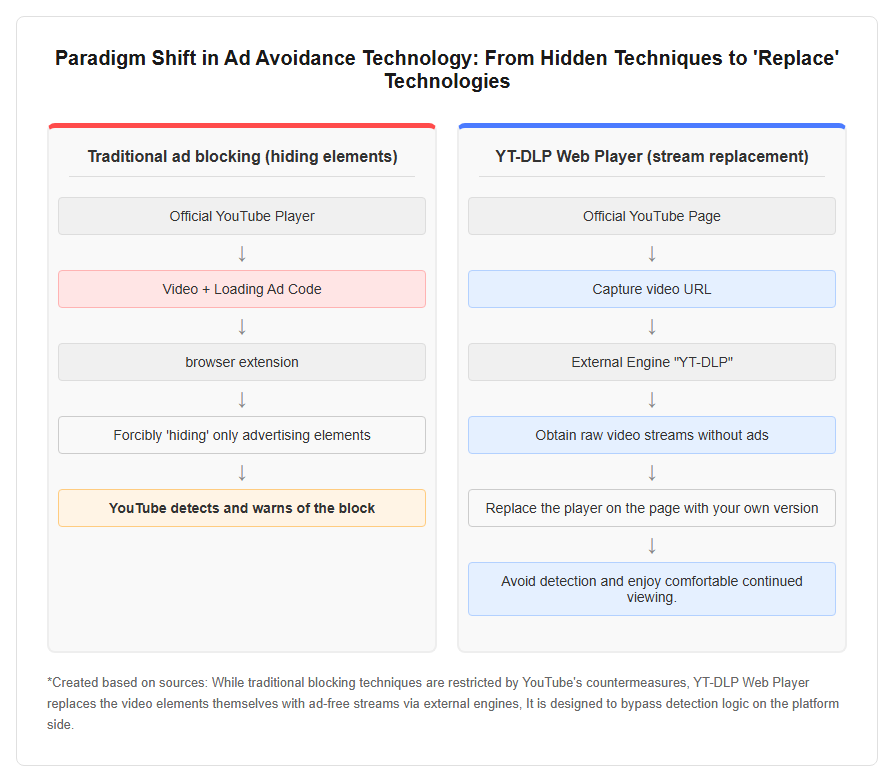
。 A major feature of this event is the shift from traditional ‘hiding’ techniques to ‘replace’ techniques. As of 2026, this tool, which is free and open-source, is positioned as the latest countermeasure in the “cat-and-game” between users and platforms over advertising.
The lineage and development philosophy of the powerful engine “YT-DLP”
The core technology of YT-DLP Web Player is the open-source project “yt-dlp.” This project quietly emerged on October 26, 2020, as a fork of “youtube-dl,” which was once the de facto standard. At that time, right after the original YouTube-DL received a takedown request under the Digital Millennium Copyright Act (DMCA) from the Recording Industry Association of America (RIAA), developers launched this YT-DLP repository as insurance.
YT-DLP has maintained an extremely fast development cycle, releasing patches within hours for YouTube’s frequent specification changes, not just clones. According to statistics as of May 2026, PyPI (Python Package Index) has over 12 million monthly downloads and has surpassed 160,000 stars on GitHub, making it the most widely used video download engine in the world.
The tool’s standout features include its versatility, supporting over 1,800 video and audio sites, and its highly free licensing structure, which is close to the public domain under “The Unlicense.” Development is currently being systematically managed by multiple volunteer maintainers, adopting calendar versioning (date-based version control) as of 2026.03.17, with updates made 20 to 30 times per year. YT-DLP Web Player delivers high convenience and avoidance performance by making this robust and up-to-date engine available directly from web browsers.
Intensifying Conflicts Over Advertising and Risks to Existing Tools
YouTube’s Tightening Regulations and User Resistance
YouTube relies primarily on advertising revenue, and the widespread adoption of tools that bypass this poses a direct threat to its business model. Therefore, since around October 2023, YouTube has fully implemented measures such as displaying warnings to users who use ad blockers stating, “The use of ad blockers is not permitted under YouTube’s Terms of Service,” and blocking access if users continue to watch without warnings.
In response to this hardline stance from the platform, users have been exploring various alternatives. YouTube Vanced, once extremely popular among Android users, ended its distribution in March 2022 after Google requested its development to be discontinued, and by around April 2023, it was completely unavailable. Patching tools such as “YouTube ReVanced” have emerged as successors, but these have also faced claims of infringement and are constantly facing threats to survival.
A survey report shows that from late 2025 to 2026, PC views decreased by about 50% in some areas, leading to theories that this was due to YouTube changing the way ad blockers counted views and user drop-offs due to crackdowns. New extensions like “Ad Speedup,” which playback ads at 16x speed and effectively skip them, have emerged, making the battle between platforms and users more complex than ever. The YT-DLP Web Player can be described as a more technically sophisticated way to avoid conflict, emerging as an extension of this intense history of conflict.
Security Threats Hidden in Widespread Ad-Blocking Extensions
Ad-blocking tools may seem convenient, but behind them lie serious security risks. In June 2026, it was pointed out that the long-established Chrome extension “Adblock for YouTube,” with over 11 million installs, contains a dangerous vulnerability that allows users to execute arbitrary JavaScript in their browser simply by changing server-side settings.
Ad blockers have very strong permissions
Furthermore, there have been reports of trusted extensions being sold to different owners, with codebases rewritten to resemble malware. The reality that even tools that have been used for a long time and receive high reviews are not always guaranteed to be safe has shocked many users. Please refer to the diagram below.
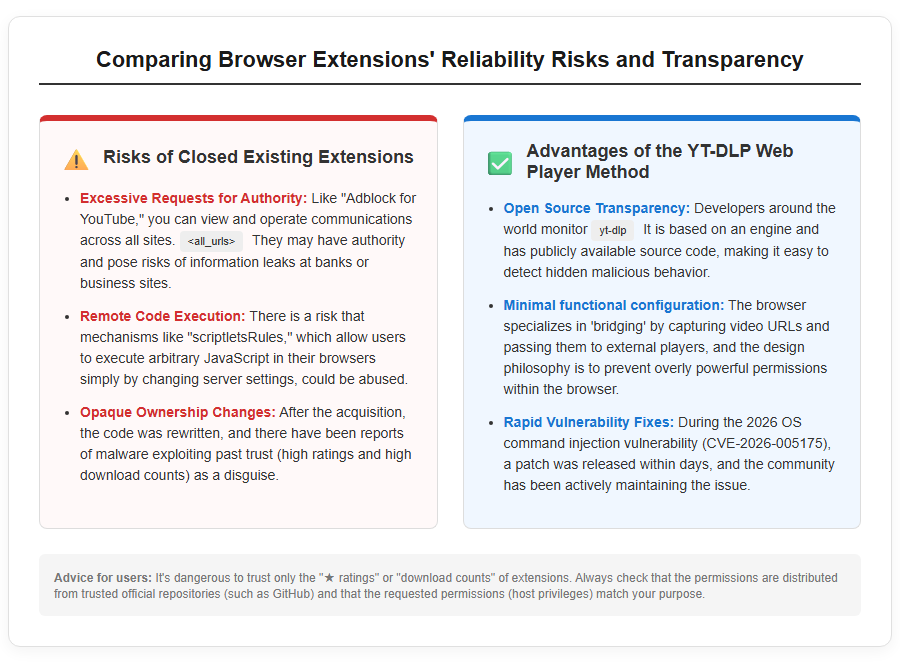
。 Against this backdrop, designs like the newly introduced “YT-DLP Web Player,” which is based on the highly transparent open-source engine YT-DLP while providing minimal bridging, have attracted attention from security-conscious users.
Technical Barriers as of 2026 and Future Outlook
Status of Compliance with the Latest Regulations “PoToken” and “SABR”
Between 2025 and 2026, YouTube introduced more advanced technical barriers such as “PoToken (Proof-of-Origin Token)” and “SABR.” As a result, simple methods have made it extremely difficult to obtain video streams. PoTokens are short-term authentication tokens linked to each video request, and if not provided correctly, video loading is blocked or downgraded to extremely low churn rates.
Currently, to make yt-dlp work, external plugins and helpers such as “bgutil-ytdlp-pot-provider” that generate tokens in the background are essential. Additionally, the introduction of the SABR protocol, which dynamically adjusts bitrates on the server side, has led to frequent disruption of traditional download paths. To counter this, YT-DLP has also enhanced its browser-to-cookie loading feature (–cookies-from-browser), taking measures such as simulating the user’s legitimate sign-in state.
Whether YT-DLP Web Player can continue to operate stably depends on how closely it can keep up with YouTube’s latest protocols. As of 2026, the situation is evolving from a state of “just installing and it works” to a highly specialized domain that only works by combining “the right helper, the latest cookies, and constant engine updates.”
The Importance of Vulnerability Management and Using Official Sources
The most important point to pay attention to when using tools is ensuring security. Serious vulnerabilities have been discovered in the past even within the underlying YT-DLP itself. For example, information released in February 2026 (CVE-2026-005175) reported a vulnerability with a severity rating of “8.8 (Critical)” that allows OS command injection under certain conditions. This vulnerability was fixed in version 2026.02.21.
To avoid such risks, it is essential to obtain the latest version from the official website or GitHub repository and update regularly. Fake “yt-dlp downloader” sites often distribute binaries containing adware or cryptocurrency miners, so use outside official distribution packages (GitHub Releases, PyPI, major package managers, etc.) is strictly prohibited.
Even when using front-end tools like YT-DLP Web Player, you must always ensure that the YT-DLP device running behind it is up-to-date and secure. The developer community also shares information about false positives by security software like Windows Defender, and users themselves need the literacy to judge accurate information themselves, which is essential for the safe use of these evasion tools.
Legal Status in Various Countries and the Future of Ad Avoidance Technologies
The legal status of YouTube ad evasion technology varies greatly by country and region. In the United States, the latest regulation of the Digital Millennium Copyright Act (DMCA) Section 1201, which took effect in October 2024, did not allow a general exemption regarding the archiving of personal videos. As a result, the provision of tools to circumvent technical protection measures remains in a legal gray area or carries potential risks.
In Germany, in November 2024, the Hamburg Higher Regional Court ruled that businesses hosting sites that guide users to avoid ad-blocking tools may be held liable. This does not mean the software itself is illegal, but it does pose significant legal pressure for those distributing or promoting the tool. On the other hand, the EU-wide Digital Services Act (DSA) does not have uniform regulations regulating downloader software itself.
Going forward, YouTube is considering more advanced AI ad embedding and methods to embed ads directly into video files, with a focus on how tools like YT-DLP Web Player will respond to these needs. The conflict surrounding advertising is expected to evolve beyond mere convenience to broader social and legal debates about privacy, security, and the nature of the platform economy.
[#YouTube #広告ブロッカー #ytdlp #サイバーセキュリティ #オープンソース #Google]
」_en.png)
コメント