It has been revealed that source files of papers posted to arXiv, the world’s largest preprint server, contain extensive leakage of confidential and personal information. The mechanism where researchers publish for convenience is unintentionally creating security risks.
- About 90% of submitted papers hide the ‘hidden secrets’
- Access to leaked API keys and confidential documents
- The risks of “comments” and “unnecessary files” associated with the LATEX format
- GPS information and creator profiles engraved in photos and PDFs
- Limitations of existing cleaning tools and the next-generation tool “ALC-NG”
- Strict Post Restrictions in the Era of Generative AI and Future Highlights
About 90% of submitted papers hide the ‘hidden secrets’
A recent large-scale survey of over 2.7 million papers submitted to arXiv, one of the world’s largest paper repositories, has revealed a surprising reality. According to the survey results, it was confirmed that 88% of papers containing source files submitted in LATEX format contained “hidden information” that should not have been made public. This survey covers all posts from the service launch in 1991 through December 2025, analyzed across three dimensions: file level, metadata level, and content level.
At arXiv, authors are required to submit source files from the perspectives of accessibility and long-term maintainability, but this has become a pathway for information leakage. As shown in the diagram below, a lot of information remains in the source file that does not appear in the compiled PDF.
Please refer to the diagram below.
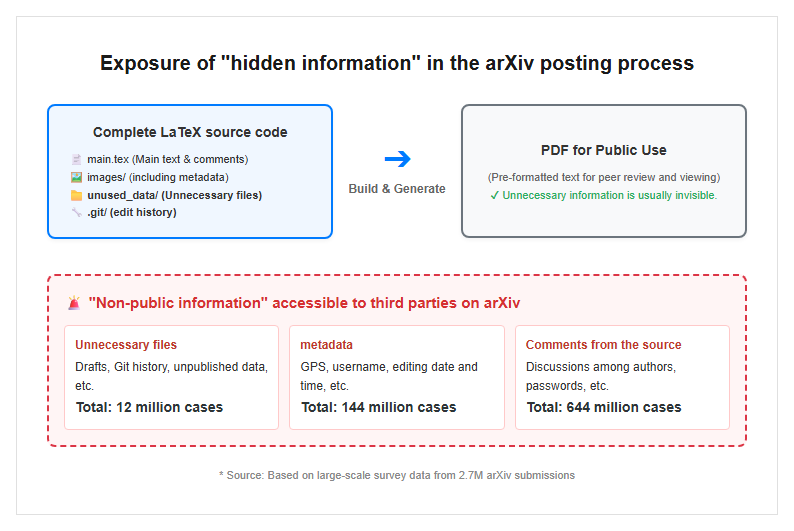
Specifically, 12 million “dangling files,” 144 million metadata entries, and 644 million comments were discovered. Notably, much of this information is unique and directly added by the author, rather than from templates. A lack of awareness within the research community that source files are exposed to public is a fundamental cause of this large-scale information breach.
Access to leaked API keys and confidential documents
Among the information discovered in the source files were numerous serious security risks that could be exploited immediately. Analysis using pattern matching and validation revealed 265 API tokens, 171 passwords, and 4 encryption private keys. This sensitive information was left in configuration files or scripts that were forgotten to be deleted at the time of posting, or in the comment section of the source code.
Even more serious are links to cloud services and collaborative editing platforms. The survey found 3,948 links to Google Docs, of which 699 were “editable” by anyone. By following these links, it has been confirmed that they had access to peer review comments from papers, unpublished experimental data, meeting minutes, and even survey data containing personal information of participants in 18 cases.
Additionally, information about network infrastructure was leaked, with 29,000 posts showing references to FTP servers, of which 23% remained with access privileges open. This information can serve as a foothold for attackers to infiltrate an organization’s internal network, fundamentally shaking the cybersecurity of academic institutions and companies.
Why does information leak? Technical blind spots and metadata threats
The risks of “comments” and “unnecessary files” associated with the LATEX format
The LATEX format, widely used for writing papers, carries a structural risk of forgetting information due to its flexibility. Within the source files, comments can be written using the “%” symbol, but there are many informal discussions and “to-do lists” among authors left here. In LLM-based content analysis, 7.9% of comments were dialogues between authors, including critical opinions about the quality of the text and strategic considerations of presentation methods, all of which were not intended for publication.
Also, when authors upload papers, they often compress the entire project folder before submitting, which can lead to unnecessary dangling files mixed in during PDF generation. This includes cases where older versions of manuscripts or entire Git edit histories have been confirmed. If Git history is leaked, it can restore confidential information that was previously deleted, making it extremely dangerous.
Furthermore, attempts at improper censorship were also discovered. There have been 269 confirmed cases where the original text remains as a comment on the source file, even when using the LATEX package to blackout information. This indicates that the author mistakenly believes that “hiding it in PDF is safe,” highlighting a gap between the source files themselves and arXiv’s mechanism, where they are published.
GPS information and creator profiles engraved in photos and PDFs
Information leaks are not limited to text. The “metadata” of images and figures inserted into papers is also a serious factor in privacy violations. Analysis using ExifTool revealed that 93% of submitted papers contained some form of metadata.
Of particular note is the GPS (location) data. In 7,326 posts, the coordinates of the shooting location were detected from the image files. A detailed analysis of these coordinates revealed not only research facilities but also locations presumed to be individual residences. After reviewing 235 papers with multiple coordinate data, it was suggested that it is highly likely that the authors’ commuting routes from home to workplace can be tracked temporally and spatially.
Beyond location information, metadata revealed “usernames” in 11% of posts and “email addresses” in 2.9%. Additionally, information such as the OS and software versions used, as well as specific hardware information, is recorded, serving as valuable sources for targeted attacks (social engineering). Researchers need to be aware that during the process of creating charts and compiling PDFs, their digital footprints are unconsciously shared worldwide.
The Forefront of Security Measures and the Future of Academia
Limitations of existing cleaning tools and the next-generation tool “ALC-NG”
Currently, there are several tools available to “sanitize” source files before posting to arXiv, but this investigation revealed that many of these tools are inadequate. Even “arxiv_latex_cleaner (ALC),” developed by Google and recommended by arXiv, has been found to have issues such as missing comment deletion or, conversely, deleting necessary files that cause compile errors. The investigation found that even papers showing evidence of ALC use still contained highly confidential links.
To improve this situation, the research team developed and released a next-generation cleaning tool called “ALC-NG.” This tool overcomes the shortcomings of traditional tools by integrating the following three features.
-
File Level: Monitor the actual build process to ensure unnecessary files are identified and eliminated.
-
Metadata level: Integrates exiftool to batch delete metadata such as location information and usernames from images or PDFs.
-
Content level: By using the Abstract Syntax Tree (AST), it accurately identifies and removes arguments and comments from complex LATEX commands.
The verification confirmed that using ALC-NG reduced some form of “hidden information” in 98% of posts, while safely posting without changing the appearance of the PDF.
Strict Post Restrictions in the Era of Generative AI and Future Highlights
Another factor undermining the integrity of information in academia is the rapid spread of generative AI. In May 2026, arXiv announced the introduction of a “one-strike policy” that imposes a one-year submission ban on papers containing unverified content generated by generative AI. This aims to strictly eliminate the “shoddy and disorderly” behavior, where AI-generated false references and AI-generated dialogue prompts remain directly within the paper.
Under these new rules, the responsible author found to violate the rules will be immediately disciplined, and unless they have published in a peer-reviewed journal after the deadline, they will not be allowed to resume submissions to arXiv. Thus, countermeasures against “unintended leaks” of information and regulation of AI-driven “dishonest posts” are two sides of the same issue in the current academic ecosystem.
Going forward, enhanced automatic screening features on the repositories, such as arXiv, are expected. For example, a system is being considered to detect sensitive patterns such as API keys and location information during uploads and issue warnings to authors. To enjoy the benefits of open science while protecting researchers’ privacy and intellectual property, it is essential to fundamentally improve each researcher’s security awareness alongside utilizing tools.
[#arXiv #情報漏洩 #サイバーセキュリティ #学術論文 #個人情報保護 #生成AI #研究倫理]


コメント