The Quantum Science and Technology Research and Development Agency (QST) has decided to move up its power demonstration target for fusion prototype reactors in Japan to the 2030s. This is driven by accelerated development by countries such as the US, UK, and China, as well as strong government support aimed at securing leadership in energy security and next-generation industries.
- Shift in Government Policy and Accelerated QST Proposal
- Intensifying international development competition and Japan’s sense of crisis
- Definition of Power Generation Demonstration and Indicators to Be Achieved
- Development Methods Inheriting the Achievements of ITER and JT-60SA
- Phased evolution through three phases of driving development
- Industry Participation and Accelerating Innovation
- Legal framework and securing talent for practical implementation
Shift in Government Policy and Accelerated QST Proposal
In the “Integrated Innovation Strategy 2024” approved by the Cabinet in June 2024, the Japanese government officially set the goal of achieving a demonstration of power generation in the 2030s, ahead of the rest of the world. In response, the expert working group of the Ministry of Education, Culture, Sports, Science and Technology began reviewing a concrete roadmap for achieving the goals starting in August 2024. The Quantum Science and Technology Research and Development Organization (QST), the main implementing agency, has significantly raised its previous target of around 2050 and proposed an accelerated plan for the “JA DEMO” plan, aiming to start power generation in the late 2030s. This shift in policy means redefining fusion not merely as a research subject but as a key technology driving next-generation clean energy sources and economic growth. QST aims to make full use of the technical foundation cultivated through the existing International Thermonuclear Experimental Reactor (ITER) program and the “Broad Approach (BA) activities” through Japan-Europe cooperation, significantly streamlining the design and prototyping processes to shorten the construction start period.
Intensifying international development competition and Japan’s sense of crisis
The biggest reason for the need to accelerate power generation demonstrations is the rapid acceleration of fusion development in other countries. In the United States, a milestone program supporting private-sector power generation demonstrations in the 2030s is being rolled out based on the “Bold Decade Vision for Commercial Fusion” announced in 2022. Specifically, venture companies such as Commonwealth Fusion Systems (CFS), originating from MIT, have raised several hundred billion yen in funding and aim to have commercial reactors operational in the early 2030s. Additionally, the UK is promoting the ‘STEP’ plan, aiming to build prototype reactors by 2040, while China is investing huge budgets in developing its own experimental reactors and large-scale test facilities. Amid these global developments, preventing the outflow of Japan’s advanced technology and specialized personnel overseas and maintaining Japan’s international competitiveness in the future fusion market have become urgent issues.
Definition of Power Generation Demonstration and Indicators to Be Achieved
The demonstration of power generation in nuclear fusion is positioned as the greatest litmus test toward practical application. The specific indicators for power generation demonstration that QST aims for include achieving a net electricity output of around 100MW, achieving a practical operating rate, and confirming the self-sufficiency of tritium, the fuel used for practical use. Demonstrating that the “net electrical output,” which is the energy generated by nuclear fusion reactions minus the power consumed within the facility, can be transmitted to the grid (grid) is an essential condition for commercialization. Additionally, performance demonstration of the “propagation blanket” for self-fueling within the reactor is essential. By clarifying these technical definitions, the aim is to objectively assess the progress of research and development and increase the feasibility of achieving the ambitious goal of the 2030s.
Technology Strategy and Roadmap: The Full Picture of the Prototype Reactor “JA DEMO”
Development Methods Inheriting the Achievements of ITER and JT-60SA
QST’s “JA DEMO” is directly based on the results of the international cooperation project ITER (International Thermonuclear Experiment Reactor) and the JT-60SA, one of the world’s largest tokamak-type devices operating in Naka City, Ibaraki Prefecture. JT-60SA first succeeded in plasma generation in October 2023, and the advanced plasma control technology obtained here is directly linked to the design of the prototype reactor. For key equipment such as Japan’s strengths in superconducting magnets, breeder blankets, and divers, the company is adopting a strategy to minimize technical gaps and risks by developing it as an extension of ITER’s technological foundation. The diagram below illustrates an image of future fusion power plants being incorporated into society.
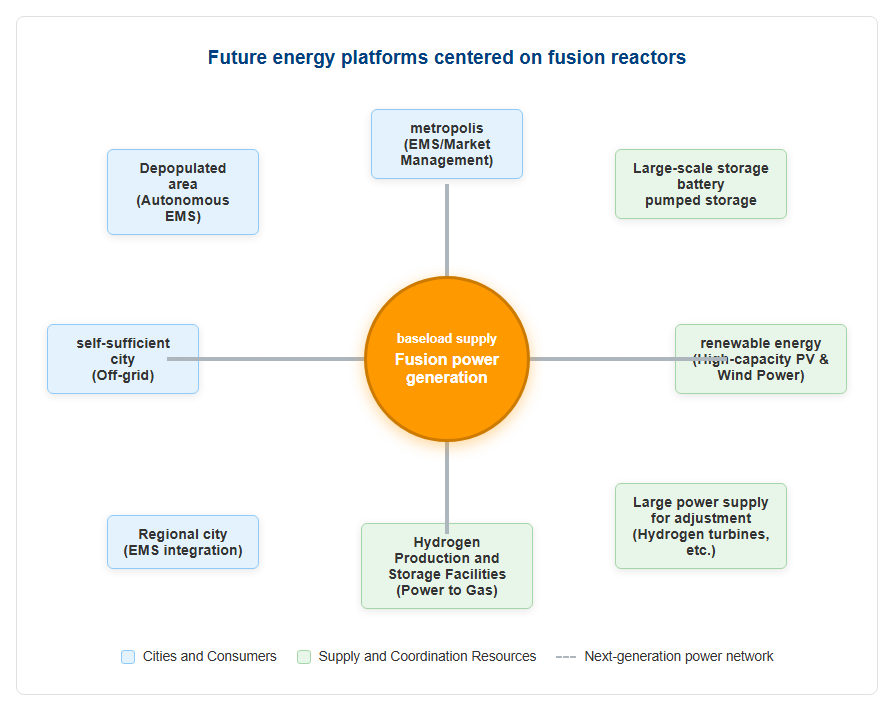
As of November 2025, 226 experts from QST, universities, and private companies are participating in the industry-academia collaboration “Joint Special Team for Prototype Reactor Design,” and conceptual design is progressing under an all-Japan framework.
Phased evolution through three phases of driving development
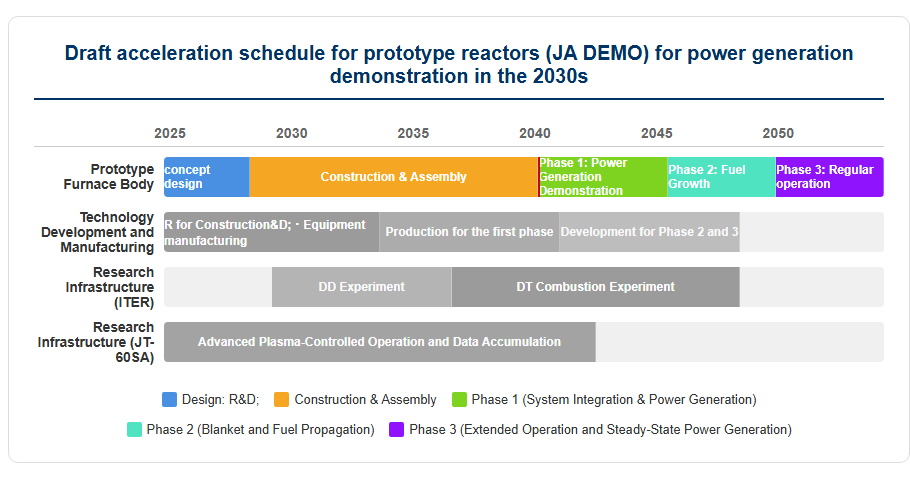
To ensure the achievement of power generation demonstration in the 2030s, QST has set multi-stage targets dividing the operation period of the “JA DEMO” into three phases. The first phase is the ‘System Integration Operation Period,’ where short-pulse runs of several minutes using existing ITER-based technologies are conducted, with the focus first on demonstrating power generation itself. The second phase transitions to the “blanket function testing phase,” where fuel growth performance is confirmed through several hours of long-pulse operation. The final third phase will be called the “Extended Operation Period,” aiming to establish a steady net power generation of about 100MW and maintenance scenarios through advanced operational scenarios reflecting research results from the JT-60SA. This phased approach lowers the technical hurdles in the initial phase while steadily accumulating the data needed for commercial reactors. The following diagram outlines the acceleration schedule for power generation demonstrations in the 2030s.
Future Developments: Ecosystem and Challenges Toward Industrialization
Industry Participation and Accelerating Innovation
To accelerate the social implementation of nuclear fusion, the “Fusion Energy Industry Council (J-Fusion)” was established in March 2024. In addition to major manufacturers such as Mitsubishi Heavy Industries, Toshiba Energy Systems, and Hitachi, many startups are also participating in the council, and supply chain construction is being advanced. In particular, startups like Kyoto Fusioneering are showing agile moves to complement government-led plans, such as launching the “FAST” project, which aims to generate power at their own small experimental reactors in the 2030s. To attract massive investments from private companies, the government plans to formulate a fundamental approach to ensuring safety in a scientific, rational, and internationally harmonized manner during fiscal year 2024. Additionally, as announced in April 2024, the strategic partnership between Japan and the U.S. will be strengthened in international frameworks through rulemaking and technology management.
Legal framework and securing talent for practical implementation
To make power generation demonstrations in the 2030s a reality, the development of legal systems and the development of specialized personnel are essential challenges. Under the current legal framework, fusion reactors are not classified as ‘nuclear reactors,’ but considering their ability to handle large amounts of tritium, a rational and highly predictable regulatory framework is required. The Cabinet Office’s task force is working closely with the Nuclear Regulation Agency to thoroughly examine agile regulatory approaches based on the Radioactive Isotope Control Act (RI Act). In addition, it is urgent to establish a systematic education system through inter-university collaboration and international cooperation to secure personnel with advanced expertise responsible for the construction and operation of prototype reactors. Success in the 2030s depends on how early these institutional and human infrastructure can be established.
[#核融合 #QST #エネルギー政策 #経済安全保障 #脱炭素 #次世代エネルギー #イノベーション #スタートアップ]


コメント