UK startup Spectral Compute has announced a groundbreaking toolkit called “SCALE,” which allows you to compile directly for AMD GPUs without rewriting the source code of NVIDIA’s proprietary parallel computing platform “CUDA.” This technology has the potential to break the “CUDA moat,” which has long dominated software in AI and high-performance computing (HPC), and to achieve true portability independent of any specific vendor.
- Overview of SCALE and Breaking Vendor Lock-in
- A true compiler that surpasses existing tools
- Development Background and the Frustrations Faced by Engineers
- Advanced optimization that absorbs hardware differences
- Benchmark results that surpass AMD’s official tools
- Legal pressure on NVIDIA’s “CUDA moat”
- Instant Porting by AI Agents and Future Prospects
Overview of SCALE and Breaking Vendor Lock-in
Spectral Compute, a startup based in London, UK, announced the beta version of its toolkit “SCALE,” which runs on AMD GPUs without any changes to the CUDA program, on July 12, 2024. Currently, about 80% to 90% of AI and high-performance computing (HPC) code is written on NVIDIA’s CUDA, leaving developers essentially tied to NVIDIA hardware. SCALE is designed to function as a drop-in replacement for NVIDIA’s official compiler, “nvcc,” allowing developers to run on different hardware, such as inexpensive AMD GPUs, while maintaining the existing CUDA codebase. Although this tool is not open source, it can be used for free by following terms such as copyright notice.
A true compiler that surpasses existing tools
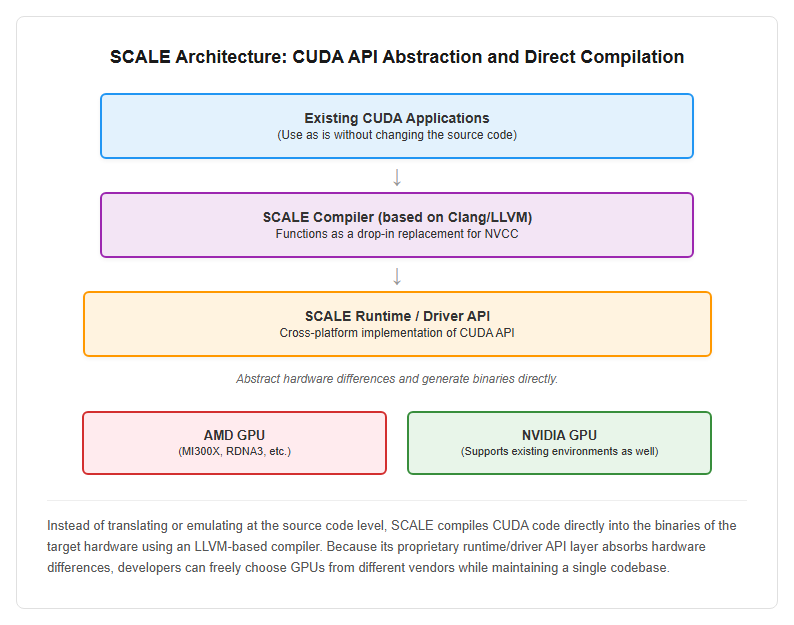
What sets SCALE apart from previous porting tools is that it is a “true compiler” that directly recompiles CUDA code for the target hardware, rather than translating code into another language or converting compiled binaries. AMD’s official “HIPIFY” converts CUDA code into C++ (HIP) for its own ROCm platform, but this had the drawback of not fully utilizing low-level optimization features like PTX. Meanwhile, SCALE is built on LLVM and Clang, generating binaries of target chips directly from source code. This approach eliminates the overhead of emulation and allows for maximizing hardware performance. The diagram below shows how SCALE abstracts the CUDA Driver/Runtime API and absorbs hardware differences.
Development Background and the Frustrations Faced by Engineers
Spectral Compute was founded in 2018 by four engineers with a combined experience of approximately 60 years in HPC optimization. Their motivation for starting SCALE development stemmed from strong frustration stemming from hands-on experience in AI development sites. His previous experience at an AI company, where he struggled with the extremely high implementation costs of NVIDIA GPUs and the poor performance of existing alternative compilers, became the driving force behind his unique solution. CEO Michael Sondergaard questioned, “Once you write code, it should run on any platform. Why can’t GPUs do something that is already done in the world of CPUs?” and aims to make GPU programming as portable as the CPU.
A technical approach to achieve overwhelming performance
Advanced optimization that absorbs hardware differences
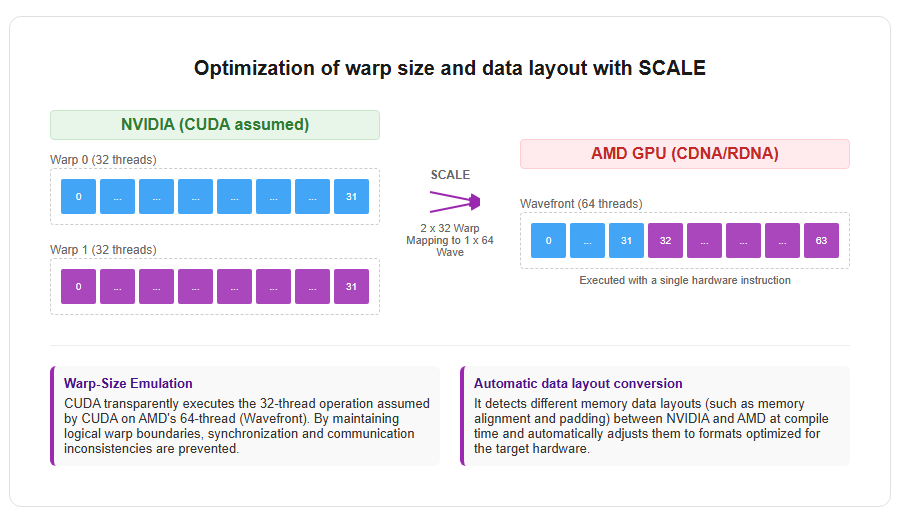
SCALE features features that automatically handle fundamental architectural differences between NVIDIA and AMD GPUs. A particularly significant technical barrier was the size difference in the smallest unit of parallel processing, the “warp.” While NVIDIA’s GPUs always operate in 32-thread units, some AMD GPUs are designed to operate in 64-thread units. Many CUDA applications are written assuming 32-thread operation, so they will not work properly on AMD as is. SCALE overcomes this compatibility barrier by offering methods such as mapping two 32 warps onto a single AMD hardware warp or processing natively while issuing compiler warnings. As shown in the figure below, SCALE handles even complex differences in data layout appropriately.
Benchmark results that surpass AMD’s official tools
SCALE’s performance shows results that surpass AMD’s own tools, the hardware provider. According to benchmark data released by Spectral Compute, SCALE significantly outperformed the HIPIFY-based approach when running on AMD GPUs, achieving about a sixfold performance improvement in some cases. Additionally, tests using the Rodinia benchmark suite showed that AMD’s MI300X GPU shows SCALE performance up to twice as fast as official tools using HIP. The company emphasizes that although “compatibility” was prioritized over “performance” during the early development phase, it has already achieved such results, and further speed improvements are expected as full-scale optimization progresses.
Shaking Dominance and a Turning Point in the GPU Market
Legal pressure on NVIDIA’s “CUDA moat”
For many years, NVIDIA has closely tied CUDA to its own hardware to prevent competitors from entering the market. However, this strong “moat” is now under legal threat. On June 15, 2026, the U.S. Department of Justice (DOJ) filed an antitrust lawsuit alleging that NVIDIA illegally uses CUDA to maintain an anti-competitive advantage. The DOJ alleges that NVIDIA is pressuring cloud providers to prioritize CUDA and changing license terms to ban translation layers for running CUDA-based code on other companies’ hardware. The emergence of tools like SCALE supports an environment where customers can freely choose GPUs by separating hardware and software, contributing to the “competitive market environment” sought by DOJ.
Instant Porting by AI Agents and Future Prospects
Compiler technology is not the only factor enhancing software portability. In January 2026, it was reported that Anthropic’s AI coding agent “Claude Code” succeeded in directly porting the entire CUDA codebase to AMD’s ROCm platform in just 30 minutes. In this demo, AI understood and adapted the code logic without going through intermediate translation layers. The SCALE development team is also working to expand the ecosystem by strengthening support for hundreds of specialized libraries such as cuDNN and cuTENSOR, and is planning compatibility with PyTorch, which is essential for AI development. SCALE has already been tested on large-scale systems such as Oak Ridge National Laboratory’s supercomputer “Frontier,” and with the company now employing about 30 people, it will be a key factor in ending NVIDIA’s dominance era.
[#CUDA #AMD #GPU #NVIDIA #AI #独占禁止法 #科学技術 #スタートアップ]


コメント