In August 2026, Unsloth AI released “Unsloth Desktop,” an open-source application that integrates AI model inference and fine-tuning into a single local environment. This release comes amid rapidly growing demand for safely and easily training and operating custom AI models on local hardware, driven by concerns over rising cloud token costs and data privacy.
- Arrival and Background of the Integrated App “Unsloth Desktop”
- Challenges in Conventional Local LLM Environments and the Impact of Integration
- No-Code Model Training and Performance Optimization
- Multimodal Support and Integration with the External Agent Ecosystem
- Private Web Search, Deep Research, and Security Control Mechanisms
- Hardware Dependencies and Practical Limitations in the Early Beta
- Impact on the Open-Source AI Ecosystem and Key Trends to Watch
Arrival and Background of the Integrated App “Unsloth Desktop”
On August 11, 2026, Unsloth AI—a prominent player in the AI open-source community—released the beta version of “Unsloth Desktop,” a native application supporting the three major operating systems: macOS, Windows, and Linux. It is the industry’s first desktop application that allows users to perform both inference (running models) and fine-tuning (additional training) for open-source large language models (LLMs) and multimodal models within a single unified local environment. Developed by Daniel Han, Michael Han, and their team, the application consolidates model optimization processes—which previously required command-line operations and advanced programming expertise—into an intuitive interface. As commercial adoption of generative AI expands, challenges such as escalating API costs from cloud services and security risks associated with transmitting sensitive data externally have become pressing concerns. Against this backdrop, demand from enterprises and researchers seeking to operate models securely on local PCs or private servers has surged, making the arrival of Unsloth Desktop a pivotal milestone in dramatically lowering the entry barriers to local AI.
Challenges in Conventional Local LLM Environments and the Impact of Integration
Previously, local AI development required chaining together multiple distinct software tools, placing a heavy burden on developers and end-users alike. For instance, inference and chat interfaces typically relied on runtimes such as llama.cpp, LM Studio, or Ollama, while fine-tuning demanded complex Python and PyTorch scripting environments. This fragmentation often led to recurring environment configuration errors and cumbersome resource management, serving as a barrier to non-technical users. By consolidating these functions into a single native UI, Unsloth Desktop creates a seamless, continuous workflow spanning model selection, data preparation, training, inference, and exposing API endpoints for external apps. As illustrated in the following diagram, users can navigate the entire process smoothly through an intuitive interface panel:
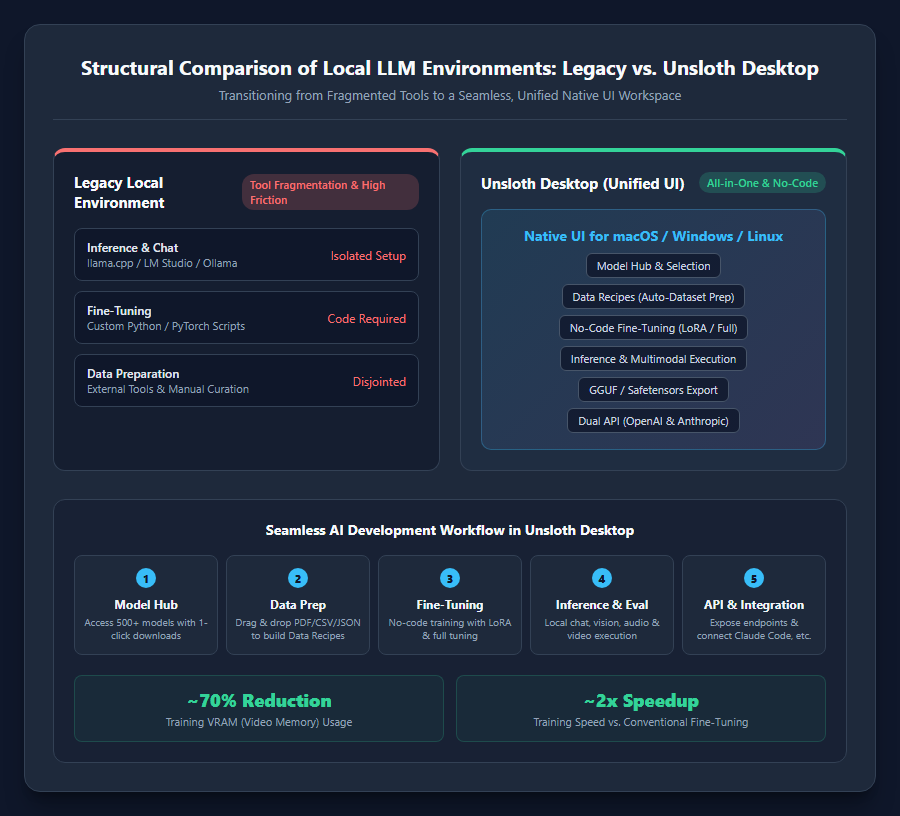
Establishing an environment where users can effortlessly manage tasks from data curation to model construction while efficiently utilizing on-premise compute resources holds profound significance for everyone from independent developers to enterprise R&D departments.
Technical Features and Versatility of Unsloth Desktop
No-Code Model Training and Performance Optimization
The primary technical breakthrough of Unsloth Desktop lies in enabling model fine-tuning through intuitive operations without writing a single line of code. Users can simply drag and drop document files—such as PDFs, CSVs, or JSONs—to automatically generate training datasets (Data Recipes) and initiate LoRA or full fine-tuning. Unsloth’s proprietary optimizations claim to reduce video memory (VRAM) usage by approximately 70% and accelerate training speeds by roughly 2x compared to conventional fine-tuning workflows without loss of accuracy. Consequently, tasks that previously demanded expensive data-center GPUs can now be executed on standard desktop PCs or high-performance laptops available in 2026. Supporting over 500 text and vision models, the platform allows trained models to be exported directly to GGUF or Safetensors formats for immediate deployment in local workflows.
Multimodal Support and Integration with the External Agent Ecosystem
Extending beyond text-generation LLMs, the application offers advanced multimodal processing and extensive integration capabilities with external software ecosystems. Various diffusion models for image and video generation/editing (such as MiniMax-H3 and LTX) as well as speech recognition and synthesis models (including Whisper) can run on the same unified interface. For developers, the app incorporates the “unsloth start” command, enabling direct connections between local models and coding agents like Claude Code, OpenAI Codex, Hermes, and OpenClaw. Furthermore, it simultaneously exposes both OpenAI-compatible (/v1/chat/completions) and Anthropic-compatible (/v1/messages) API endpoints on a single port (defaulting to 8888). This makes it remarkably straightforward to drop local models in as backends for existing AI development tools and third-party applications.
Private Web Search, Deep Research, and Security Control Mechanisms
Unsloth Desktop also introduces sophisticated capabilities in information gathering and security management. To complement local models with up-to-date information not present in their training data, it incorporates a private, unlimited web search engine. Its “Deep Research” mode goes a step further: the local AI autonomously formulates a research plan, browses and verifies multiple web pages, and synthesizes a detailed report complete with cited sources. Every operation is built on a 100% local, privacy-first principle that collects zero telemetry or usage logs. When tools such as web search or code execution are invoked, a granular sandboxing mechanism and authorization prompt system govern file system access permissions. The underlying control structure balances security with usability, as shown below:
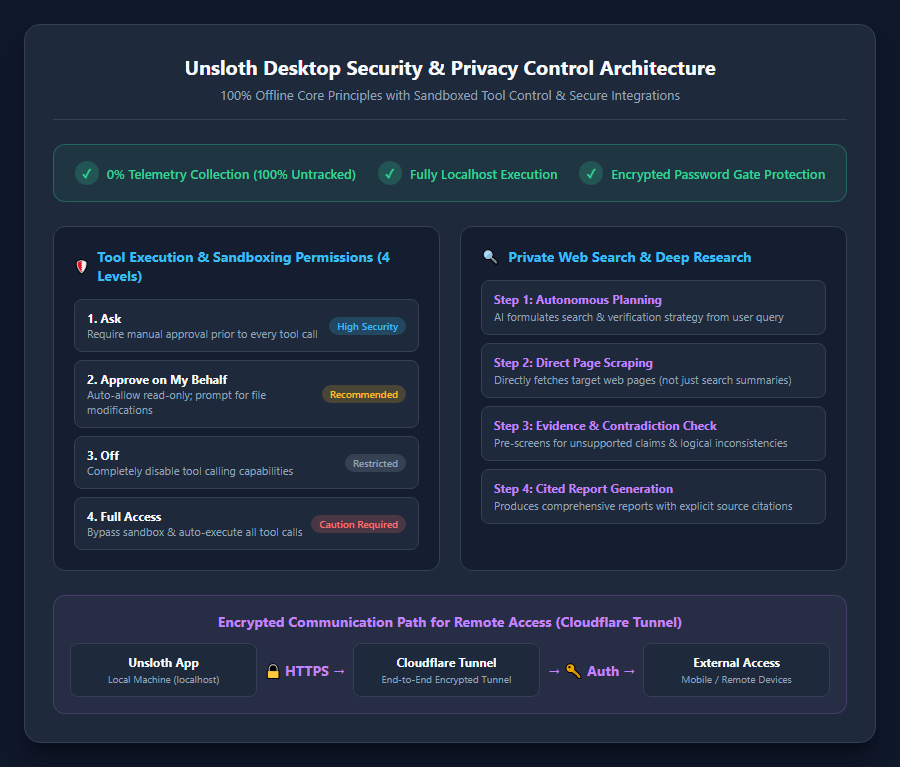
Even during remote access scenarios, robust security protocols remain intact through secure communication channels powered by Cloudflare Tunnels.
Practical Evaluation, Challenges, and Future Outlook
Hardware Dependencies and Practical Limitations in the Early Beta
While Unsloth Desktop delivers a feature-rich, integrated environment, user feedback from its August 2026 beta release highlights several practical challenges and hardware-dependent constraints. Although the desktop app binary itself utilizes the Tauri framework and remains lightweight at approximately 60MB, its architecture downloads and builds the runtime stack—including PyTorch, uv, and llama.cpp (exceeding 2GB)—upon initial startup. As a result, setting up the app in a strictly air-gapped offline environment requires advance preparation. Furthermore, while performance is stellar on NVIDIA GPUs (via CUDA) and Apple Silicon (via Metal), users on AMD GPUs (ROCm/Vulkan) have reported device selection glitches, such as inaccurate memory detection and degraded generation speeds. Additionally, vendor benchmark claims of “2x speed and 70% VRAM reduction” can vary significantly depending on the specific model architecture and dataset conditions, underscoring the need for independent validation.
Impact on the Open-Source AI Ecosystem and Key Trends to Watch
Despite early beta hurdles, the release of Unsloth Desktop represents a major turning point in the evolution of the open-source AI ecosystem. By adopting a dual-licensing structure—where the core library is licensed under Apache 2.0 and optional UI components under AGPL-3.0—Unsloth maintains open accessibility while securing a sustainable framework for ongoing development. Moving forward, as frontier-class open-weight models like Qwen3.8, Gemma 4, and DeepSeek-V4 become increasingly compact and efficient, on-premise AI adoption across security-sensitive industries such as healthcare, finance, and manufacturing is expected to accelerate dramatically. As hybrid architectures balancing cloud and local AI become the industry standard, Unsloth’s role in bridging model development and deployment within a single application will continue to draw intense interest from engineers and researchers worldwide.
References
-
[Unsloth Desktop Documentation] https://unsloth.ai/docs/desktop
-
[Unsloth GitHub Repository] https://github.com/unslothai/unsloth
-
[NVIDIA Japan Blog – Advancing Local AI and Open Source Models] https://blogs.nvidia.co.jp/blog/local-ai-open-source-models-agents-nemotron/
-
[Unsloth Studio Documentation] https://unsloth.ai/docs/new/studio
[#Unsloth #UnslothDesktop #LocalLLM #OpenSourceAI #FineTuning #AITechnology]

コメント