In June 2026, the Ministry of Economy, Trade and Industry announced a new strategy aimed at strengthening the competitiveness of the battery storage industry. Behind this is the dramatic shift in the global market environment, such as rapid changes in EV policies in the US and Europe and the overwhelming supply capacity of Chinese companies.
- Background of the Revision of the Battery and Power Industry Strategy
- Specific numerical targets for 2035
- Accelerating the development of common infrastructure technologies through NEDO
- Collaboration for Mass Production of the Toyota-Idemitsu Union
- Platform strategy centered on materials and intellectual property
- Economic Impact and Remaining Challenges Toward 2040
Background of the Revision of the Battery and Power Industry Strategy
In June 2026, the Ministry of Economy, Trade and Industry significantly revised the traditional battery industry strategy and announced a new strategy for the battery and power supply industries. As global investment competition intensifies, it serves as a crucial compass for maintaining Japan’s energy security and industrial competitiveness. The background to this revision is the uncertainty surrounding support measures for EV adoption such as the Inflation Reduction Act (IRA) following the change in administration in the United States, as well as changes in the external environment, such as the full-scale implementation of environmental regulations (the European Battery Regulation) in Europe. Furthermore, risks in the supply chain, such as oversupply risks of products with overwhelmingly competitive price advantages by Chinese companies and strengthened export controls on critical minerals, are rapidly emerging. Until now, the main indicators were the scale of physical manufacturing capacity and securing global share, but with the new strategy, we have shifted away from competition based on quantity and have made a major shift toward prioritizing quality, the value of the entire supply chain, and ensuring economic security.
Specific numerical targets for 2035
The new strategy sets an ambitious goal to triple Japanese companies’ sales of storage batteries-related sales in the global market to approximately 5 trillion yen by 2035 compared to 2025. The timeline for establishing a domestic manufacturing base has also been adjusted, with the initial target of 2030 revised to a more realistic plan aiming to establish 150 GWh/year by the mid-2030s. Currently, with government support based on the Economic Security Promotion Act, the domestic manufacturing base is already expected to be expanded to over 100 GWh per year. To this end, the government maintains a policy of subsidizing one-third of capital investment and half of technology development costs, and in June 2023, decided to provide up to 127.6 billion yen in subsidies for seven projects by Toyota Motor Corporation and others. Additionally, the goal is to promote line optimization through data collection and analysis at manufacturing sites, and to train and secure a total of 30,000 personnel across the entire supply chain.
Public-Private Initiatives Toward the Practical Use of All-Solid-State Batteries
Accelerating the development of common infrastructure technologies through NEDO
Regarding all-solid-state lithium-ion batteries, which Japan holds global technological superiority in next-generation batteries, we have clearly maintained a roadmap aiming for full-scale practical use around 2030. To accelerate practical application, the New Energy and Industrial Technology Development Organization (NEDO) is promoting the SOLiD-Next project for evaluation and foundational technology development of next-generation all-solid-state storage battery materials over five years from fiscal 2023 to 2027, with a total project cost of approximately 10 billion yen. At the core of this business is the development of standard battery models (ruler batteries) that serve as common criteria for material evaluation. Until now, material manufacturers found it difficult to obtain detailed performance evaluations when their materials were incorporated into batteries, but by utilizing standard models, appropriate feedback becomes possible. Currently, four models including high-durability and high-input models have been presented ahead of schedule, aiming to fundamentally solve durability challenges and create an ecosystem that continuously produces new materials.
Collaboration for Mass Production of the Toyota-Idemitsu Union
Corporate actions are also concrete and accelerating. Toyota Motor Corporation and Idemitsu Kosan have begun collaborating toward the practical application of all-solid-state batteries between 2027 and 2028. The target is sulfide-based solid electrolytes that are considered to deliver high capacity and high output for BEVs. This material is soft and easily adheres to other materials, making it suitable for mass production. Idemitsu has developed manufacturing technology for lithium sulfide, an intermediate material for solid electrolytes, by utilizing sulfur, a byproduct obtained during petroleum refining. Both companies have formed a task force of several dozen members, advancing a three-phase roadmap: Idemitsu will begin full-scale supply of lithium sulfide in October 2027, and Toyota will introduce all-solid-state battery-equipped vehicles using this to the market. The government is also strongly supporting this initiative, and METI has decided to provide subsidies of up to 117.8 billion yen for Toyota’s next-generation battery development and capital investment, accelerating the establishment of a mass production system through public-private collaboration.
Japan’s Survival Strategy and Future Market Outlook
Platform strategy centered on materials and intellectual property
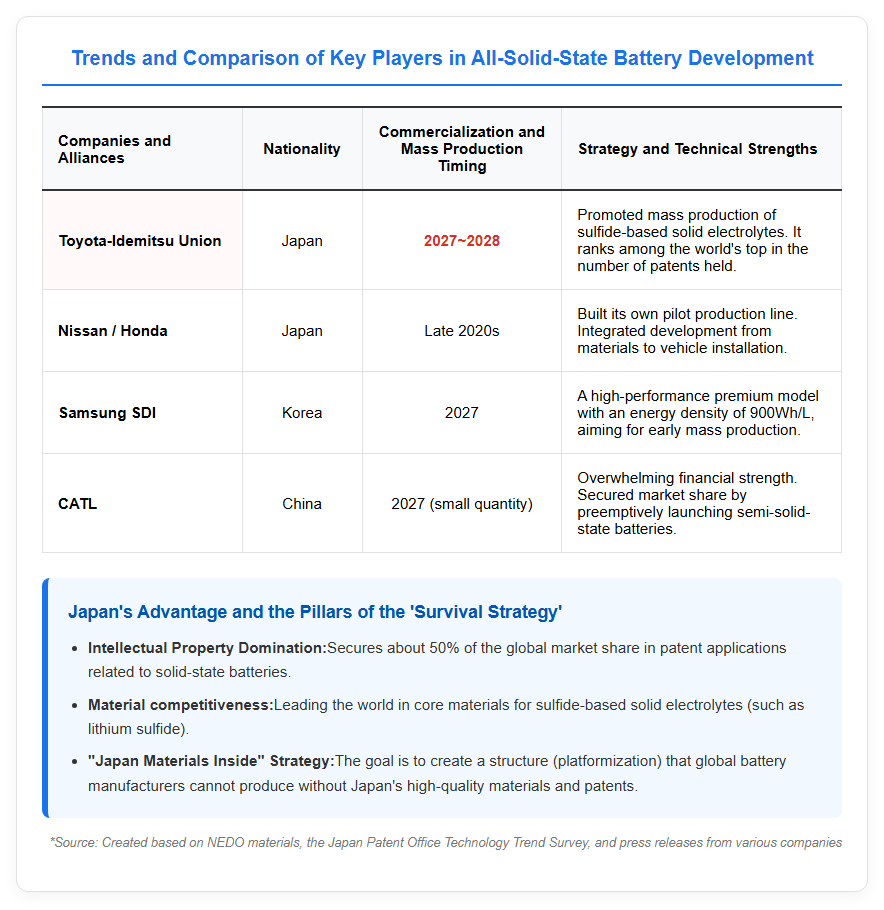
International competition for all-solid-state batteries is extremely fierce, and South Korea’s Samsung SDI is sticking to a schedule to start commercial mass production in 2027, setting an industry-leading target for energy density of 900Wh/L. While China’s CATL is aiming for small-scale production by 2027, it is also cautiously aware that technical challenges remain before full-scale commercialization begins. In response to this fierce pursuit, Japan’s survival strategy lies in controlling the throat of the supply chain through patents and materials. Japan holds about 50% of the global market share in patent applications related to all-solid-state batteries, and especially in the field of sulfide-based solid electrolytes, companies like Idemitsu Kosan and Mitsui Mining & Metals are leading globally. No matter how large the battery factory overseas is, establishing a structure that requires sourcing the core materials and intellectual property from Japan — in other words, establishing the structure of Japan Materials Inside—is key. It aims not just for mass production of finished products, but to establish itself as a platformer supporting the infrastructure of the global EV industry. Please refer to the diagram below.
Economic Impact and Remaining Challenges Toward 2040
By 2040, when all-solid-state batteries become widely available, global sales of all-solid-state battery packs for automotive use are estimated to reach approximately 2.1 trillion yen, with an annual CO2 reduction effect estimated at about 14 million tons. In the future, solid-state batteries are expected to leverage their high safety and high-output characteristics to expand their application range from high-end EVs to stationary and grid-controlled storage batteries. However, there are still high hurdles left before practical implementation. Currently, manufacturing costs are several times higher than those of conventional lithium-ion batteries, making technological innovation to reduce mass production costs essential. Additionally, it is extremely important to lead international standardization discussions through institutions such as the Japan Automobile Research Institute (JARI) and to create a market environment where Japanese technology is properly evaluated. To ensure that the pursuit of perfect quality does not delay market launch, it is necessary to advance social implementation with a sense of speed. With full-scale practical implementation in 2030 as a starting point, the battle for Japan’s battery storage industry to once again stand at the center of the world is now at a critical juncture.
[#全固体電池 #経済産業省 #蓄電池 #トヨタ #次世代技術 #EV #経済安全保障 #NEDO]


コメント