
Meta has shifted its long-standing open-source strategy to exclusively offering its new AI model, Muse Spark. Behind this is a sophisticated monetization strategy aimed at recovering over $100 billion annually in AI infrastructure investments and competing with competitors.
- Key Points of the Announcement and Launch of Paid Offerings for Developers
- A leap in performance and the lineage from “avocado” to “mango”
- The Impact of Multimodal Inference and ‘Contemporary Mode’
- “Compression of thought” achieved with one-tenth the computational load
- Pivoting to closed sources prioritizing investment recovery
- Massive annual investment of 5 billion and market concerns
- Building AI in the living area and integrating it into smart glasses
- Future Challenges and the Path to ‘Superintelligence for Individuals’
Key Points of the Announcement and Launch of Paid Offerings for Developers
On July 9, 2026, Meta announced its latest AI model, “Muse Spark 1.1,” and began offering it for developers for a paid fee. This release significantly enhances the capabilities of the initial model announced in April 2026, enabling advanced understanding of text, images, and videos, as well as coding, debugging, and autonomous use of external tools. The usage fee is set at $1.25 per 1 million input tokens and $4.25 per 1 million output tokens, aiming to capture market share at a lower price than competing Anthropic’s “Claude Sonnet 4.6.” Meta positions this model as a “bridge” connecting different software and web services, It enables the execution of complex, multi-step tasks with minimal human intervention. In particular, advanced coding and error correction capabilities are emphasized, and the developer community expects it to become a powerful tool that can truly compete with existing coding support tools like OpenAI’s Codex.
A leap in performance and the lineage from “avocado” to “mango”
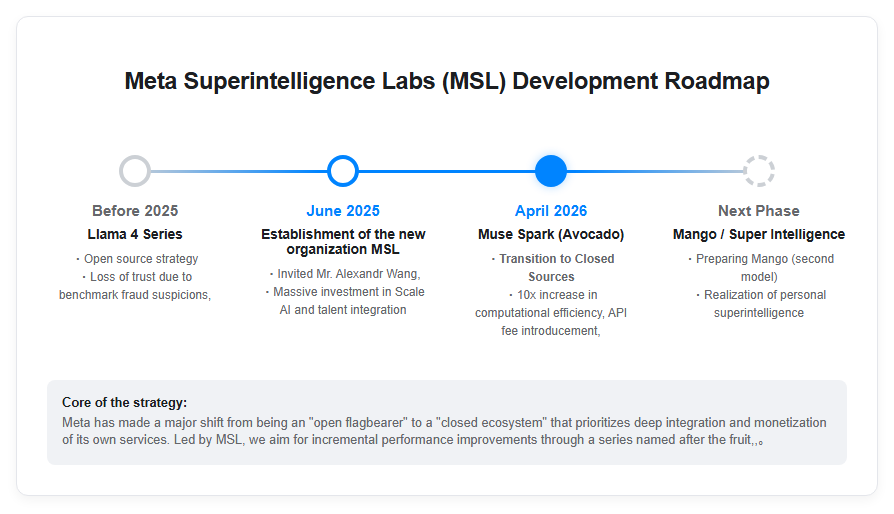
Muse Spark was born as the first result of Meta’s newly established AI research and development division, Meta Superintelligence Labs (MSL). Leading the development is Alexandr Wang, co-founder of Scale AI and appointed as Meta’s Chief AI Officer in June 2025. This model, developed in-house under the codename “Avocado,” completely revamped its development structure and architecture from the previously disappointing Llama 4. According to benchmarks from independent evaluation agencies, the Muse Spark has achieved a top 5 rating in the Intelligence Index, achieving a dramatic performance improvement over traditional models. Meta is already preparing a second model called “Mango,” and plans to gradually scale AI capabilities across the series. The diagram below outlines the development roadmap that Meta’s new organization aims for.
Unique inference technology and overwhelming computational efficiency
The Impact of Multimodal Inference and ‘Contemporary Mode’
The biggest feature of Muse Spark is that it is designed as a native multimodal inference model. It can highly process not only text but also image and audio inputs, and supports Visual Chain of Thought, which allows you to think step-by-step while “looking at images.” Furthermore, a “Contemplating mode” was introduced, where multiple sub-agents perform parallel inference and consolidate results. This mode counters advanced reasoning modes like OpenAI and Google, demonstrating overwhelming power on scientific riddles and complex reasoning tasks. In fact, the highly challenging benchmark, the “Humanity’s Last Exam,” achieved a high correct answer rate of 58%. With particular expertise in medicine and health, the training data developed in collaboration with over 1,000 physicians enables more specialized answers to questions about food nutrition and exercise function than other general-purpose models.
“Compression of thought” achieved with one-tenth the computational load
Over the past nine months, Meta has fundamentally redesigned its pre-training stack, achieving remarkable computational efficiency. As a result, Muse Spark achieves performance equivalent to the mid-size Llama 4 model, with less than one-tenth the computational load. Meta calls this “thought compression,” and through reinforcement learning, it is trained to think briefly and efficiently before answering. This efficiency is crucial for integrating AI into large-scale services used daily by billions of users, such as Instagram and WhatsApp. By optimizing the cost and speed of a single response, Meta aims to provide a stress-free, fast AI experience to the world’s largest user base. This low-cost, high-efficiency design is Meta’s greatest weapon against other frontier models, and further optimization is being advanced when combined with Meta’s self-developed chip “MTIA.”
Meta’s Strategic Shift: Moving Away from Open Source
Pivoting to closed sources prioritizing investment recovery
Until now, Meta has acted as the flagship of “open source AI” through the Llama series, but with Muse Spark, it has dramatically shifted that approach. Muse Spark is offered as a closed proprietary model, and the model’s weight is not disclosed. Behind breaking this “family motto,” the open strategy, was a realistic business demand to recover enormous development costs. If the weight is made public as open source, other companies can cheaply host their own resources, making it difficult for Meta to monetize its own APIs. CEO Zuckerberg once declared in his manifesto that “the open will win,” but as competition for cutting-edge models intensified and investment volumes ballooned into the trillions of yen, he was forced to shift toward direct monetization through exclusive offerings.
Massive annual investment of 5 billion and market concerns
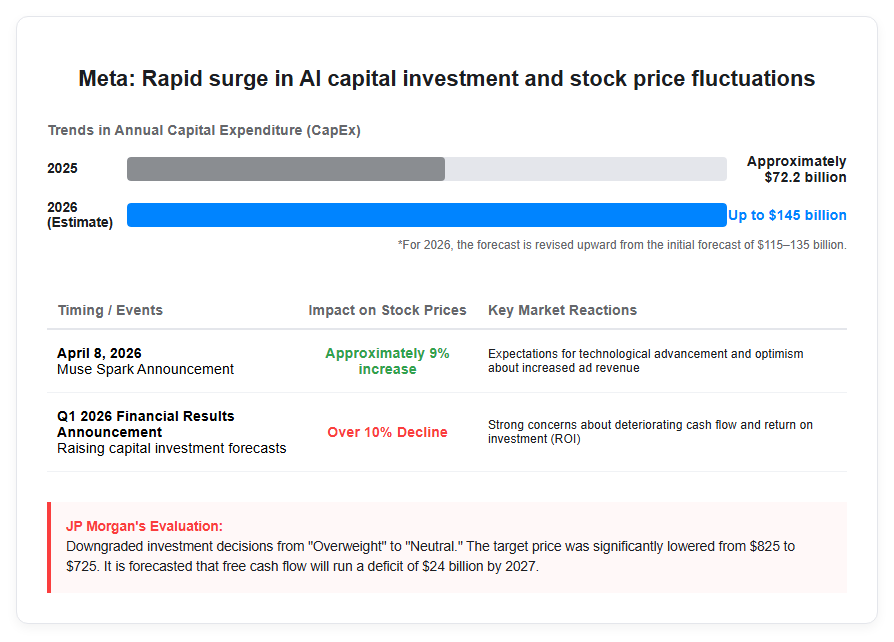
Meta’s investment in AI is so massive that it shocks Wall Street. The full-year 2026 capital expenditure forecast has been significantly raised to a maximum of $145 billion (approximately 22.7 trillion yen). This is nearly double the previous year’s approximately $72.2 billion. In response to this massive “arms race,” investors have erupted with concerns about deteriorating cash flow and return on investment (ROI), and after the earnings announcement, stock prices have plunged by more than 10%. JP Morgan analysts point out that compared to Google and Amazon, Meta’s AI monetization model outside of advertising remains unclear. Meta aims to recoup this massive investment through revenue from AI-powered advertising engines like Andromeda and GEM, API charges for the newly launched Muse Spark, and even billing for the personal AI agent Hatch. The following graph summarizes the trends in Meta’s capital expenditures and their impact on the stock price.
Evolution into an AI Agent Company and Future Prospects
Building AI in the living area and integrating it into smart glasses
What Meta envisions beyond Muse Spark is not just a chatbot, but the construction of “living area AI” that deeply integrates into human daily life. By integrating Muse Spark beyond social media platforms like Instagram and WhatsApp, they aim to bring AI into the human “field of vision” by integrating Muse Spark into the latest AI glasses, “Meta Glasses,” available starting at $299. This aims to realize personal superintelligence where AI understands what users are seeing in real time and provides shopping suggestions, directions, and translations. For businesses, we have deployed “Meta Business Agent,” establishing a system that automates reservations, customer service, and sales 24/7. Meta is shifting the core of its business model from an “advertising giant” to an “AI agent giant” that supports people’s daily lives 24/7.
Future Challenges and the Path to ‘Superintelligence for Individuals’
The Muse Spark is just the first step in Meta’s rebound offensive. Going forward, we are planning to further enhance agent functions with higher autonomy and launch the next-generation model “Mango.” However, this journey is also full of challenges. In particular, strong opposition to facial recognition features through smart glasses and concerns over user data privacy have become major risk factors that shake social trust. Additionally, as seen in the departure of lead scientist Jan Lecan, Meta’s shift toward a language model-centric strategy may cause it to fall behind competitors in research on “world models” that deeply understand the physical world. Whether Meta can achieve true “personal superintelligence” depends not only on technical savvy but also on how much it becomes a “habit” for users and gains social acceptance.
[#Meta #MuseSpark #AIエージェント #生成AI #クローズドソース #知財戦略 #マルチモーダル #MetaSuperintelligenceLabs]


コメント