On July 9, 2026, Meta announced its self-developed next-generation AI model, “Muse Spark 1.1,” and simultaneously began releasing the paid developer API “Meta Model API.” Shifting from the open-source approach maintained through the Llama series to proprietary closed models, it is taking on a serious challenge to the market dominated by OpenAI and Anthropic, armed with overwhelmingly low prices.
- Meta’s strategic shift as the first paid AI model
- Core Features and Agent Capabilities of “Muse Spark 1.1”
- Release of developer API “Meta Model API”
- “Thought compression” and “native multimodal”
- How Multi-Agent Orchestration Works
- Active context management for 1 million tokens
- Disruptive pricing strategies that overwhelm competitors
- Strengths and weaknesses seen in proprietary benchmarks
- Shopping modes and wearable integration
- Recovery of infrastructure investment and “Meta Compute”
- Expectations for the Next-Generation Model “Watermelon”
- Ongoing Challenges in Copyright Litigation and Safety
Meta’s strategic shift as the first paid AI model
On July 9, 2026, Meta began a public preview for its first paid hosted AI model, Muse Spark 1.1, for the U.S. market. Until now, the company has maintained a strategy of offering models like the Llama family as open weights for free and covering development costs with advertising revenue, but with this release, they have completely changed their approach. Behind this is the urgent challenge of recouping astronomical AI infrastructure investments, which are expected to reach up to $145 billion (approximately 23.49 trillion yen) in 2026 alone. Additionally, in March 2026, Google notified us of API supply restrictions for the AI model “Gemini,” which accelerated the full migration to its own model. Going forward, Meta will adopt a pay-as-you-go business model similar to OpenAI and Anthropic, directly competing in the global generative AI market.
Core Features and Agent Capabilities of “Muse Spark 1.1”
“Muse Spark 1.1” is designed with a focus on “agent capabilities” beyond mere text generation. Notably, the context window has been significantly expanded from the original 262K tokens to 1 million tokens. This has made it possible to retain important information while compressing old data through active memory management features, even in large codebases and long sessions. It also features three inference modes: “Instant,” which responds instantly depending on task complexity; “Thinking,” which allows for contemplation; and “Contemplating,” which runs multiple subagents in parallel. For complex tasks like “planning a family trip,” it has the capability to execute multiple steps simultaneously—such as itinerary creation, destination comparison, and booking services—while minimizing human intervention.
Release of developer API “Meta Model API”
At the same time as the model announcement, Meta released the OpenAI-compatible “Meta Model API” as a public preview. This API is designed so that developers can easily switch their existing codebase to Meta’s endpoints simply by changing the base URL and API key. At launch, developers in the United States will be eligible, and new accounts will receive a free credit of $20 (about 3,240 yen). Alexander Wang, Chief AI Officer at Meta AI, promotes this API as “pricing that scales to massive consumption,” suggesting it is a strategic move to position itself as a B2B cloud provider. As of July 2026, the full release date for the Japanese version has not been announced.
Technical Background and Innovative Architecture
“Thought compression” and “native multimodal”
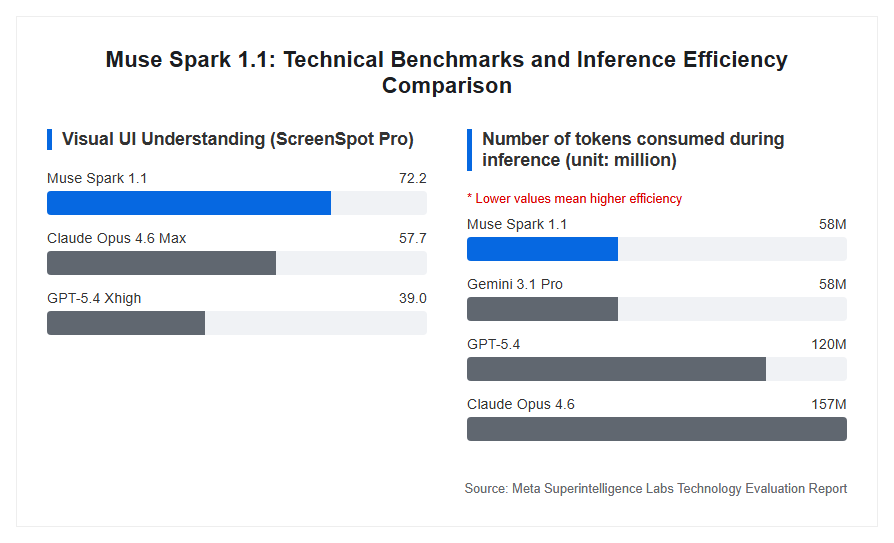
Muse Spark 1.1 is not just an expanded version of existing model parameters; it adopts a fundamentally new technological approach. At the core of this is the “Thought Compression” technology in reinforcement learning. This algorithm imposes penalties for excessive token consumption (thought time) alongside rewards for correct answers, resulting in an algorithm that can now provide equivalent intelligence with about half the number of tokens compared to competing models like GPT-5.4. Additionally, from the early stages, it is built as a “native multimodal,” processing text, images, and audio simultaneously with a single logic. The resulting “Visual Chain-of-Thought” enables logical reasoning in dynamic visual environments and offers advanced support such as real-time correction of yoga forms.
Please refer to the diagram below.
How Multi-Agent Orchestration Works
In scaling inference, Meta adopts a unique philosophy of “horizontal deployment of multiple agents” rather than “single-agent deep exploration.” In the “Contemplating Mode” included in Muse Spark 1.1, multiple sub-agents instantly launch behind a single complex prompt. These multiple agents divide tasks such as analysis, search, and configuration in parallel, ultimately integrating them into a single comprehensive answer. This orchestration capability eliminates response delays caused by long periods of thinking for a single model, enabling advanced reasoning to be delivered at near-real-time speeds. In fact, it outperforms competitors in executing plans across multiple tools and handling zero-shot responses to unknown custom skills.
Active context management for 1 million tokens
Muse Spark 1.1 is equipped with the ability to actively manage a massive context window of 1 million tokens to meet the vast data handling of modern AI scenarios. It not only retains data but also performs advanced processing that effectively extracts information from past work steps and compresses unnecessary data while preserving important context. This enabled a stable execution environment where information “forgetting” and inconsistencies were less likely to occur during debugging thousands of lines of source code and in-depth investigations based on vast amounts of documents. It also supports Anthropic’s proposed open standard, the Model Context Protocol (MCP), ensuring flexibility to instantly integrate with existing tools and skills without individual fine-tuning.
Market Competition and the Social Impact of Practical Application
Disruptive pricing strategies that overwhelm competitors
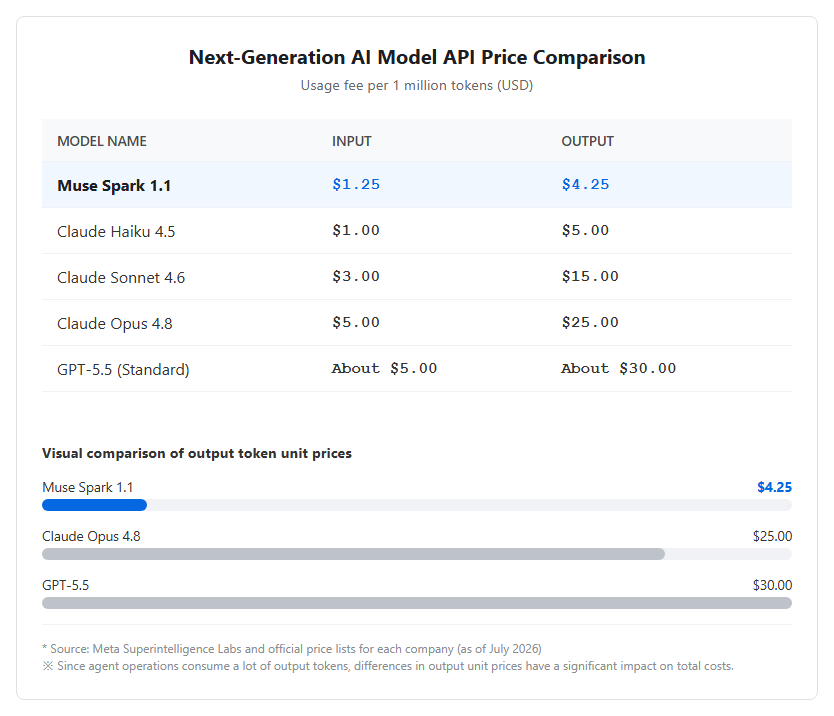
The biggest shock Meta has made is its “unbeatable” API pricing, about a quarter of that of competitors’ flagship models. The usage fee for Muse Spark 1.1 is set at $1.25 per 1 million input tokens and $4.25 per 1 million output tokens (about 689 yen). This is overwhelmingly cheaper compared to Claude Opus 4.8 ($25) and GPT-5.5 (about $30), offering a significant advantage in output costs, which are especially critical for agent operations. Meta has the foundation for advertising revenue that allows Meta to continue offering this API as a strategic “loss leader” (flagship product), even at the risk of losses. This cost reduction is expected to dramatically reduce the cost of running thousands of AI agents in parallel, enabling even small and medium-sized developers to build advanced autonomous systems.
Please refer to the diagram below.
Strengths and weaknesses seen in proprietary benchmarks
In benchmark evaluations, Muse Spark 1.1 clearly demonstrates its role as a “domain-specific powerhouse.” On the “MCP Atlas,” which evaluates tool usage, it scored 88.1, surpassing models from Anthropic and OpenAI, while in “DeepSWE 1.1,” which tests long-term coding ability, it is more than 13 points ahead of GPT-5.5. Additionally, it scored low in “ARC-AGI-2,” which measures abstract reasoning and unknown pattern recognition, It is clear that Meta focused its resources on “supporting the daily lives of general users” rather than being a “universal tool for programmers.” A notable strength lies in the medical and healthcare fields, where rigorous training in collaboration with over 1,000 practicing physicians has led to scores in scientific reasoning that outperform competing models.
Shopping modes and wearable integration
Meta’s uniqueness in practical application lies in the fusion of social graphs on social media and AI. Muse Spark 1.1 features the industry’s first “Shopping Mode,” where AI learns users’ preferences and interests on Instagram and suggests personalized products through conversation. Furthermore, by integrating with smart glasses such as Ray-Ban Meta, we aim to realize “ambient (environment-integrated) computing,” where AI interprets the user’s vision in real time and guides it with voice. For example, you can identify products based on the scenery you are looking at and then compare prices directly on Facebook Marketplace, creating a seamless purchasing experience. This can be seen as a paradigm shift that transforms AI from a “work tool” into a “daily infrastructure.”
Future Developments, Key Points, and Ongoing Challenges
Recovery of infrastructure investment and “Meta Compute”
Meta’s most important future challenge is monetizing massive capital investments. The company is constructing the massive data center Hyperion in Louisiana, with a total construction cost of $27 billion, aiming to secure an unprecedented computing capacity of 5 gigawatts (GW) by 2030. Along with this, the launch of a new division, “Meta Compute,” to lend surplus computing resources to external customers, was also announced. The paid API for Muse Spark 1.1 is not just about selling AI models; it is also a touchstone for Meta’s transformation into an “AI cloud provider” that competes with AWS and Azure. CEO Zuckerberg envisions an ambitious vision to deliver “personal superintelligence” to 3 billion users worldwide based on this infrastructure.
Expectations for the Next-Generation Model “Watermelon”
Meta is already working on developing even more powerful next-generation models alongside the release of Muse Spark 1.1. It was discovered that a model codenamed “Watermelon,” which uses more than ten times the computing resources of Muse Spark 1.1 in the 1GW-class cluster “Prometheus” currently under construction in Ohio, is currently under training. This model aims to overcome the advanced abstract reasoning and long-term coding capabilities that challenged Muse Spark, and to fully surpass the top-tier models of OpenAI and Google. Additionally, it has been clearly stated that an “open-source version” of Muse Spark, which is currently closed, is still in development, and how it will be delivered in the future has become a major concern for the community.
Ongoing Challenges in Copyright Litigation and Safety
Amid rapid development, legal risks and ensuring safety are also major concerns. In February 2026, a class-action lawsuit was filed by creators over major copyright infringement on Meta’s platform. The outcome of this lawsuit has a significant impact on securing training data for generative AI, and it is pointed out that rising rights processing costs may put a brake on development competition. In terms of safety, Muse Spark 1.1 features industry-leading guardrails, with over 98% of the time it rejects dangerous questions related to biological and chemical weapons, but vulnerabilities to jailbreak attacks involving multiple turns (multiple interactions) remain unresolved. Financial authorities have also raised concerns that the runaway of autonomous agents could pose systemic risks, and balancing the expansion of functionality with security will be key to future adoption.
[#Meta #MuseSpark #生成AI #AIエージェント #機械学習 #ビッグテック #科学技術]
コメント