
Fujitsu announced that it will begin manufacturing domestically produced AI servers compatible with NVIDIA’s next-generation GPU “Rubin” starting in fall 2026. Behind this is the growing demand for “Sovereign AI” from an economic security perspective, and a strategic partnership aimed at developing the next-generation supercomputer “Fugaku NEXT” aiming for 2030.
- Domestic production of the “Rubin” generation to begin in autumn 2026
- The overwhelming computing performance brought by the next-generation GPU “Rubin”
- AI infrastructure to protect national sovereignty: ‘Sovereign AI’
- Reliability of “Made in Japan” at the Kasashima Factory
- 40 Years of Water Cooling Technology Supporting GPUs That Generate Heat
- Outlook for “Fugaku NEXT” and the domestic processor “MONAKA”
Domestic production of the “Rubin” generation to begin in autumn 2026
On July 14, 2026, Fujitsu announced at its own event, “Fujitsu Experience Day 2026,” that it plans to begin manufacturing domestically produced high-end AI servers compatible with NVIDIA’s next-generation GPU microarchitecture “Rubin” starting in autumn 2026. Since March 2026, the company has already announced that NVIDIA’s ” They have begun manufacturing sovereign AI servers equipped with “Blackwell” generation GPUs, aiming for early market launch as next-generation models following this. Manufacturing takes place at the Fujitsu Group’s Kasashima Plant in Kahoku City, Ishikawa Prefecture, known for producing high-performance servers such as the supercomputer ‘Fugaku’. The diagram below shows the positioning of the company’s manufacturing sites.
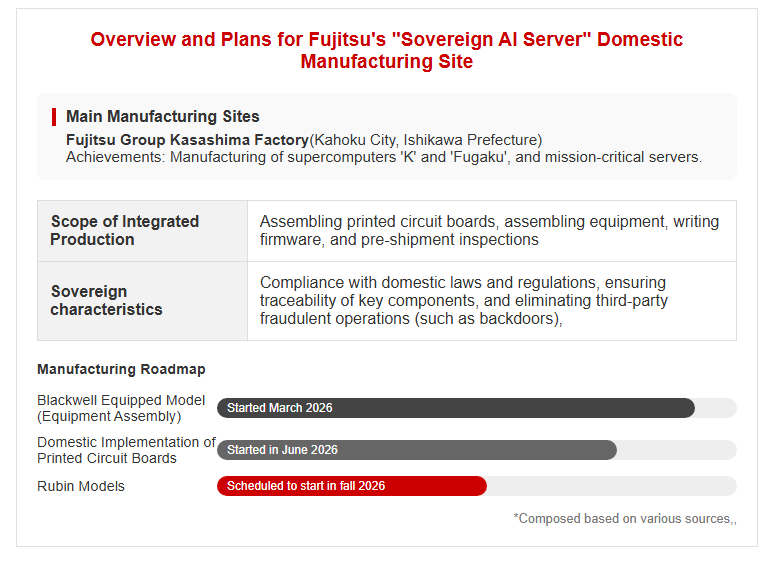
With this integrated domestic production system, the entire process from design to manufacturing and inspection is completed within Japan, aiming to ensure reliability and sovereign performance at the hardware level. It is intended to provide AI infrastructure to clients requiring high security such as finance, public sector, and research institutions, especially as an AI infrastructure supporting mission-critical domains.
The overwhelming computing performance brought by the next-generation GPU “Rubin”
NVIDIA’s next-generation microarchitecture, Rubin, is designed to deliver performance improvements that surpass the previous generation Blackwell. Rubin is manufactured on a 3nm process and features next-generation wide-bandwidth memory, HBM4. For example, in the 4-bit floating-point (FP4) operations frequently used in AI, Blackwell achieved 20 petaflops, while Rubin reached 50 petaflops—2.5 times the performance. Furthermore, in 2027, a “Rubin Ultra” with two Rubin cores connected is planned, aiming to boost performance up to 100 petaflops. Fujitsu’s rapid response to this latest architecture is of great significance for accelerating the training and inference of generative AI and large language models (LLMs) within domestic infrastructure. Additionally, the Rubin generation is planned to be paired with a new CPU called “Vera,” which is expected to set a new standard for accelerated computing.
“Sovereign AI” and the Strategic Significance of Domestic Production
AI infrastructure to protect national sovereignty: ‘Sovereign AI’
In recent years, in response to the current situation where AI value chains are highly dependent on companies in the United States and China, the concept of “sovereign AI,” which involves controlling domestic data and infrastructure independently, has rapidly gained popularity. Overreliance on overseas AI models and cloud services risks economic security risks, such as the leakage of confidential data abroad or service outages due to geopolitical circumstances. Fujitsu’s proposed “Sovereign AI Server” can operate under Japanese domestic regulations and addresses these concerns by ensuring traceability down to hardware components. This means not just being “domestic,” but maintaining technical control domestically and creating an environment where AI development reflecting the country’s culture and values can continue. Please refer to the diagram below.
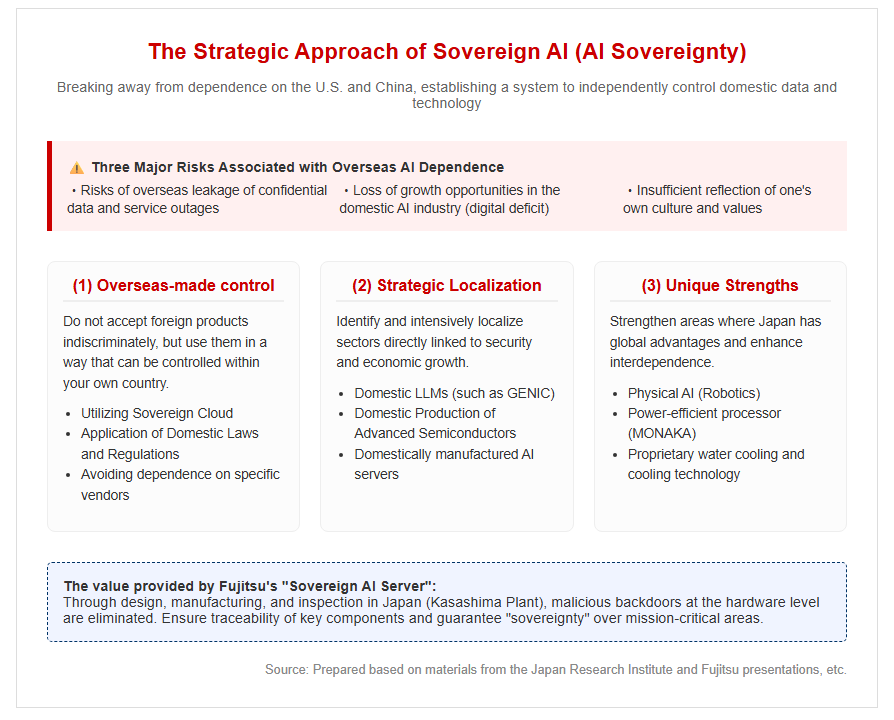
The Japanese government is also supporting the strengthening of domestic AI development capabilities through the “GENIAC” project, and Fujitsu’s efforts are closely linked to this national strategy.
Reliability of “Made in Japan” at the Kasashima Factory
Fujitsu’s Kasashima plant in Ishikawa Prefecture, responsible for manufacturing AI servers, is the heart of the company’s high-end computing manufacturing and has a proven track record of delivering world-class supercomputers like the K-series and Fugaku. For the Blackwell generation server manufacturing, which began in March 2026, a system has been established domestically to handle not only equipment assembly but also printed circuit board assembly. To prevent the establishment of external backdoors (unauthorized entry routes), the entire process from firmware writing to hardware operation verification is completed within the company’s own group, ensuring strict quality control without third-party involvement. This advanced manufacturing technology has been highly praised by NVIDIA CEO Jensen Huang for “enabling full-stack collaboration,” and it is the source of Fujitsu’s strength in consistently delivering everything from silicon levels to applications. From autumn 2026, Rubin-compatible models are expected to apply this highly reliable manufacturing process inherited from “Fugaku.”
Roadmap and Technical Foundation for the Next Generation
40 Years of Water Cooling Technology Supporting GPUs That Generate Heat
With the improvement in AI server performance, GPU power consumption and heat generation have increased dramatically, making it difficult for conventional air-cooled systems to achieve cooling. In contrast, Fujitsu has introduced its proprietary “liquid cooling solution,” cultivated over more than 40 years in general-purpose machines and supercomputers, into its AI servers. The company’s liquid cooling technology circulates liquids with higher thermal conductivity than air, achieving about 40% power savings across the entire facility. Additionally, to prevent mission-critical operations, the CDU (coolant distributor) pumps supplying cooling water are doubled, allowing the system to continue operating even in the event of a failure by supporting “active exchange,” a unique strength not found in other companies. Racks equipped with high-output GPUs like Blackwell and Rubin can generate tens of kilowatts of power per rack, making this advanced water cooling technology an essential element for achieving sustainable data center operations.
Outlook for “Fugaku NEXT” and the domestic processor “MONAKA”
Fujitsu’s AI strategy extends beyond a single server product to the development of the next-generation supercomputer “Fugaku NEXT,” aiming for operational launch around 2030. This project, jointly advanced by RIKEN, Fujitsu, and NVIDIA, aims to achieve the world’s first Zettascale in AI performance (FP8). The insights gained from this massive project will be gradually fed back to product lines such as Rubin-compatible servers. Additionally, alongside equipping NVIDIA GPUs, Fujitsu plans to begin manufacturing domestically produced servers equipped with its self-developed power-saving processor, FUJITSU-MONAKA, within fiscal 2026. MONAKA is based on the Arm architecture, achieving advanced data confidentiality through overwhelming power efficiency and confidential computing technology. By leveraging NVIDIA’s powerful ecosystem and differentiating itself through its own silicon, Fujitsu will simultaneously secure Japan’s computing sovereignty in the era of “Sovereign AI” and strengthen its competitiveness in the global market.
[#富士通 #NVIDIA #Rubin #ソブリンAI #富岳NEXT #国産サーバ #液冷技術 #科学技術]


コメント