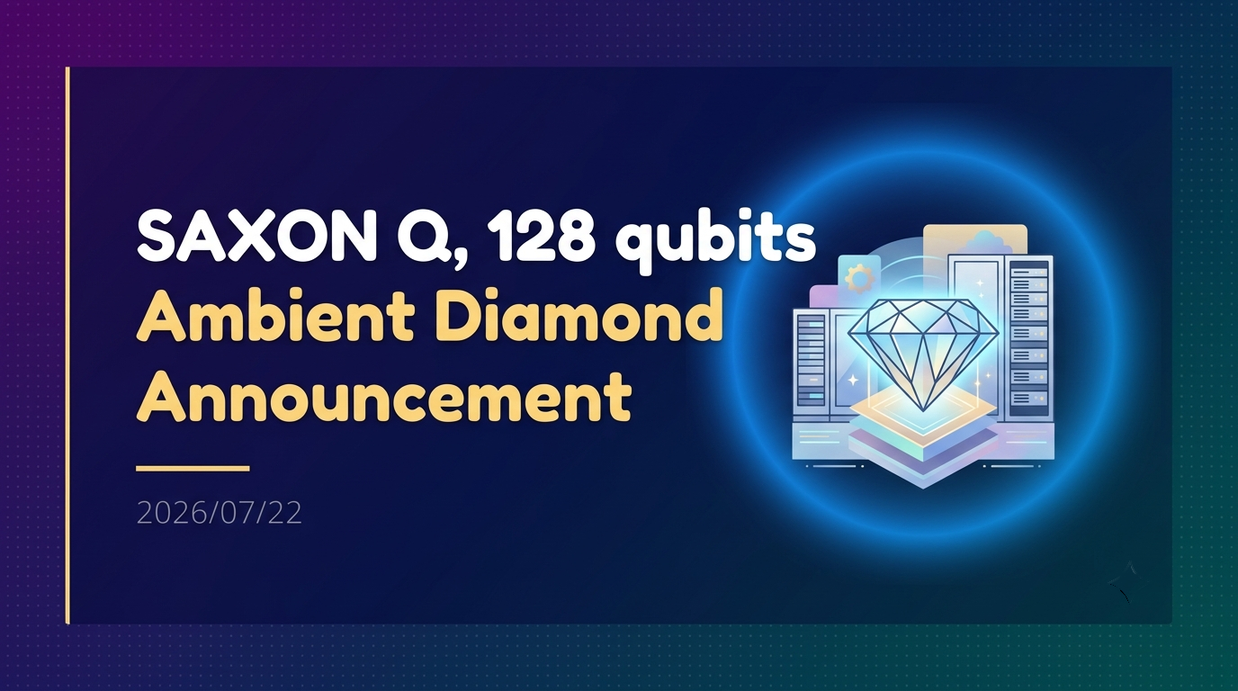
SAXON Q, a German quantum computing startup, has announced the commercial release of its SXQ128, a diamond quantum computer running at room temperature and equipped with 128 qubits. Behind this is a proprietary nitrogen cavity (NV) center technology that does not require cryogenic refrigeration units, and a scalable design philosophy that enables easy integration into standard server environments.
- Commercialization of Diamond NV Center Technology for Room Temperature Operation
- Historical Background and Academic Foundation of the University of Leipzig
- The Path to 128 Qubits and Scalability
- Outstanding energy efficiency and integration with existing server environments
- Vibration-resistant and robust mobile quantum computer characteristics
- Demonstration in Industry and Provision of Cloud Platform
- Expanding partnerships and market adoption
- A future aimed at miniaturization and integration into smartphones
Commercialization of Diamond NV Center Technology for Room Temperature Operation
On July 22, 2026, SAXON Q, a spin-off from the University of Leipzig in Germany, officially announced the commercial release of the 128-qubit “SXQ128” and the 512-qubit “SXQ512.” This is the first commercial system in a diamond-based nitrogen-cavity (NV) center quantum processor with more than 10 physical qubits. Many conventional quantum computers required massive refrigeration units to cool to around minus 273 degrees Celsius to maintain superconducting circuits, vacuum infrastructure, and even specialized cleanroom facilities. However, the SAXON Q system enables operation at room temperature by utilizing unique defects inherent in the diamond’s crystal structure. This technological advancement marked a major step forward for quantum computing from a “giant experimental device” to a “practical calculator.”
Historical Background and Academic Foundation of the University of Leipzig
The technical foundation of SAXON Q lies in years of research at the Felix Bloch Institute for Solid-State Physics at Leipzig University. Leipzig is also known as the “cradle of solid quantum mechanics,” where pioneers of quantum mechanics such as Werner Heisenberg and Felix Bloch were active in the field. From this historic academic environment, SAXON Q was established in 2021 by physicists Professor Marius Gruntmann and Professor Jan Meyer. The company’s team consists of about 20 physicists and computer scientists, who play a key role in directly bridging the university’s outstanding research achievements to industry. The company is recognized as one of the most notable startups in Germany, having won the Saxon Founders’ Prize in 2025. Please refer to the image below.
The Path to 128 Qubits and Scalability
SAXON Q has been steadily and rapidly expanding its qubit count according to a roadmap. In 2023, we started with a four-qubit system utilizing one NV center and three nuclear spins, and by 2025, we have achieved ten qubits. And in the newly announced 2026 commercial model, a multicore strategy that operates multiple cores in parallel achieves 128 qubits (8 cores, 16 qubits each). What makes this scaling possible is our proprietary patterning technology, which applies manufacturing processes established in the semiconductor industry to diamond chips. Plans are underway to expand to 512 qubits by 2027 and to several thousand bits after 2030, with further miniaturization progressing from desktop size to chip size in parallel.
Operational efficiency and suitability for industrial infrastructure
Outstanding energy efficiency and integration with existing server environments
One of the biggest features of the SXQ128 and SXQ512 is their outstanding energy efficiency. These systems operate solely on power from standard AC outlets and achieve energy efficiency six to ten times higher than classic GPU-based hardware clusters. Additionally, it is designed to slide directly onto standard 19-inch server racks, allowing for deployment without significantly altering existing data center infrastructure. While traditional quantum machines required enormous cooling costs and installation space, SAXON Q’s system offers a plug-and-play approach that can be naturally integrated into a company’s existing IT environment.
Vibration-resistant and robust mobile quantum computer characteristics
The diamond-based NV center technology also offers extremely high resistance to noise and vibration from the environment. This characteristic enables operation in mobile and harsh environments previously unimaginable with quantum computers. SAXON Q defines its system as a “mobile quantum computer” and is considering future applications such as autonomous vehicles, medical devices, and even use within satellites. Since it lacks a cooling device, it has the potential to shrink to a size that fits in a handbag or small box, and within a few years, the realization of quantum chips embedded inside smartphones is even a goal.
Demonstration in Industry and Provision of Cloud Platform
The SAXON Q system has already been adopted by multiple research institutions and industry partners. The German Aerospace Center (DLR) received industry certification in 2024, and from 2025, external users will be able to use real aircraft qubits through the QCi Connect cloud platform. It has also started operations at the Frauenhofer IWU Institute in Dresden, where quantum computing is directly integrated into the institute’s proprietary programs through a new API, enabling software development for industrial use. In this way, companies’ access to quantum computing is rapidly expanding both via the cloud and on-premises (off-premises).
Future Outlook and Significance for Society
Expanding partnerships and market adoption
SAXON Q is strengthening partnerships not only for technological development but also for commercial adoption. Starting April 1, 2025, Bechtle, a leading European IT services company, has added SAXON Q quantum computers to its product portfolio, launching sales and support. In June 2026, the team at Bechtl’s Competence Center will become the first certified partner for the deployment of the SAXON Q system. This integration with existing sales networks is a crucial step in transforming quantum computers from tools for limited researchers into business solutions used daily by a wide range of companies. Please refer to the diagram below.
A future aimed at miniaturization and integration into smartphones
After the release of the SXQ128, the company’s next goal is to further “increase chip size” in the technology. Currently, we have received a seven-figure euro investment from the Technology Founders Fund Saxonia (TGFS), which is accelerating the next phase of scaling and downsizing. Through the integration process into the company’s patented CMOS semiconductor technology, the company is expected to evolve from current desktop sizes to embedded quantum processors in the future. As a result, an era is approaching where our familiar devices benefit from quantum computing in fields such as rapid data analysis in medical research, logistics optimization, and even advanced artificial intelligence.
Reference Page
-
【Investors – SaxonQ】https://www.saxonq.com/investors/
-
【News – SaxonQ】https://saxonq.com/news-press/
-
【Whitepaper – SaxonQ】https://saxonq.com/whitepapers/
-
【Company – SaxonQ】https://saxonq.com/company/
[#量子コンピュータ #量子技術 #ダイヤモンド量子コンピュータ #SAXONQ #常温動作 #次世代技術 #ディープテック #ライプツィヒ]


コメント