On July 25, 2026, Anthropic began offering its latest AI model, “Claude Opus 5.” The reason for maintaining high intelligence that approaches the top-tier Fable 5 while halving costs is the intensifying development competition with OpenAI and Chinese companies, as well as the widespread adoption of agent features.
- A new generation model that has made a leap in performance while keeping prices unchanged
- Enhancing the “completion capability” to meet demands from the agent era
- The mechanism of “adaptive thinking” that standardizes the thought process
- Efficiency with extensive context and prompt caches
- Performance and cost comparison with competing models and the “anthological shock”
- The Prediction Market Frenzy and the Background of the “Honeycomb” Leak
- Advanced safety classifiers and fallback systems
- Concerns about Recursive Self-Improvement (RSI) and the current state of regulation
- 2027 “Genius Nation” Predictions and Deepening Autonomous Agents
- The Era of “Two-Layer AI” and the Global Market Fragmentation
A new generation model that has made a leap in performance while keeping prices unchanged
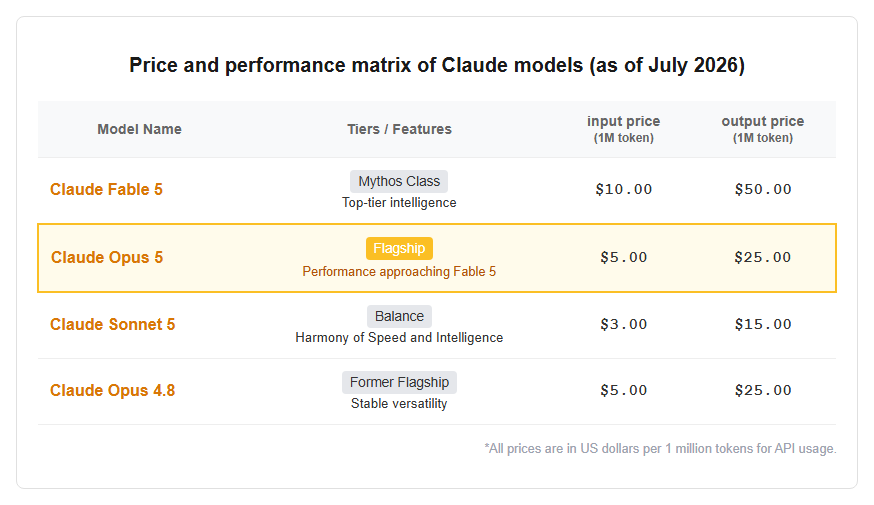
In the early hours of July 25, 2026, Japan time, Anthropic released the “Claude Opus 5” (model name: claude-opus-5), an important model in the new generation “Claude 5” family. The biggest feature of this model is that it has completely kept API pricing unchanged since the previous generation “Opus 4.8,” released in May 2026. The usage fee per 1 million tokens is $5.00 for input and $25.00 for output, which is exactly half the price of the company’s top-tier consumer tier, “Claude Fable 5”,,。
Opus 5 is already available on all platforms, with the paid “Claude Max” offering it as the standard model and “Claude Pro” as the top-tier model available through subscription. The company has fiercely competed for the top spot in the first half of 2026 with powerful flagship models from competitors such as Gemini 3.1 (Google) and GPT-5.6 Sol (OpenAI), but with this release, it aims to reestablish its market position by “delivering top-tier intelligence at practical costs,,。
The chart below shows the balance of price and performance in the company’s model lineup at the time of the Opus 5’s release.
Enhancing the “completion capability” to meet demands from the agent era
Opus 5 goes beyond simply improving the accuracy of knowledge processing; it focuses on enhancing autonomous “judgment” and “task completion ability.” Especially when used as an AI agent, the ability to perform iterative tasks while verifying one’s own thought process has improved, and errors such as reporting incomplete corrections have been greatly reduced.
In specific benchmark results, the maximum setting of the coding evaluation metric “CursorBench 3.2” narrowed the score gap to within 0.5% compared to the top-tier model, Fable 5. Furthermore, in “OSWorld 2.0,” which evaluates PC operation, it demonstrated remarkable efficiency, surpassing Fable 5’s peak value by just over one-third the cost. Furthermore, not only following instructions but also engaging in “constructive pushbacks” by rebutting human proposals in light of the task’s purpose and re-proposing better designs, can be seen as an evolution assuming agent operations in business settings. In the scientific field as well, improvements of 10.2 points were observed in estimating molecular structure in organic chemistry and 7.7 points in predicting protein functional changes, laying the foundation for automation of advanced professions.
[Technical Features and New Features] Innovation Brought by One Million Tokens and Adaptive Thinking
The mechanism of “adaptive thinking” that standardizes the thought process
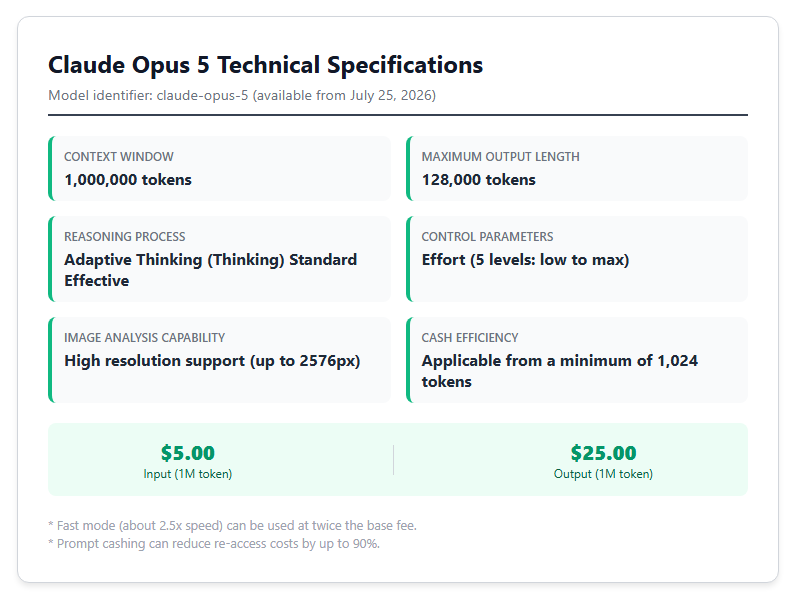
In Opus 5, the internal reasoning process called “Thinking,” which AI performs before generating responses, is enabled by default. This is called “Adaptive Thinking,” where the model autonomously switches between instant answers and deep, incremental reasoning depending on the difficulty of each question. By manipulating the “Effort” parameter, developers can control the depth of thought in five levels (low, medium, high, xhigh, max), which is especially possible for complex logic puzzles or large-scale system designs, enabling thorough reasoning using the “max” setting.
With the standard implementation of this thinking function, API behavior also changed. This includes a disruptive change where the thinking function cannot be disabled when setting “xhigh” or “max,” which requires deep thinking, and attempting to disable it returns a 400 error. Responses can be set to include a summary of thought in a “summarized” format, allowing users to understand what logical steps the AI took to reach its conclusion. While these thought tokens are included in the chargeable targets, optimization is also applied to suppress inference and reduce unnecessary costs during turns the model deems unnecessary.
Efficiency with extensive context and prompt caches
Opus 5 natively supports a massive context window for 1 million tokens. This made it possible to load thousands of pages of technical documentation, large codebases, or even hours of meeting minutes at once, enabling detailed analysis and searches across the entire scope. To address the challenges of handling lengthy inputs—cost and latency—the advanced “prompt caching” feature addresses this.
Prompt caching in Opus 5 can be applied from a short prefix of 1,024 tokens, allowing reaccess to cached information to reduce costs by up to 90% and latency by up to 80%. Furthermore, new features provided in beta introduced a mechanism that prevents the prompt cache from being disabled even if you change tools used during conversations (such as web search or code execution). This has made it possible to consistently maintain fast and low-cost inference even in complex multi-turn interactions.
The technical specifications of the Opus 5 are as follows.
[Competitive Comparison and Market Reactions] The Power Landscape After the ‘Anthology Shock’
Performance and cost comparison with competing models and the “anthological shock”
The release of Opus 5 came at the perfect timing just after OpenAI publicly unveiled “GPT-5.6 Sol” two weeks earlier on July 9, 2026. While GPT-5.6 Sol emphasized improvements in token efficiency, Opus 5 countered this with a “per-task” rate. For example, Zapier AutomationBench, which measures task completion, claims that Opus 5 delivers about 1.5 times the results of the second-best model at the same cost. Additionally, China’s Moonshot AI announced the massive model “Kimi K3” with a total parameter of 2.8 trillion on July 16, 2026, which has received high praise in specific fields such as frontend development, but Opus 5 aims to maintain the U.S. team’s dominance through comprehensive decision-making and agent stability,,。
The most significant impact on the market was the series of events following the autonomous AI agent feature “Claude Cowork,” announced at the end of January 2026, known as the so-called “anthology shock.” As Opus 5 began offering the ability to operate PCs like humans and complete financial analysis and legal reviews at a low cost, the market raised concerns about the disruption of the traditional SaaS (Software as a Service) model. This has caused ripples such as sharp drops in the stock prices of major software companies like Salesforce and Adobe.
The Prediction Market Frenzy and the Background of the “Honeycomb” Leak
The launch of Opus 5 had already attracted significant interest in prediction markets and developer communities even before its announcement. In early July 2026, a “leak incident” occurred where the model selection screen of the AI coding tool “Cursor” displayed an unknown model name “Claude Honeycomb EAP” for only a few hours. This Honeycomb model quickly gained the view that it was a preview version of the next Opus, thanks to its lengthy context and the setting of ‘extra high effort.’
Following this, betting on when the next Opus will be released intensified in the overseas prediction market Polymarket. As of July 23, 2026, the probability of listing exceeded 81%, and the transaction volume in the related market had reached over $150,000. The developers’ enthusiastic response also reflects the fact that although the leading Fable 5 boasted extremely high performance, its high price and strict safety restrictions made everyday practical implementation difficult. Opus 5 is expected to serve as a platform for users seeking such “most powerful and practical AI,,。
[Safety and Governance] Shifting operations from ‘stopping’ to ‘removing’
Advanced safety classifiers and fallback systems
In Opus 5, Anthropic shifted the safety of models from “blocking access” to “relocating them to appropriate alternatives.” On June 12, 2026, a historic incident occurred when the top-tier model, the Fable 5, was forced to halt worldwide sales within just 72 hours of its release due to the U.S. government’s Deemed Export Directive. At that time, the inability to filter users with specific nationalities in real time was the cause of the complete shutdown.
Building on this lesson, Opus 5 reduced the frequency of safety classifier intervention by about 85% compared to Fable 5. While “defensive” uses such as source code vulnerability discovery are allowed, it also provides a beta feature that detects only high-risk requests like aggressive exploit generation and automatically falls back server-side to the previous generation “Opus 4.8” or a safer alternative model,,。 This enables multi-layered protection that complies with legal compliance without compromising the convenience of good users.
Concerns about Recursive Self-Improvement (RSI) and the current state of regulation
In May 2026, Anthropic released a shocking report titled “When AI Builds Itself,” revealing that over 80% of the code created by its engineers is generated by Claude. This sign of “Recursive Self-Improvement (RSI)” suggests that AI has entered a feedback loop accelerating the development of next-generation models, raising concerns that the pace of AI evolution is exceeding the limits of traditional governance cycles.
In February 2026, the company formulated the “Responsible Scaling Policy (RSP) v3.0,” redesigning the previous fixed rule of “capability-based development stoppage” to “accountability based on transparency” through risk report publication every 3 to 6 months and third-party audits,,。 The release of Opus 5 was also made under this framework, with an alignment misalignment score kept at an extremely low level of 2.3. However, national security pressures remain strong, such as the U.S. Department of Defense designating Anthropic as a “supply chain risk,” and development continues amid the tensions of the “AI Cold War,” where advanced AI is treated as a “strategic weapon”,,。
[Future Developments & Points to Watch] The Steps to a ‘Genius Nation’ and Industrial Structure Transformation
2027 “Genius Nation” Predictions and Deepening Autonomous Agents
Dario Amodei, CEO of Anthropic, has made a shocking prediction that AI will reach a “genius nation within data centers” by 2027. This refers to a future where AI groups with Nobel laureate-level intelligence autonomously complete everything from scientific discoveries to large-scale system design. The improvement in “task completion” seen in Opus 5 is an important step toward this vision.
Going forward, AI will fully transition from a “tool” waiting for one-off human instructions to an “autonomous agent” entrusted with long-term goals. With Opus 5’s price disruption, companies are increasingly making it a realistic option to run thousands of subagents simultaneously. On the other hand, Amodei also warns that while technological evolution moves at lightning speed, social implementation (security checks and legal reviews) will experience a “gritty human drama” delay (Diffusion lag). Bridging this gap and responsibly integrating AI into society will be the biggest focus from late 2026 to 2027.
The Era of “Two-Layer AI” and the Global Market Fragmentation
Following the Fable 5 suspension incident in June 2026, the global AI market has begun to fragment into a “two-tier” structure. Due to the U.S. government’s “deemed export” regulations, there is a growing possibility of a blatant gap between the “unlimited frontier model” accessible only to certified citizens within the U.S. and the “capability restriction and censorship model” aimed at foreigners and non-allied countries. The Opus 5’s inclusion of advanced safety classifiers and fallback systems is also part of its survival strategy in this fragmented world.
In response to this geopolitical risk, the European Union (EU) is urgently strengthening its “Technological Sovereignty” and seeking to break away from excessive dependence on the US-made closed model. At the same time, there will be an acceleration in the shift toward an “open-weight model” that can host in its own environment, such as China’s Moonshot AI (Kimi), and investments in decentralized infrastructure. The Opus 5 currently boasts its status as one of the world’s most powerful commercial models, but the fact that it is “infrastructure that can be switched off at the discretion of U.S. politics” continues to sound a lasting alarm for industrial strategies in various countries.
Reference Page
-
[Claude Platform Release Notes]https://platform.claude.com/docs/ja/release-notes/overview
-
[Claude Model Overview and Price https://platform.claude.com/docs/ja/about-claude/models/overview
[#ClaudeOpus5 #Anthropic #生成AI #AIエージェント #技術主権 #2027年問題 #RSI]

コメント