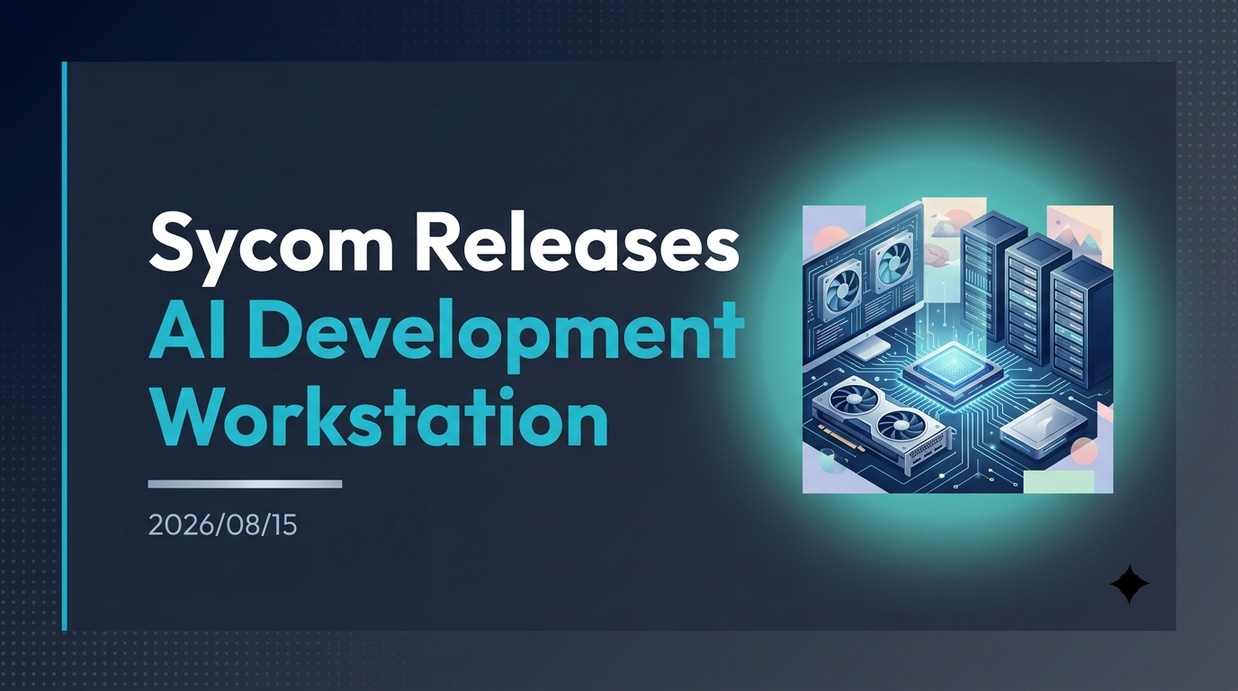
Sycom, a Japanese BTO (Build to Order) PC manufacturer, has released the “Lepton Twin GPU Edition,” a workstation specialized for AI and Large Language Model (LLM) development. This move addresses the growing demand in Japan for stable, local computing resources as enterprises shift away from total cloud dependency for sensitive AI research.
Launch of New AI Workstations by Sycom in Japan
- Key Points and Product Lineup for Professional AI Development
- Dominant VRAM Capacity via Dual GPU Configurations
- Maximizing Outcome per Hour through Advanced Cooling Technology
- The 2027 AGI Roadmap and the Strategic Value of Local Infrastructure
- Integrating AI Video Production and Education Services
- Global Semiconductor Market Trends and Future Indicators in 2026
Key Points and Product Lineup for Professional AI Development
Sycom Co., Ltd., a specialized PC manufacturer headquartered in Yashio City, Saitama Prefecture, Japan, announced the release of its latest AI-focused workstation series, the “Lepton Twin GPU Edition”. Orders for these high-performance machines officially began on August 7, 2026, targeting research institutions, universities, and professional developers in Japan involved in LLM development, Retrieval-Augmented Generation (RAG), and deep learning. Sycom has maintained a reputation in the Japanese market since 1999 for its “cell production” system, where a single skilled technician assembles each unit from start to finish, ensuring high quality and rigorous testing.
The series is built on three distinct hardware platforms to meet various professional needs. These include the “Lepton WS4100TRX50A” featuring the AMD TRX50 chipset, the “Lepton WS3600Z890i” based on Intel Z890, and the “Lepton WS3600X870A” utilizing the AMD X870 platform. Initial pricing in Japan starts at approximately 1,882,560 JPY for the AMD X870 model, reaching 3,419,870 JPY for the flagship AMD TRX50 configuration. Sycom differentiates itself by providing full transparency regarding the manufacturers and model numbers of all internal components, such as ASUS or ASRock motherboards, which provides necessary assurance for Japanese corporate and academic clients.
The following diagram illustrates Sycom’s unique assembly process at its Japanese facility.
Dominant VRAM Capacity via Dual GPU Configurations
In AI development, Video RAM (VRAM) capacity is a critical factor that dictates the size of model parameters and batch processing capabilities. The “Lepton Twin GPU Edition” comes standard with a dual-GPU configuration, enabling computational power that exceeds single-card limits. The base professional configuration features two “NVIDIA RTX PRO 4500 Blackwell Workstation Edition” cards, each with 32GB of VRAM, specifically optimized for high-level inference and training tasks.
For Japanese organizations requiring even greater scale, the workstations can be customized with two “NVIDIA RTX PRO 6000 Blackwell Max-Q” cards, delivering a combined VRAM of 192GB. This massive memory pool allows for the local execution of large-scale LLMs and massive image generation tasks that would typically encounter bottlenecks on standard high-end desktops. Additionally, to cater to a broader range of Japanese developers, Sycom offers configurations with the latest GeForce RTX 50 series cards. To support these power-hungry dual-GPU setups, the systems are equipped with In Win P130II power supplies that comply with the ATX 3.1 standard and include dual 12V-2×6 connectors.
Infrastructure Designed for High-Level AI Research
Maximizing Outcome per Hour through Advanced Cooling Technology
A significant challenge in enterprise AI training is the “Outcome per Hour” gap, where simple hardware additions do not translate into faster results due to thermal issues or synchronization losses. Sycom addresses this in the Japanese market by applying its long-standing expertise in cooling to prevent thermal throttling. By maintaining stable clock speeds during multi-day training sessions, these workstations ensure that the resulting AI models achieve the expected quality without “hidden failures” caused by overheating.
The cooling system for the CPU utilizes a Sycom-original design based on the Asetek 636S-M2 360mm liquid cooler. The workstations use HAVN BF 360 Flow cases equipped with dual 180mm high-airflow front fans to maintain an optimal internal environment. Sycom’s philosophy emphasizes not just lowering temperatures, but also maintaining quiet operation—verified through noise testing in independent anechoic chambers in Japan—which is essential for workstations placed in office or laboratory settings where researchers need to concentrate.
The following diagram shows the relationship between hardware stability and AI training efficiency.
The 2027 AGI Roadmap and the Strategic Value of Local Infrastructure
Japanese industry experts are increasingly focused on the “AI 2027” scenario, which predicts the potential emergence of Artificial Super Intelligence (ASI) by late 2027. In this rapidly accelerating environment, the competitive lifespan of AI research is shrinking to three to six-month windows. For Japanese companies, having local infrastructure like the Lepton workstations is becoming a strategic necessity to avoid the cost, security risks, and availability bottlenecks of global cloud providers.
Local AI environments are particularly vital for Japanese firms managing sensitive data or R&D automation. Experts suggest that completing the transition to local AI infrastructure within 2026 is a “foundation phase” that will determine a company’s competitiveness in 2027 and beyond. Furthermore, geopolitical tensions have led to stricter export controls on advanced semiconductors, making it crucial for the Japanese industry to secure reliable local suppliers like Sycom who can provide the latest Blackwell-generation hardware to maintain technological autonomy.
Sycom’s Diversified Strategy and Market Outlook in Japan
Integrating AI Video Production and Education Services
Sycom’s strategy in Japan has evolved beyond mere hardware manufacturing into an integrated AI solutions provider. On April 1, 2026, the company launched a new business unit led by AI Creative Director Raimu Wright, combining AI video production, specialized education, and hardware provision. This initiative aims to streamline Japanese media production workflows and achieve high-quality visual expression through generative AI.
This new venture operates on three pillars: AI-assisted video production for Sycom’s own eSports team “@Sycom,” consulting and training for Japanese local governments and educational institutions, and the proposal of local workstations specifically for generative AI. Notably, Sycom is also involved in social initiatives in Japan, such as conducting AI video production workshops for people with disabilities in collaboration with ePARA. This approach of linking hardware capabilities directly to high-quality outputs sets Sycom apart from traditional PC vendors in Japan.
Global Semiconductor Market Trends and Future Indicators in 2026
The global semiconductor market is projected to reach a record 975 billion USD in 2026, driven by a 26% increase in AI-related demand. According to a Deloitte report, while generative AI chips account for nearly half of the total market revenue, they represent only 0.2% of the sales volume, highlighting a highly concentrated and high-margin market structure. Sycom’s targeting of the professional workstation segment aligns perfectly with this high-value trend in the semiconductor industry.
However, several indicators warrant attention. The first is the concern over ROI for AI investments; if the monetization of AI slows down, it could lead to a sudden reduction in demand for high-end chips. Consequently, the industry is shifting focus from individual chip performance to “system integration,” which includes the simultaneous optimization of compute, memory, and networking. Additionally, power supply constraints are becoming a bottleneck for large-scale AI. For Japanese users, the power efficiency and PSU certifications found in Sycom’s workstations will remain critical selection criteria as they prepare for the full-scale AI deployment phase anticipated in 2027.
Reference Pages
-
[Sycom Official Press Releases (Japan)] https://www.sycom.co.jp/release/index.html
-
[Sycom Corporate Profile] https://www.sycom.co.jp/corporate/index.html


コメント