Coinciding with Anthropic’s relaunch of Claude Fable 5 on July 1, 2026, new design guidelines for mastering next-generation AI have been released. There is a demand for advanced autonomy and adaptation to safety, overturning conventional prompt engineering conventions.
- The top-tier model resumed after an 18-day hiatus
- Positioning of the Model-Specific Guide “Prompting Claude Fable 5”
- The Leap in Capability Brought by the Mythos Class and Its Application to “Unsolved Problems”
- Smart control through “principles” that restrict behavior
- Clearly Defining Boundaries and Conditions for Voluntary Action
- Elimination of Fabricated Reports Through Progress Audits
- Asynchronous design to handle longer turns
- Distinguishing Between Effort Settings and the “Think” Feature
- Parallel utilization of memory systems and sub-agents
- High operating costs and the challenge of the “alignment tax”
- Building a safety net through a two-model system
- Focus on AI wealth distribution and global competition
The top-tier model resumed after an 18-day hiatus
The Claude Fable 5 is the foundational model of the top-tier “Mythos” class, released by Anthropic on June 9, 2026. Shortly after release, Amazon researchers reported safeguard bypass methods, and due to U.S. export control directives, the company was forced to suspend publication for about 18 days starting June 12. This suspension was an unusual situation, as the technical means to verify users’ nationalities in real time were lacking, resulting in the blockage of access for all users, both inside and outside the United States. Subsequently, restrictions were lifted on June 30, 2026, and global distribution officially resumed from July 1. Behind this revival is the emergence that AI capabilities have entered a phase directly linked to national security and geopolitical risks, raising new challenges for developers and companies in risk management and utilization.
Positioning of the Model-Specific Guide “Prompting Claude Fable 5”
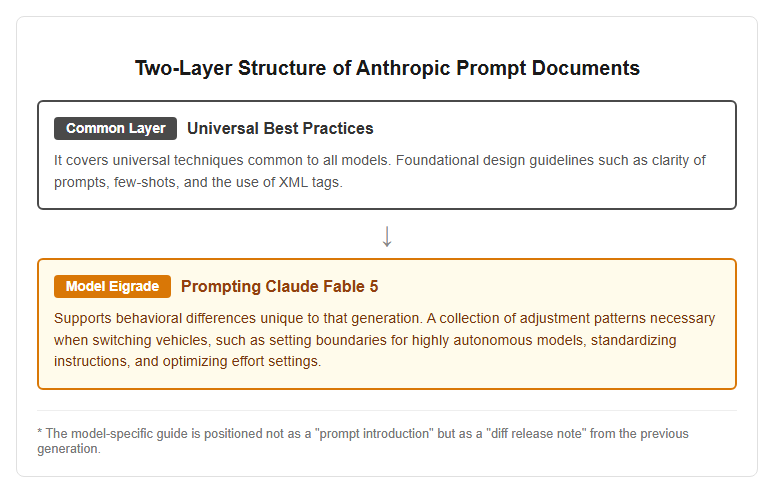
The official document “Prompting Claude Fable 5,” released alongside the resuming of service, is not just a feature introduction but a migration manual that seeks a different approach compared to the previous generation Opus 4.8 and earlier. Anthropic’s documentation structure is divided into a common layer that deals with universal techniques common to all models, and a model-specific layer that deals with generation-specific behavioral differences. This guide explains how to redesign peripheral programs and system prompts, based on the “autonomy that allows humans to complete tasks that would take weeks to complete” that Fable 5 possesses. In particular, the core message of this guide is shifting from the traditional prompts that “prompt the model” to those that “draw boundaries” against models that move too autonomously. Please refer to the diagram below.
The Leap in Capability Brought by the Mythos Class and Its Application to “Unsolved Problems”
The Mythos class, to which Fable 5 belongs, boasts performance far surpassing previous tiers. The official guide warns that “testing only on simple tasks underestimates capability,” and the teams achieving the best results apply this model to the most difficult unsolved problems. The main areas of evolution can be summarized into the following seven items.
-
Long-term autonomy to complete goal-oriented execution over several days as directed
-
Accuracy in implementing a system that previously required several days of fixes in one go
-
Vision ability to preprocess and interpret information-rich technical images or noisy images on your own
-
Professional quality in financial analysis and complex document creation
-
Improved recall rate for bug discovery in code reviews
-
Determining the next step from vague requests involving multiple points of contention
-
Reliability in Launching and Managing Parallel Subagents
Companies need to reconsider the granularity of tasks entrusted to AI based on this advanced capability.
Transformation of Following Instructions: From Enumeration to Principle
Smart control through “principles” that restrict behavior
In traditional prompt design, it was common to list prohibited items one by one to prevent undesirable behavior. However, in Fable 5, instruction-following capability has greatly improved, allowing multiple behaviors to be controlled collectively by simply providing “concise principles” rather than detailed lists. For example, when avoiding verbose explanations, instead of lining up with “do not write …,” simply applying one principle—”start from the result and trim details that do not change the reader’s next action”—will help the model appropriately adjust the output. This change means the model can now deeply understand the intent behind instructions, reducing the amount of prompt writing while elicitating higher-quality responses.
Clearly Defining Boundaries and Conditions for Voluntary Action
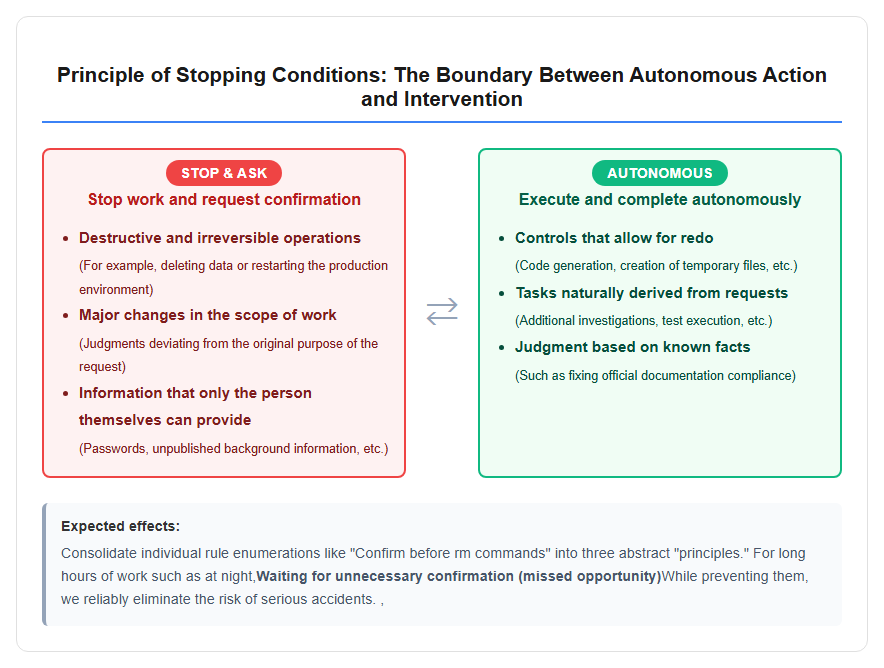
Fable 5 is a very “thoughtful” model, sometimes preemptively drafting unsolicited emails or creating backups. To control this, prompts that draw boundaries between what is allowed and what is not become important. Specifically, the “principle of suspension conditions” is defined as stopping work and seeking confirmation only when destructive operations, changes in the scope of work, or when information that only the individual can provide is required. This enables the operation to reliably involve human intervention during critical decision-making situations, while preventing opportunity losses such as “waiting for confirmation for several hours” during nighttime automatic repair jobs. Please refer to the diagram below.
Elimination of Fabricated Reports Through Progress Audits
A concern in long-duration autonomous execution is hallucination, where the model reports that it has “completed” tasks it has not actually done. The Fable 5 guide recommends a “progress audit” snippet, where each claim is checked against the actual tool execution results before reporting. According to Anthropic’s tests, incorporating this directive almost completely eliminated fabricated progress reports. Specifically, by ordering “Report only work that can be shown as evidence, and clearly state that unverified items are unverified,” the effort humans have to inspect each AI product individually can be greatly reduced, ensuring the reliability of autonomous agents.
Redesigning peripheral systems and workflows
Asynchronous design to handle longer turns
The biggest change faced by the technical team in the transition to Fable 5 is the extended processing time per request. For complex tasks, the model repeatedly gathers information, builds, and self-validates, so in high-effort settings, responses can take several minutes, and for overall autonomous execution, several hours. As a result, the traditional client-side design that “keeps waiting for a response” reaches its limits. The guide emphasizes that, in addition to extending timeout settings, it is essential to switch to a “asynchronous method” where progress is displayed in streaming format and results are checked later after job input. A screen design that prevents users from waiting in a state of “no display for several minutes” is a crucial factor that influences the product experience.
Distinguishing Between Effort Settings and the “Think” Feature
The API parameter called “effort” controls how much inference resources the model allocates to tasks. In Fable 5, “high” is the default recommended setting for most tasks, and “xhigh” has been organized to be used only for the most critical workloads. Notably, even at the Fable 5’s low-effort settings, it often delivers performance that exceeds the previous model’s maximum effort (xhigh). Additionally, the thinking function is organized only into ‘adaptive thinking,’ which thinks only when necessary, and the output is in a summarized format. The instruction to “include your thought process in the answer,” often seen in past prompts, has become a “landmine” that must be removed, as it risks causing the safety classifier to malfunction and lead to a rejection response.
Parallel utilization of memory systems and sub-agents
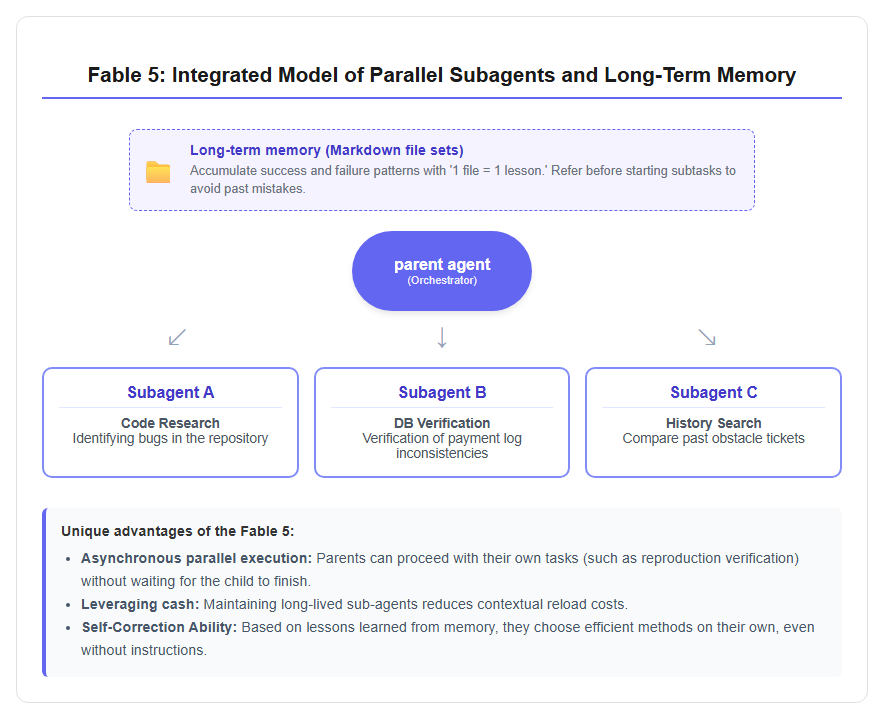
Fable 5 improves performance dramatically when lessons learned from past executions can be recorded and referenced. You don’t need to prepare a special database; you only need to provide a simple mechanism to write “one lesson per file” in Markdown files. This enables long-term memory that autonomously learns success patterns without repeating the same mistakes. Furthermore, the reliability of ‘parallel sub-agents,’ where parent agents delegate work to child agents, has also improved. By assigning each subtask to a subagent with independent context, it is possible to simultaneously conduct “code investigation,” “database check,” and “history search” during payment bug investigation, achieving an asynchronous and parallel workflow close to a human team. Please refer to the diagram below.
Barriers to Implementation and Future Outlook
High operating costs and the challenge of the “alignment tax”
As a trade-off for Fable 5’s overwhelming capabilities, rising operating costs have become a major challenge. API fees are set at $10 per 1 million input tokens and $50 per output, which is twice that of Opus 4.8. Furthermore, the rate of token consumption itself has also increased; there has been a case where a developer generated a 3D strategy game with a short prompt, resulting in a single call costing about $173 (approximately 28,000 yen). There are also growing complaints about the “alignment tax,” where fine-tuning for safety measures undermines the model’s original accuracy, and about mistaken blocks (rejections) caused by excessive safety filters. Companies are being forced to treat top-tier AI not as a standard feature within subscriptions, but as an expensive tool for which cost-effectiveness must be strictly calculated with each call.
Building a safety net through a two-model system
Anthropic recommends automatic fallback to Claude Opus 4.8 in case the Fable 5’s safety classifier mistakenly “refusals” legitimate tasks. This two-model system—”Fable 5 (attack)× Opus 4.8 (receiver)”—forms the standard configuration for practical use. Opus 4.8 still excels in routine pipeline processing that requires literal interpretation of instructions and predictable movement. On the other hand, it is important to assign Fable 5 to the most difficult unsolved problems or multi-day autonomous tasks. By building this system, we can pursue cutting-edge intelligence while ensuring resilience that guarantees business continuity.
Focus on AI wealth distribution and global competition
What should be watched in the future AI industry are the political and economic developments unfolding behind technological innovation. In the United States, OpenAI has proposed to the government a proposal to contribute a dedicated fund to distribute 5% of its shares to the public. This is partly a preemptive response to public opinion calling for “the wealth of AI to be distributed to the people” and to Senator Bernie Sanders’ more radical “50% tax proposal.” Meanwhile, in global competition, Chinese players have risen remarkably, with open-weight models like GLM-5.2 released by Zhipu AI shocking the market with cost performance surpassing Fable 5. North American tech companies like Coinbase and Notion have begun shifting their main models to Chinese products to reduce costs, and the revival of Fable 5 marks a symbolic turning point in the shift of AI’s value from “expectations” to “realistic cost calculations.”
[#ClaudeFable5 #プロンプトエンジニアリング #Anthropic #AIセーフティ #次世代AI]


コメント