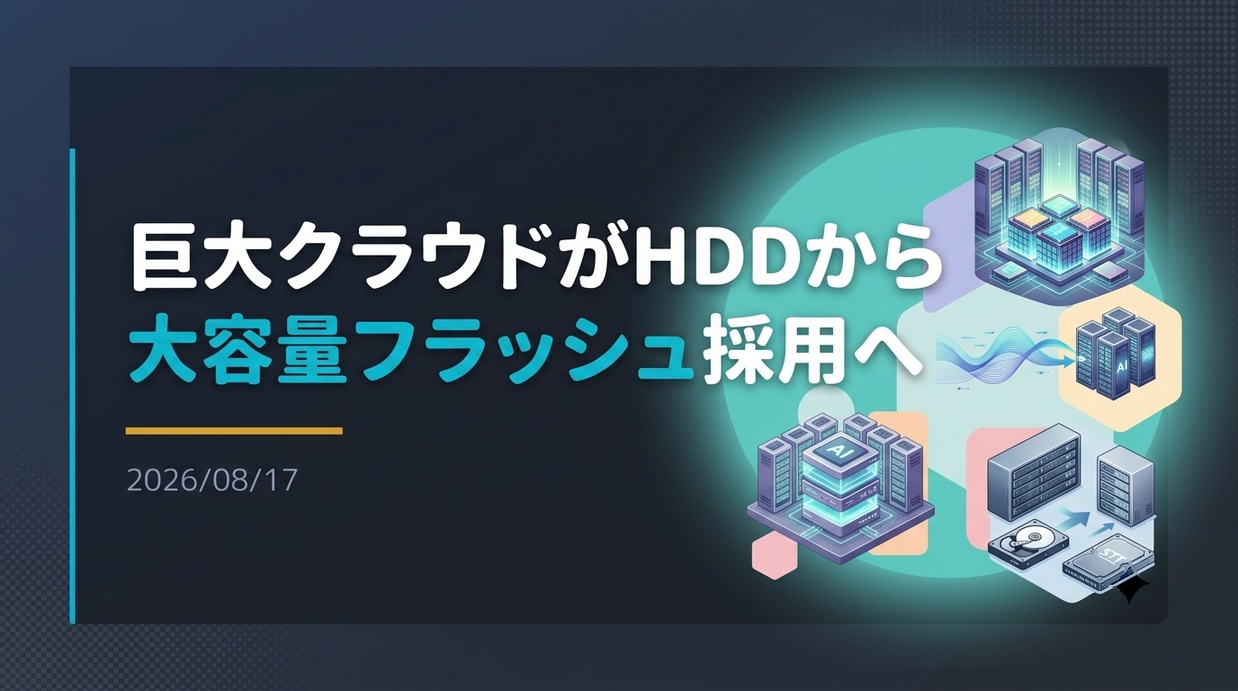
Driven by the explosive spread of AI servers, major cloud providers like Meta are shifting their storage strategy from traditional Hard Disk Drives (HDDs) to high-capacity flash storage, specifically QLC SSDs. This transition is fueled by the stagnation of HDD performance and the evolution of storage into a critical infrastructure component that determines the processing speed of AI training and inference.
Key Highlights and the Departure from HDDs
- Meta’s Large-Scale Flash Adoption and Supply Chain Security
- HDD Performance Limits and New Requirements for AI Servers
- QLC SSDs Realizing a Middle Storage Tier
- Efficiency Through Hardware-Software Integration
- Structural Supply Shortages and Accelerating Chip Inflation
- Future Developments and AI Infrastructure Challenges
Meta’s Large-Scale Flash Adoption and Supply Chain Security
Meta, a global leader in cloud services, is dramatically pivoting its storage strategy to support the exponential growth of its AI computing capabilities. According to internal documents leaked in July 2026, the company has entered into multi-year long-term supply agreements with SanDisk (a brand of Western Digital), the South Korean giant Samsung Electronics, and the Japanese firm Sumitomo Electric Industries. Meta plans to deploy 7 gigawatts of AI computing capacity in 2026, doubling that figure to 14 gigawatts by 2027. To support this massive expansion, the company’s annual capital expenditure is projected to reach \$145 billion, which is approximately 23.4 trillion Japanese yen.
A significant portion of this investment is dedicated to securing flash memory storage from SanDisk and memory chips from Samsung Electronics. Furthermore, Meta is advancing its vertical integration of hardware, with its proprietary AI chip, codenamed “Iris”—the fourth generation of the Meta Training and Inference Accelerator (MTIA)—scheduled for mass production in September 2026. The following diagram illustrates the conceptual framework of the next-generation AI infrastructure Meta is currently building.
HDD Performance Limits and New Requirements for AI Servers
For decades, HDDs served as the primary repository for data center storage, but they are now facing insurmountable challenges in the AI era. While HDD recording density continues to improve, input/output (I/O) performance has failed to keep pace, resulting in a consistent decline in bandwidth per terabyte (BW/TB). This performance gap causes “hot data” (frequently accessed data) to become stranded within HDDs, creating a significant bottleneck for the entire system. In the context of AI servers, SSDs are no longer merely “storage devices” but have been transformed into essential infrastructure components that dictate the overall speed of AI processing.
During the AI training process, huge datasets must be continuously supplied to GPUs; if the storage readout is too slow, expensive GPUs are forced into an idle “wait state,” severely reducing throughput. Furthermore, specialized AI workloads—such as saving “checkpoints” to record training progress or performing high-speed searches in vector databases for Retrieval-Augmented Generation (RAG)—require performance levels that exceed the physical limits of HDDs. To bridge this performance gap, data center engineers are being forced to transition from traditional spinning disks to high-speed flash storage.
Technical Evolution and the Construction of a New Storage Tier
QLC SSDs Realizing a Middle Storage Tier
Historically, data centers have relied on a two-tier storage system: cost-efficient HDDs for bulk data and high-performance but expensive Triple-Level Cell (TLC) flash for active workloads. Meta is now proposing the introduction of Quad-Level Cell (QLC) SSDs as a third, middle tier to occupy the unique performance space between these two extremes. QLC technology, which stores four bits of information per cell, has existed since approximately 2009, but its adoption was previously hindered by low write endurance and capacity limitations. However, the recent mainstreaming of 2-terabit (2Tb) QLC NAND dies and 32-die stacking techniques has led to a rapid scaling of density at the drive level.
Meta is targeting workloads that require a performance range of approximately 10 MB/s/TB—a level where HDDs are increasingly falling short and TLC is not cost-effective. Servers utilizing QLC can achieve a byte density approximately six times higher than the densest TLC-based servers Meta currently deploys. In addition to density, QLC offers superior power efficiency compared to HDDs, particularly for read-intensive workloads such as AI inference logs and data archiving, providing a significant total cost of ownership (TCO) advantage.
Efficiency Through Hardware-Software Integration
To maximize the performance of flash storage, innovative approaches that differ from conventional SSD architectures are being implemented. A prime example is the DirectFlash technology Meta is adopting in collaboration with the American company Pure Storage. Standard SSDs typically include an internal Flash Translation Layer (FTL) to make the flash memory appear and behave like a traditional HDD to the operating system, but this “middleman” often introduces performance inefficiencies and reduces reliability.
The DirectFlash approach removes this translation layer from the drive hardware and instead integrates it into highly optimized host-side software. This allows for a 30% improvement in NAND flash utilization efficiency, enabling more usable capacity from the same number of memory chips. Specifically, DirectFlash Modules (DFMs) can achieve five to ten times the density of standard SSDs, resulting in massive savings in physical space and power consumption. Meta is working to integrate this technology into its proprietary software stack to efficiently manage exabyte-scale storage. Please refer to the following diagram for a comparison of these storage architectures.
Market Transformation and Future Outlook
Structural Supply Shortages and Accelerating Chip Inflation
The explosive growth in AI demand is causing profound structural changes in the NAND flash market. Market forecasts for 2026 indicate that while demand for high-capacity enterprise SSDs for AI servers is skyrocketing, suppliers have limited their capacity expansions, focusing instead on process upgrades. Consequently, the market is expected to face a severe structural supply shortage. While demand for consumer electronics—the traditional driver of the market—remains weak, the robust demand from data centers is more than offsetting this, keeping contract prices for NAND flash on a sustained upward trajectory.
This situation has led to “chip inflation,” where the surging prices of memory components are becoming a major macroeconomic concern, significantly increasing the capital expenditure burden for buyers like Meta. Suppliers are prioritizing their production resources for high-margin AI products, which analysts suggest could lead to price hikes or reduced shipments for consumer products like personal computers and smartphones, particularly in Japan where price sensitivity is high. The following graph illustrates the projected supply-demand gap for the coming years.
Future Developments and AI Infrastructure Challenges
The key focus moving forward will be how this storage revolution rebalances the overall AI infrastructure. The essence of AI is shifting from mere “computing power” to a comprehensive system capability—how to store, move, and supply massive amounts of data efficiently. Through the introduction of its “Iris” chip, Meta aims to reduce its dependence on specific semiconductor manufacturers like NVIDIA while simultaneously optimizing its storage hierarchy.
However, the widespread adoption of QLC SSDs still faces technical hurdles, such as managing the significant performance delta between read and write operations through software. Additionally, physical constraints such as power supply and cooling capacity are becoming major barriers to the expansion of data centers globally. The AI infrastructure arms race has entered a new phase, moving beyond a simple contest of chip performance to a competition over supply chain security and overall system energy efficiency. Investors and technologists must continue to monitor these structural shifts in the memory and storage sectors that support the data behind the AI revolution.
Reference Pages
-
[A case for QLC SSDs in the data center – Engineering at Meta] https://engineering.fb.com/2025/03/04/data-center-engineering/a-case-for-qlc-ssds-in-the-data-center/
-
[2026 NAND Flash: AI & HDD Shortage Ignite Price Surge – TrendForce] https://www.trendforce.com/research/category/Semiconductors/NAND%20Flash
-
[Pure Storage at William Blair Conference: Strategic Growth Insights – Investing.com] https://www.investing.com/news/transcripts/pure-storage-at-william-blair-conference-strategic-growth-insights-93CH-4078574
【#AIServers #SSD #NANDFlash #DataCenter #Meta #Semiconductors #QLC #TechTrends】
コメント