Google has revealed plans to launch a prototype satellite for “Project Suncatcher,” a research initiative to execute AI calculations in space using satellite-mounted AI chips. Driven by the critical limits of terrestrial AI data centers—namely massive power consumption and severe constraints on land and water resources—the project aims to build next-generation computing infrastructure that leverages the infinite solar energy and physical advantages of outer space.
- Key Highlights: Overview and Objectives of the “Project Suncatcher” Prototype Satellite
- Technical Approach: TPU-Equipped SmallSat Constellations and Ultra-High-Bandwidth Laser Links
- Terrestrial Bottlenecks vs. Space Advantages: Power/Thermal Constraints and Vacuum Transmission
- Harsh Orbital Realities: Cosmic Radiation, Space Debris, and Vacuum Thermal Management
- Strategic Partnerships and Business Model: Planet Labs Synergy and Risk Externalization
- Future Outlook: From 2027 Validation Missions to 2030s Scaled Deployment
Key Highlights: Overview and Objectives of the “Project Suncatcher” Prototype Satellite
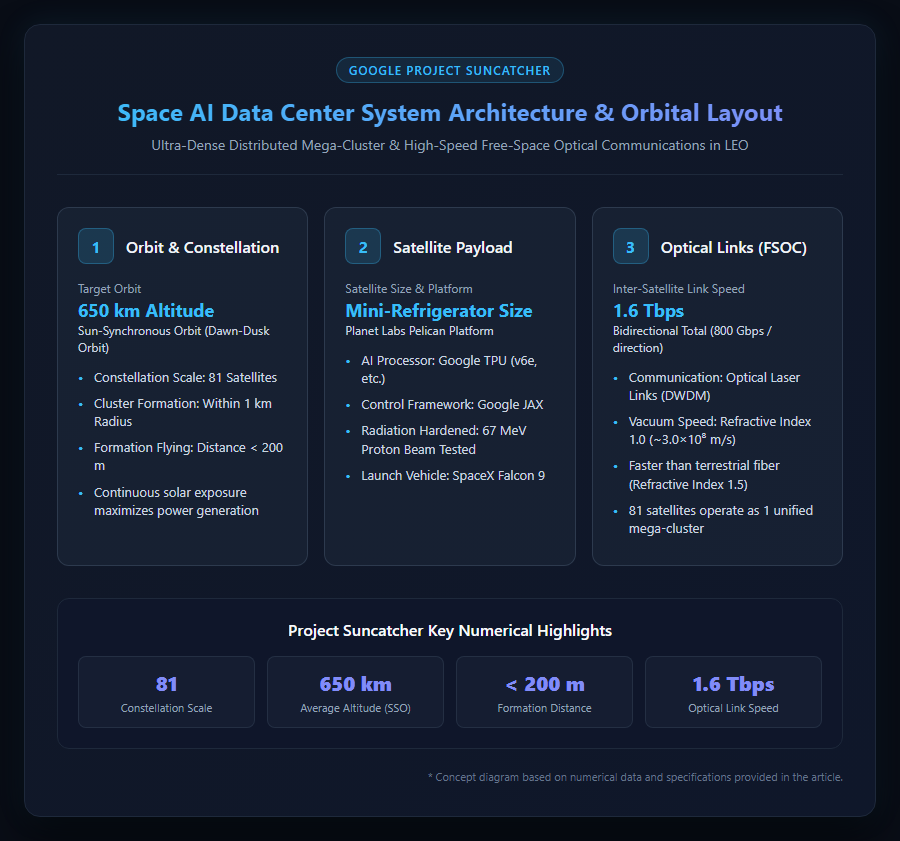
Google (Alphabet) has officially launched “Project Suncatcher,” a technology demonstration initiative designed to deploy small satellites equipped with its proprietary AI accelerator chips, TPUs (Tensor Processing Units), into Low Earth Orbit (LEO). The project presents a vision for a distributed space-based data center concept that circumvents terrestrial grid strain and land/water resource bottlenecks by performing AI workloads directly in orbit. The initial prototype satellite, roughly the size of a mini-refrigerator, will launch aboard a SpaceX Falcon 9 rocket as part of the Transporter-18 rideshare mission. Prior to launch, radiation exposure testing using a 67 MeV proton beam was conducted at UC Davis facilities to verify hardware survivability under harsh orbital conditions. The primary objective of this mission is to collect operational TPU data in space and identify potential failure modes, paving the way for a planned 2027 launch of two additional satellites to test inter-satellite optical laser links. The diagram below illustrates the deployment vision for space data centers.
Technical Approach: TPU-Equipped SmallSat Constellations and Ultra-High-Bandwidth Laser Links
At the core of Project Suncatcher are Google’s custom TPUs (such as TPU v6e) paired with ultra-high-bandwidth Free Space Optical Communications (FSOC). Rather than relying on isolated server racks like conventional ground facilities, the planned 81-satellite constellation is engineered to operate as a single, massive distributed mega-cluster across orbit. To match machine learning throughput standard in terrestrial data centers, high-speed chip-to-chip interconnects ranging from hundreds of Gbps to several Tbps are required. To meet this demand, Google has proposed utilizing Dense Wavelength Division Multiplexing (DWDM) combined with spatial multiplexing. Ground-based experiments achieved bidirectional speeds of 1.6 Tbps (800 Gbps per direction) using transceiver pairs. To minimize signal attenuation and maintain high optical reception power, the satellite constellation is designed to operate in Sun-Synchronous Orbit (Dawn-Dusk orbit) at an average altitude of 650 km, maintaining an ultra-dense cluster within a 1 km radius through precise formation flying at inter-satellite distances under 200 meters.
Terrestrial Limitations vs. Orbital Data Advantages
Terrestrial Bottlenecks vs. Space Advantages: Power/Thermal Constraints and Vacuum Transmission
Ground-based data center expansion is confronting severe power grid deficits and environmental sustainability limits. As of 2024, U.S. data centers account for over 4% of total domestic electricity consumption, a figure projected to reach up to 12% by 2028, alongside daily water consumption reaching hundreds of thousands of gallons per facility for cooling. Conversely, operating in a Sun-Synchronous Orbit grants continuous exposure to sunlight, providing up to 8x the uninterrupted solar energy available on Earth and enabling steady power generation with minimal reliance on heavy batteries. Space also delivers a distinct physical advantage in latency: signals in terrestrial silica optical fiber (refractive index ~1.5) are capped at roughly 67% of light speed (~2.0 × 10⁸ m/s). Direct laser communications in the vacuum of space (refractive index 1.0) face zero atmospheric resistance, achieving the theoretical speed of light (~3.0 × 10⁸ m/s) for ultra-fast short-range inter-satellite data transfers.
Harsh Orbital Realities: Cosmic Radiation, Space Debris, and Vacuum Thermal Management
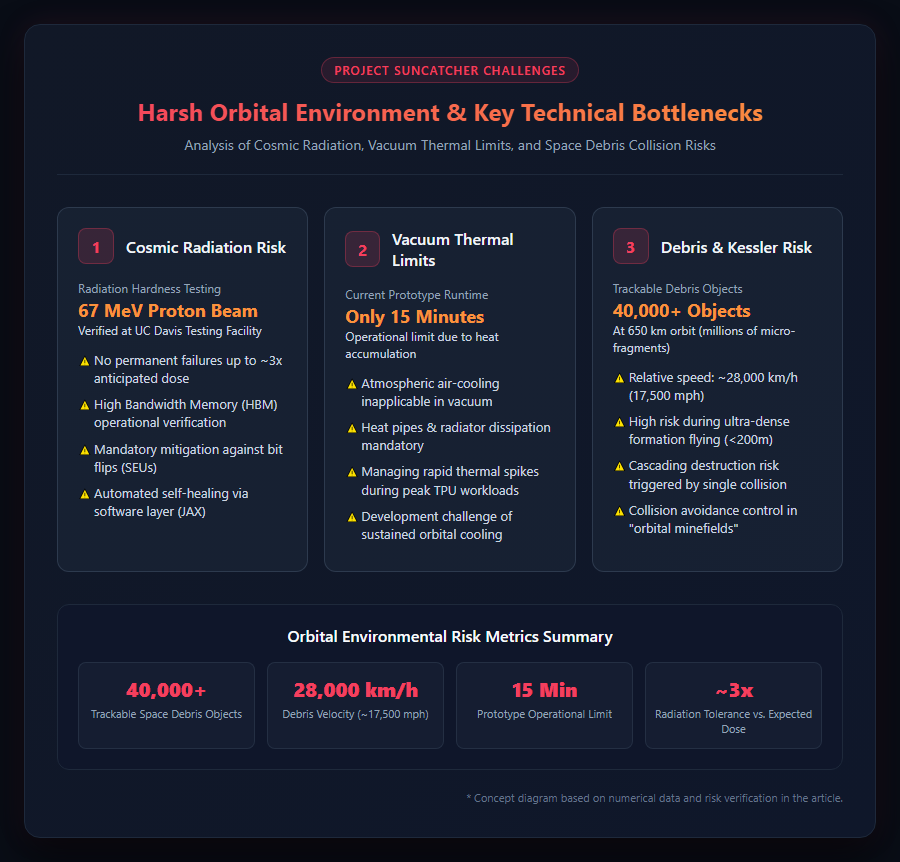
Despite these immense benefits, establishing orbital data centers introduces formidable technical and physical challenges. Chief among them is cosmic radiation, which induces frequent Single Event Upsets (SEUs)—bit flips in memory caused by high-energy particles. Google’s testing confirmed hardware resilience up to roughly three times the anticipated radiation dose without permanent failure, including High Bandwidth Memory (HBM); however, long-term orbital deployment necessitates automated software-layer self-healing mechanisms (such as JAX). Thermal management poses another hurdle: without atmospheric air, standard air-cooling methods are useless, requiring heat pipes and radiator panels to dissipate waste heat into space. Due to thermal accumulation, the current prototype’s continuous operational window is limited to just 15 minutes. Furthermore, at an altitude of 650 km, over 40,000 trackable debris objects and millions of micro-fragments travel at hypersonic speeds of approximately 17,500 mph (~28,000 km/h). Operating an ultra-dense constellation in this “orbital minefield” creates constant collision hazards and risks triggering catastrophic cascading destruction (Kessler Syndrome). The diagram below illustrates orbital debris interactions with satellite clusters.
Alliance Strategy and Future Outlook
Strategic Partnerships and Business Model: Planet Labs Synergy and Risk Externalization
Google selected smallsat industry leader Planet Labs as its key implementation partner for Project Suncatcher. The two companies share deep historical ties dating back to NASA Ames Research Center and have maintained a strong strategic partnership since 2017, when Google sold its satellite division, Terra Bella, to Planet Labs while retaining a major equity stake. The demonstration satellite utilizes Planet Labs’ next-generation “Pelican” platform, vertically integrating Google’s custom AI framework JAX with TPU hardware to orchestrate multiple smallsats as a unified AI computing cluster. From a financial perspective, Google avoids taking massive capital expenditure (CapEx) and total loss risks associated with satellite manufacturing and rocket launches on its own balance sheet. By restricting its role to supplying primary payloads (TPUs and optical gear), Google executes an astute alliance strategy that externalizes physical hardware operating risks.
Future Outlook: From 2027 Validation Missions to 2030s Scaled Deployment
Project Suncatcher is not aimed at immediate commercialization, but is structured as a long-term moonshot initiative akin to Google’s decade-plus investment in autonomous vehicles. Following the initial prototype launch in late 2026, an early-2027 mission will deploy two satellites to validate orbital distributed machine learning and optical laser links. The long-term vision entails expanding to an 81-satellite cluster, with potential capital investments in space data centers reaching parity with terrestrial data centers by the mid-2030s. Launch economics remain the critical factor: driven by reusable rockets such as SpaceX’s Falcon 9 and Starship, learning-curve efficiencies from doubling cumulative launched mass are projected to drive launch costs below \$200/kg by the mid-2030s. At this cost threshold, annual satellite power costs (~\$810 based on Starlink Mini estimates) become competitive with terrestrial data center energy bills, securing commercial viability.
Reference Pages
- [Google Research Blog] https://research.google/blog/exploring-a-space-based-scalable-ai-infrastructure-system-design/
- [Google Official Blog] https://blog.google/technology/research/google-project-suncatcher/
【#Google #ProjectSuncatcher #SpaceDataCenter #Satellite #AIInfrastructure #SpaceX #PlanetLabs】
コメント