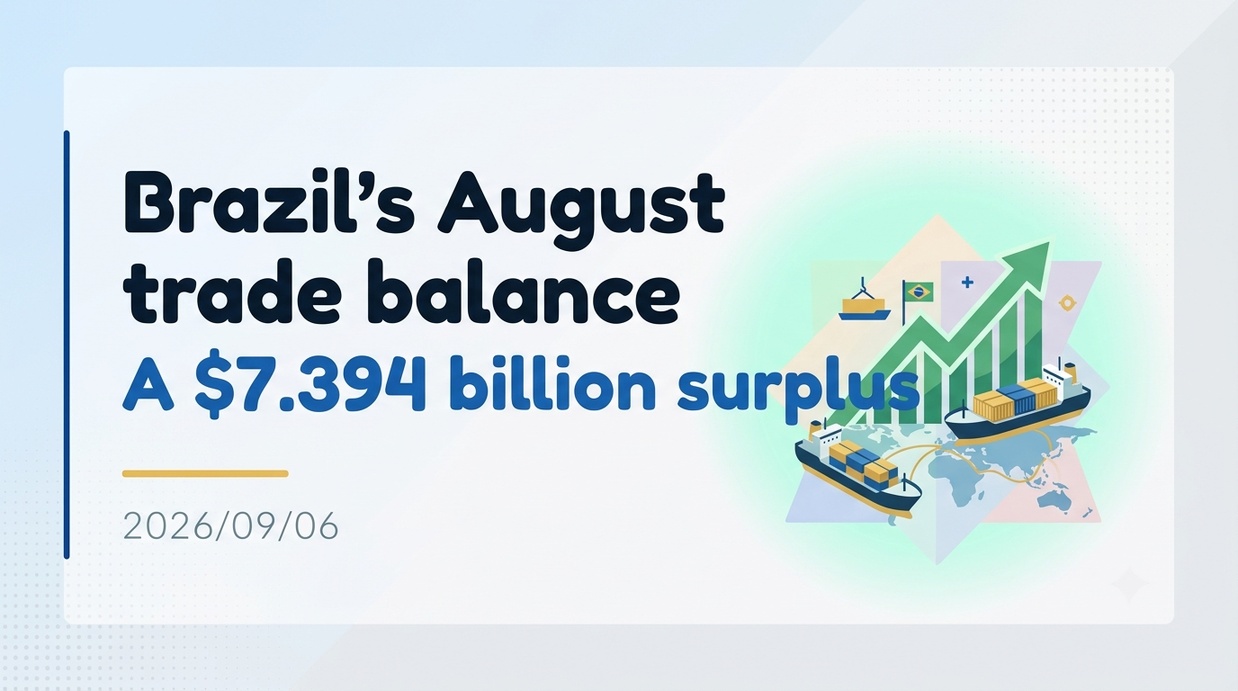
In August 2026, Brazil recorded a trade surplus of \$7.394 billion, exceeding market expectations. While robust exports of agricultural products and mineral resources fueled the growth, underlying shifts are emerging, including a notable slowdown in shipments to China, Brazil’s largest export destination.
Key Takeaways from the August Trade Figures
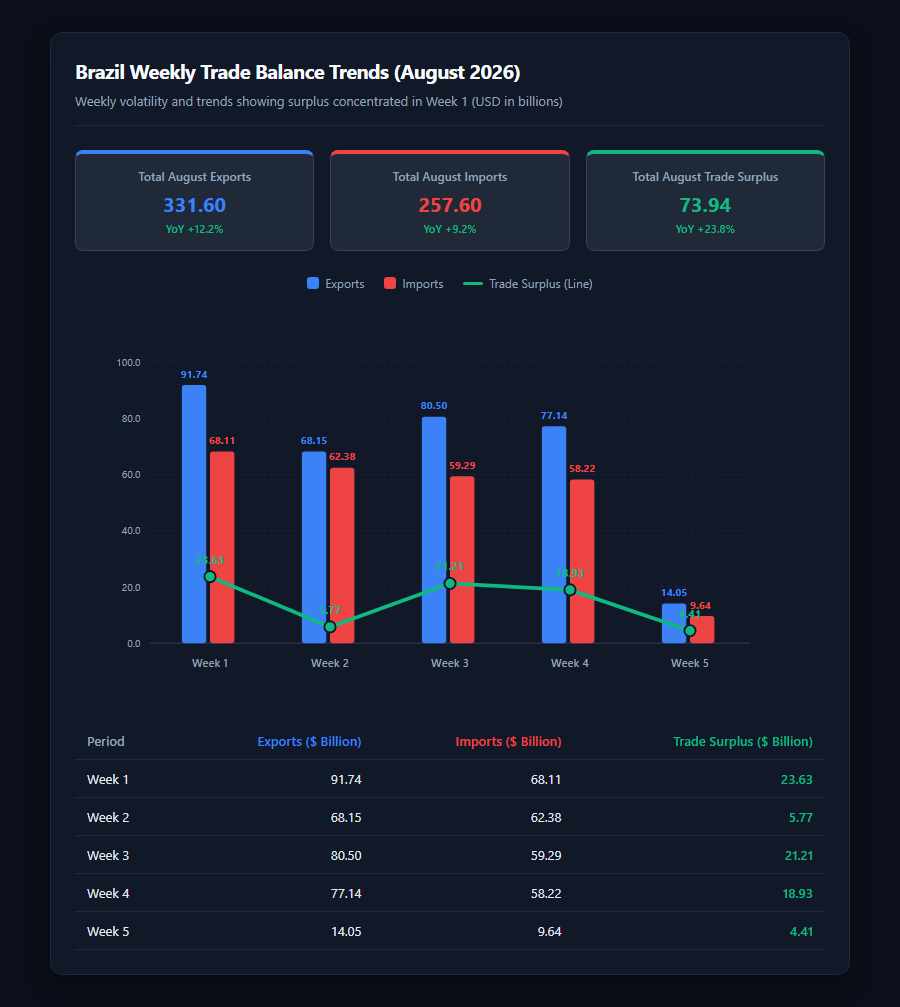
According to trade statistics released by the Brazilian Ministry of Development, Industry, Trade, and Services (MDIC) on September 4, 2026, the monthly trade surplus reached \$7.394 billion, beating the market consensus of \$7.14 billion. Total exports rose by 12.2% year-on-year to \$33.16 billion, while imports climbed 9.2% to \$25.76 billion, signaling a double-digit expansion on both sides of the ledger. Year-to-date (January–August 2026), the cumulative trade surplus hit \$55.3 billion, representing a substantial 28.2% increase compared to the \$43.16 billion recorded during the same period in 2025, keeping the country on track for a record-breaking year. However, a closer look at the sequential transition from July’s surplus of \$7.067 billion reveals that the monthly expansion was driven by a larger decline in imports rather than accelerating export momentum. Total trade volume (exports plus imports) fell by 3.7% to \$58.922 billion from July’s \$61.17 billion, pointing to a seasonal softening in overall trade activity. For a detailed breakdown of weekly performance in August, please refer to the chart below.
Major Export Categories and Drivers of Growth
Sector-specific data for August highlights broad-based growth across all major export categories. Agricultural exports rose 11.4% year-on-year, mining exports jumped 16.4%, and manufactured goods increased by 10.2%. Within the agricultural sector, the primary driver remained soybeans, which grew by 14.0% year-on-year (up \$540 million), supported by unroasted coffee beans (up 24.1% or \$210 million) and live animals (up 174.3% or \$170 million). In the mining sector, copper ore and concentrates saw explosive growth of 223.1% year-on-year (up \$670 million), while crude oil exports surged by \$740 million, serving as the largest absolute contributor to the month’s performance. The manufacturing sector also exhibited strong momentum, led by fuel oil (up 61.6% or \$550 million), poultry (up 40.5% or \$270 million), soybean meal and other animal feed (up 36.6% or \$250 million), wood pulp (up 30.2% or \$210 million), and aircraft (up 81.8% or \$190 million). This diversified mix of commodities and high-value industrial goods continues to fortify Brazil’s export engine.
Geopolitical Shifts in Trade and Domestic Demand
Shrinking Shipments to China and Europe’s Rapid Ascent
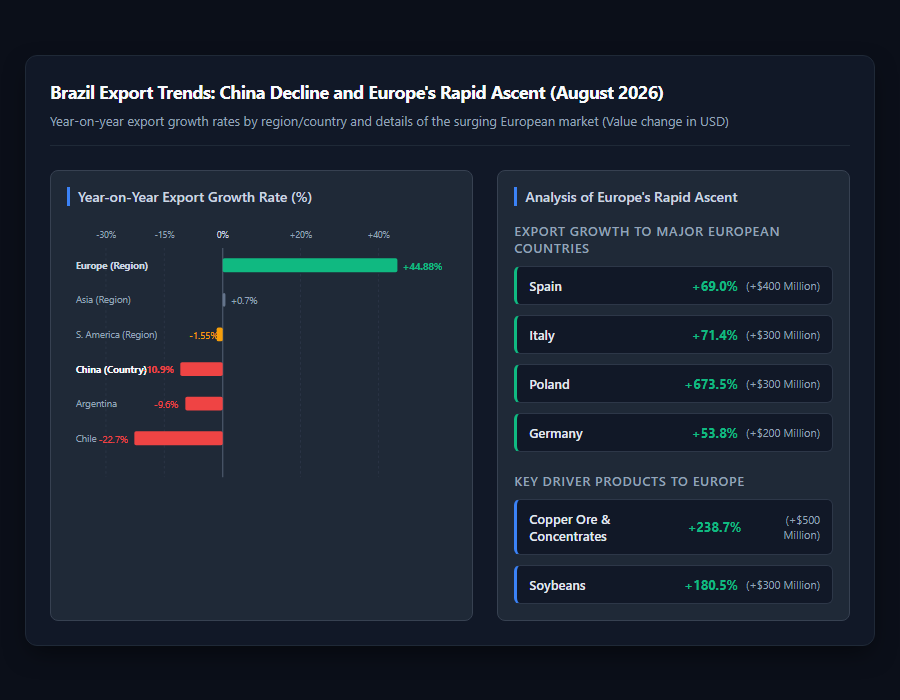
The most striking development in August’s trade data lies in the shifting geography of Brazil’s trading partners. Exports to China, Brazil’s long-standing top export market, fell by 10.9% year-on-year. Consequently, export growth to the broader Asian region flattened to a mere 0.7%, indicating a significant disruption in the traditional China-dependent trade paradigm. In stark contrast, European markets experienced an extraordinary surge. Exports to Europe leaped by 44.88% year-on-year, representing the highest growth rate among all regional trade blocks. On a country level, shipments to Spain soared by 69.0% (up \$400 million), Italy by 71.4% (up \$300 million), Poland by 673.5% (up \$300 million), and Germany by 53.8% (up \$200 million). This surge was primarily driven by massive European demand for Brazilian copper ore (up 238.7% or \$500 million) and soybeans (up 180.5% or \$300 million), suggesting a strategic realignment where European buyers are absorbing products that previously went to Asia. The regional distribution of Brazil’s exports is shown in the diagram below.
Domestic Demand Reflected in Evolving Import Trends
Brazil’s imports rose 9.2% year-on-year to \$25.76 billion in August, with the underlying data reflecting robust domestic consumption and industrial investment. While agricultural imports grew by 7.4% and manufactured imports rose by 13.4%, mining imports plummeted by 41.3%. A major factor behind the headline import growth was a 212.7% surge in fuel oil imports from North America (up \$800 million). Simultaneously, reflecting a strong appetite for digital infrastructure and technology investments within Brazil, imports of data processing machines skyrocketed, rising 345.5% (up \$200 million) from North America and 163.4% (up \$300 million) from Asia. Furthermore, pharmaceutical imports from Europe and North America maintained double-digit growth rates, driven by a steadily expanding domestic healthcare sector. These robust purchases of capital goods, technology, and consumer manufacturing products demonstrate that Brazil’s domestic economic activity remains highly resilient.
Market Reactions and the Economic Outlook
Impact on the Brazilian Real and Derivative Markets
The stronger-than-expected trade surplus is anticipated to provide short-term support for the Brazilian Real (BRL) in foreign exchange markets. Historically, periods where Brazil’s trade balance outperformed consensus estimates have seen the Real appreciate by an average of 2% to 3% against the US Dollar over the following month. Under these favorable macroeconomic conditions, derivative investors are well-positioned to capitalize on BRL strength by initiating short positions on USD/BRL futures or purchasing BRL call options. Moreover, the steady influx of export revenues provides some breathing room for the Banco Central do Brasil, which has maintained its benchmark Selic rate at a restrictive 14.00% to combat inflation. Expectations of a more flexible monetary policy path should bolster local equities, making bullish derivative strategies—such as call options on the Bovespa Index or the US-listed iShares MSCI Brazil ETF (EWZ)—increasingly attractive to global investors.
Upcoming Milestones and Mid-to-Long-Term Risk Scenarios
The Ministry of Development, Industry, Trade, and Services (MDIC) remains highly optimistic, maintaining its forecast for a record-breaking full-year trade surplus of \$90.0 billion (a 32% increase year-on-year) on the back of historical exports projected at \$394.4 billion. Nonetheless, several mid-to-long-term risks warrant close monitoring. First, political uncertainty looms over the October 2026 presidential election, with tight polling reported between incumbent President Lula and right-wing challenger Flávio Bolsonaro. The election is bound to introduce heightened volatility into the currency and equity markets. Second, external trade pressures are intensifying. The United States’ decision on July 15, 2026, to impose a 25% tariff on select Brazilian imports (effective July 22, with exemptions for coffee and beef) threatens to escalate bilateral trade tensions. Finally, systemic challenges, such as the agricultural sector’s vulnerability to extreme weather events and the dampening effect of the prolonged 14.00% interest rate on private investment, remain critical wildcards for Brazil’s economic trajectory.
Reference Pages
- 【Brazilian Ministry of Development, Industry, Trade and Services (MDIC) Official Data (PDF)】https://balanca.economia.gov.br/balanca/publicacoes_dados_consolidados/tabelas/nota/Nota.pdf
【#BrazilEconomy #TradeBalance #Commodities #BrazilianReal #GeopoliticalRisk #EmergingMarkets #Macroeconomics】


コメント