xAI has quietly integrated a new LLM-powered detection flow into X’s recommendation algorithm to target multi-step self-reply spam. This unannounced update aims to filter out low-quality AI-generated content and deliberate reply spam, preserving the health and transparency of the platform’s timeline.
- Unannounced Code Update and the Addition of the “multi_step_reply_spam” Flow
- Strict Filtering Criteria and the “low_blast_radius” Exclusion Rule
- Contextual Spam Analysis Using the Gemini-Based “oai-gemma4-26b-2” Model
- Proprietary System Prompts and Explaining Decisions via “Under the Hood”
- Engagement Penalties, Safe-Guards, and Fine-Tuning Rules
- The Evolution of Transparency: Shifting from Raw Metrics to Algorithmic Judgment
Unannounced Code Update and the Addition of the “multi_step_reply_spam” Flow
On September 4, 2026, xAI rolled out an unannounced code update to its open-source repository, xai-org/x-algorithm, which manages X’s recommendation engine. The update modified 7 files and added 487 lines of code, officially implementing a dedicated spam-filtering flow called “multi_step_reply_spam.” While X has consistently championed algorithmic transparency, this silent update bypassed the repository’s “Notable Updates” log, making it detectable only through direct code analysis. This move highlights a reality under X’s open-source banner: behind-the-scenes adjustments to the timeline are constant and unpublicized. The rapid integration reflects the platform’s urgent technical battle against a rising tide of low-quality AI-generated content and increasingly sophisticated reply spam that disrupts user experience daily.
Strict Filtering Criteria and the “low_blast_radius” Exclusion Rule
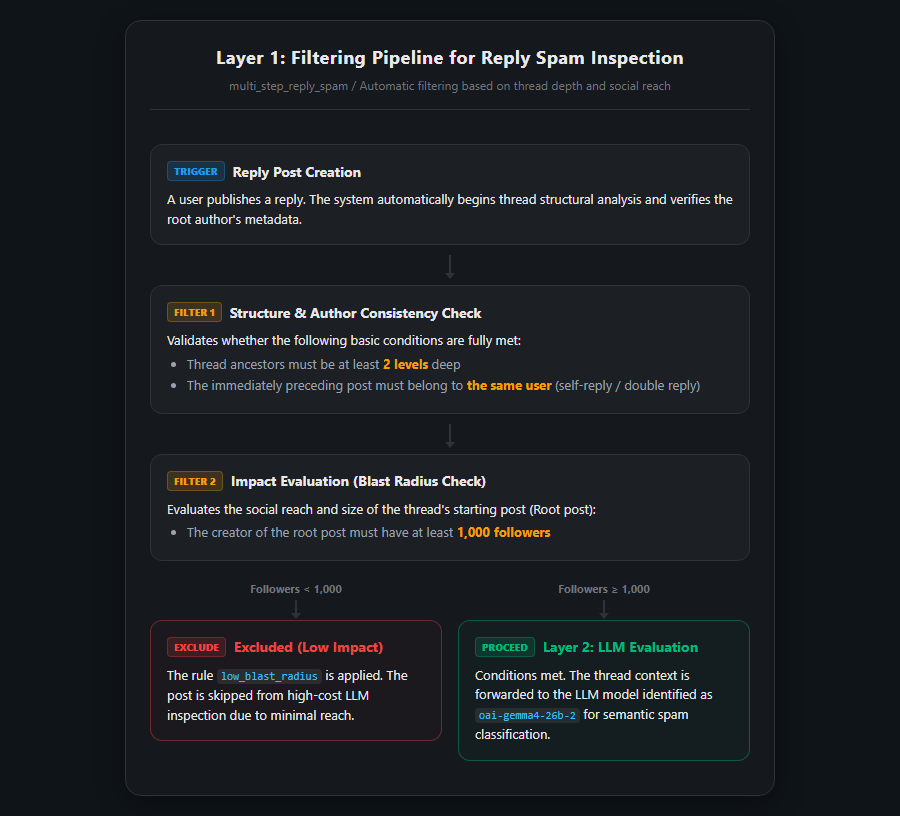
The newly introduced spam detection flow is built across three distinct layers, starting with a rigorous filtering phase that determines which posts undergo inspection. The system specifically targets “self-replies”—cases where a user continually replies to their own thread. The code outlines strict qualifying criteria: the post must be a reply, the thread must have at least two levels of ancestors, the immediately preceding post must belong to the same user, and the creator of the root post must have at least 1,000 followers. If the root creator has fewer than 1,000 followers, the thread is skipped under the label “low_blast_radius” (minimal impact) to conserve computing resources. This ensures X prioritizes spam inspection on threads with the highest potential reach. Refer to the diagram below.
The LLM-Based Evaluation Engine and the Hidden System Prompts
Contextual Spam Analysis Using the Gemini-Based “oai-gemma4-26b-2” Model
In the second layer of the flow, posts filtered through the initial criteria are subjected to a deep contextual evaluation. Unlike traditional static filters, this step utilizes a Large Language Model (LLM) to perform semantic analysis on the entire thread. The code references a model identified as “oai-gemma4-26b-2,” a Gemini-based engine optimized for analyzing the textual nuances of conversation. By feeding the full thread context and user data into the LLM, X can mimic human judgment to detect complex, AI-generated spam and repetitive patterns that easily bypass keyword blocklists. This integration of advanced natural language processing directly into X’s active recommendation pipeline represents a major leap in automated moderation.
Proprietary System Prompts and Explaining Decisions via “Under the Hood”
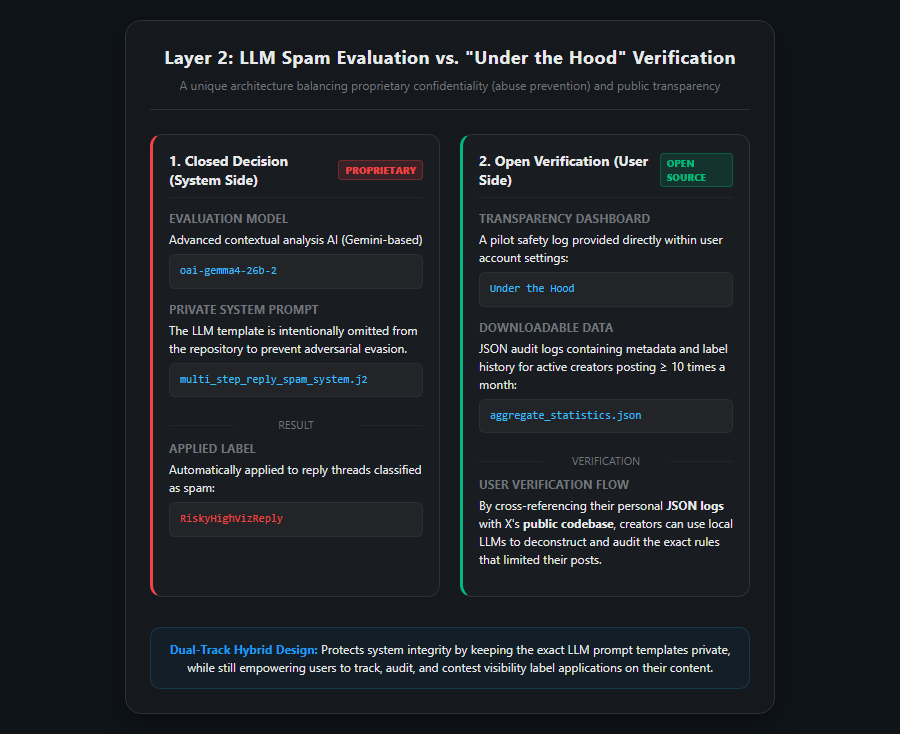
Interestingly, the system prompt template containing the exact instructions given to the LLM—titled “multi_step_reply_spam_system.j2″—was intentionally omitted from the public repository. According to X’s README, publishing these prompts would essentially provide a blueprint for spam operators to reverse-engineer and bypass the filters. To balance security with transparency, X offers a pilot tool in user settings called “Under the Hood.” This feature allows active creators to see the safety labels applied to their accounts and posts, relying on a dual approach: open-sourcing the system’s structural flow while providing individuals with tools to verify their own outcomes. Refer to the diagram below.
Algorithmic Impact, Mitigation Rules, and the Future of Transparency
Engagement Penalties, Safe-Guards, and Fine-Tuning Rules
The third layer of the flow governs enforcement, applying severe penalties to posts flagged as spam by the LLM. Once a reply is classified as spam, its reply-ranking score is immediately set to 0.0, rendering it practically invisible to the average user, and the post is tagged with the safety label “RiskyHighVizReply.” Simultaneously, the code contains fail-safes to prevent false positives from harming legitimate accounts. For instance, if the latest reply in a thread is not flagged, the system discards the entire spam classification. It also automatically removes false flags on other users’ posts and discards flags if only a single instance is detected. Furthermore, the same commit increased the threshold for coordinated spam detection from 1,000 to 5,000, illustrating the complex, ongoing balancing act of tightening and relaxing spam-control parameters.
The Evolution of Transparency: Shifting from Raw Metrics to Algorithmic Judgment
This update signals a broader shift in how social media recommendation engines are audited. While X’s August 2026 code release sparked widespread debate over hard-coded weights—such as a link copy giving +20.0 points and a like giving only +0.5—the discussion has moved beyond simple numerical coefficients. The core question is now about the nature of the judging entity: increasingly, LLMs operating behind closed prompts are dictating what users see. To maintain user trust, xAI must find ways to map out the “boundaries of judgment,” perhaps by publishing aggregate decision patterns or the success rate of user appeals. Making these AI-driven moderation contours inspectable will define the next frontier of algorithmic transparency.
Reference Page
- 【xai-org/x-algorithm (GitHub)】https://github.com/xai-org/x-algorithm
【#XAlgorithm #SpamDetection #LargeLanguageModels #OpenSource #SocialMedia #InformationTechnology】


コメント