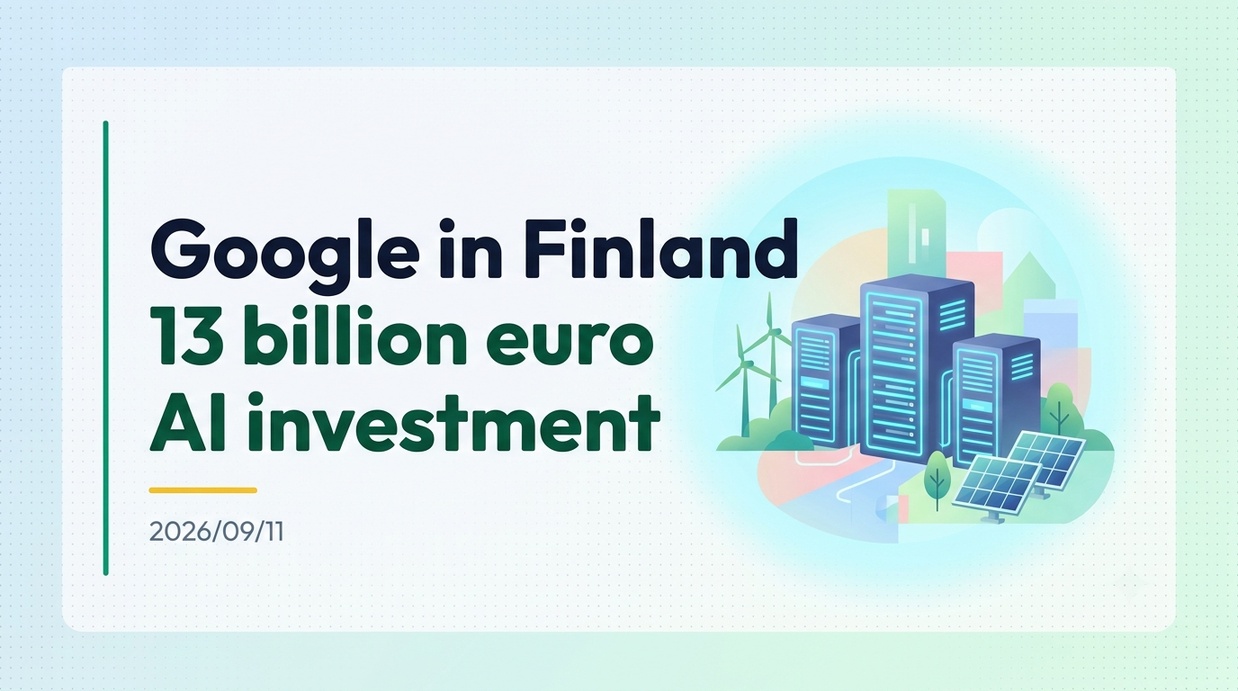
Google has announced a massive €13 billion (approx. ¥2.3 trillion) investment to expand its AI infrastructure in Finland over the next two years. The move is driven by skyrocketing global demand for AI compute and a strategic shift to diversify footprint away from the US—where rising power costs and regulatory hurdles loom—toward the energy-efficient Nordics.
- Overview of the Four-Site Data Center Buildout and Massive Capital Commitment
- Regional Economic Transformation: Job Creation and GDP Boost
- Securing 50% of Loviisa Nuclear Power and the Impact of a 22-Year PPA
- Advanced Model: 629 MW Wind Power, 94 MW Battery Storage, and District Heat Recovery
- Mounting US Data Center Hurdles and the Strategic Imperative of the Nordic Shift
- The Future of AI Infrastructure: Regulatory Compliance and Environmental Harmony
Overview of the Four-Site Data Center Buildout and Massive Capital Commitment
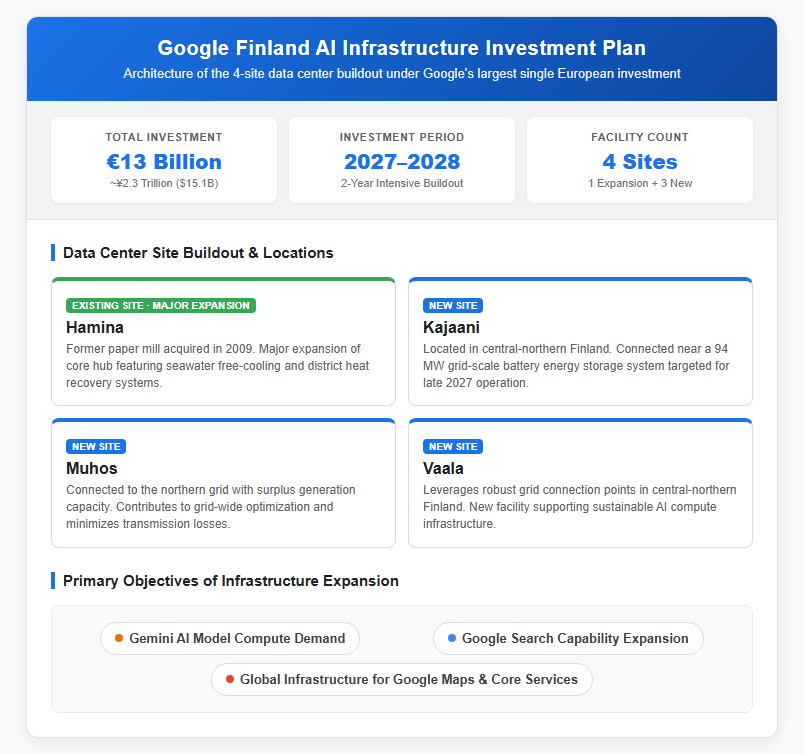
On September 9, 2026, Google (Alphabet) officially announced a plan to invest at least €13 billion (approximately ¥2.3 trillion) between 2027 and 2028 to expand Finland’s digital and AI infrastructure. This represents the company’s largest single investment project in Europe to date. Specifically, Google will significantly expand its existing data center in Hamina—originally established in 2009 following the acquisition of a paper mill—while constructing three brand-new data center facilities in Kajaani, Muhos, and Vaala in central-northern Finland. This extensive infrastructure expansion aims to meet the rapidly surging demand for key services, including Search, Maps, and the Gemini AI models. By leveraging the Nordics’ robust power grid and cool natural environment, Google intends to build a resilient foundation to support continuous computational needs. The conceptual diagram of this infrastructure rollout is shown below.
Regional Economic Transformation: Job Creation and GDP Boost
This massive €13 billion investment is projected to deliver an extraordinary ripple effect to Finland’s domestic economy. During the peak construction phase from 2027 to 2028, the project is expected to support over 37,000 jobs nationwide, including approximately 16,000 direct construction jobs. Furthermore, the construction phase is estimated to boost Finland’s average annual GDP by €3.6 billion (approximately ¥643 billion), equivalent to roughly 1.3% of the nation’s total GDP. It is also anticipated to generate approximately €911 million in annual labor income. Once operational, the facilities are planned to sustain around 7,000 long-term jobs annually at wages significantly exceeding the national average median income. Finnish Prime Minister Petteri Orpo praised the announcement, stating that it strongly demonstrates Finland’s attraction as an investment destination and brings lasting benefits for both technological innovation and sustainable economic growth.
An Innovative Energy Strategy Combining Nuclear, Renewables, and Battery Storage
Securing 50% of Loviisa Nuclear Power and the Impact of a 22-Year PPA
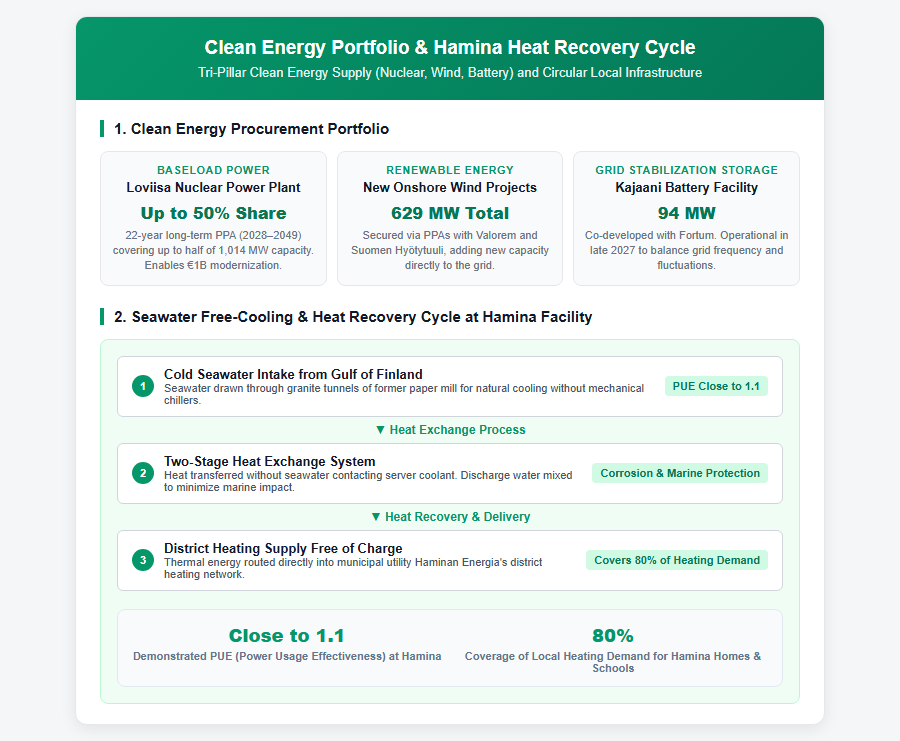
To ensure a stable power supply for continuous data center operations, Google signed a 22-year Power Purchase Agreement (PPA) with Fortum, a major Finnish energy provider. Covering the generation capacity of the Loviisa Nuclear Power Plant located near the Hamina facility, the agreement begins on a small scale in 2028 and ramps up to supply up to 50% of the plant’s total output between 2030 and 2049. Generating 1,014 megawatts, Loviisa is a critical baseload power source supplying roughly 10% of Finland’s electricity; however, without long-term revenue certainty, Fortum faced the prospect of abandoning the €1 billion modernization investment required to extend operations beyond 2030. This long-term contract secures the economic feasibility needed to keep the plant operational through 2050. The deal has drawn significant attention as Europe’s first landmark financing framework that utilizes AI compute demand to guarantee carbon-free, 24/7 power for AI training and inference.
Advanced Model: 629 MW Wind Power, 94 MW Battery Storage, and District Heat Recovery
Alongside securing nuclear baseload power, Google is simultaneously expanding its use of renewable energy and energy storage systems. Through contracts with energy firms Valorem and Suomen Hyötytuuli, Google secured a total of 629 megawatts of new onshore wind power capacity. In addition, in partnership with Fortum, Google is constructing a grid-scale 94-megawatt battery energy storage system near the new Kajaani facility, targeted for grid connection in late 2027. This battery storage system will stabilize grid frequency and mitigate supply-demand fluctuations. On the environmental front, the Hamina facility utilizes free seawater cooling from the Gulf of Finland, achieving an exceptional Power Usage Effectiveness (PUE) close to 1.1. The captured waste heat is supplied free of charge to the local district heating grid operated by municipal utility Haminan Energia, covering 80% of the heating demand for local homes and schools. An overview of this sustainable heat recovery model is illustrated below.
Background and Medium-to-Long-Term Outlook of the Global AI Infrastructure Migration
Mounting US Data Center Hurdles and the Strategic Imperative of the Nordic Shift
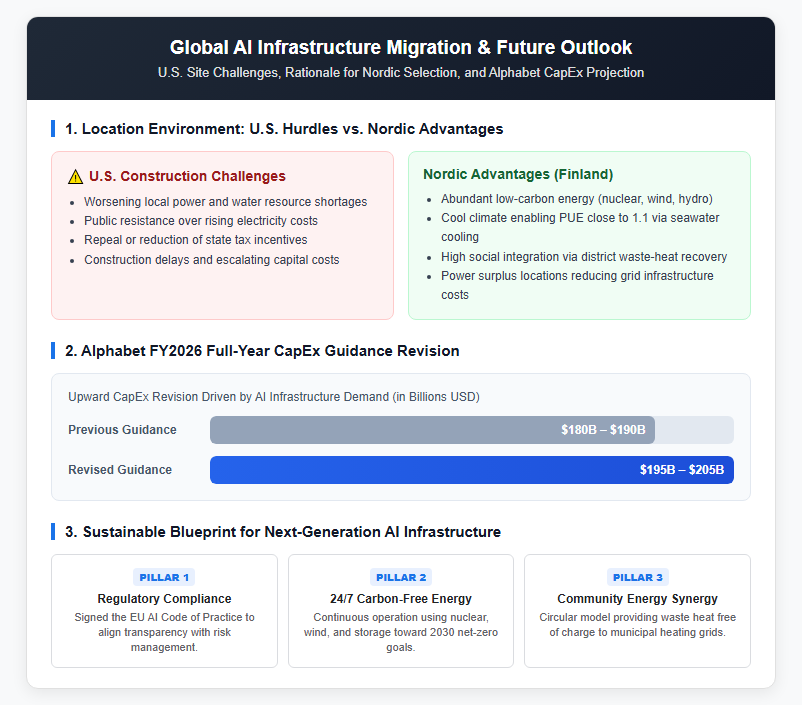
The key driver behind hyperscalers like Google accelerating overseas expansion lies in the deteriorating environment for domestic data center construction in the United States. In the US, the intense concentration of hyper-scale data centers has triggered severe power and water shortages, public pushback against rising electricity rates, and the repeal of local tax incentives, leading to soaring construction costs and project delays. Conversely, Nordic countries offer an exceptionally attractive alternative thanks to their abundant low-carbon energy sources—including nuclear, hydro, and wind power—and cool climates that dramatically reduce cooling costs. To keep pace with explosive AI demand, parent company Alphabet raised its full-year 2026 capital expenditure (CapEx) guidance from \$180–190 billion to \$195–205 billion. Geographical diversification away from US concentration has become a strategic imperative to avoid regulatory and political risks while securing long-term compute capacity.
The Future of AI Infrastructure: Regulatory Compliance and Environmental Harmony
Google’s investment in Finland establishes a pioneering infrastructure model that integrates technical capability, regulatory compliance, and environmental stewardship. As the European Union implements comprehensive AI regulations such as the EU AI Act, Google became a signatory to the voluntary EU AI Code of Practice, aiming to balance regulatory compliance with expanded market access. Furthermore, in pursuit of its corporate target to achieve net-zero carbon emissions across all operations by 2030, Google is striving for 24/7 carbon-free energy execution. By combining nuclear power, renewables, battery storage, and local heat recovery, this initiative presents a blueprint for future infrastructure design that benefits the surrounding community and national grid as a whole rather than simply housing server racks. Going forward, distributed infrastructure development that satisfies both sustainability and regulatory compliance is expected to become the industry standard. A conceptual diagram outlining these future developments is presented below.
Reference Pages
- 【Google Official Blog】https://blog.google/innovation-and-ai/infrastructure-and-cloud/global-network/google-ai-commitment-to-finland/
- 【Fortum Official Press Release】https://www.fortum.com/fi/media/2026/09/sisapiiritieto-fortum-ja-google-vauhdittavat-kestavaa-kasvua-suomessa-yhtiot-ovat-allekirjoittaneet-ydinvoimaa-koskevan-sahkonostosopimuksen-ppa
- 【Finnish Government Official Release】https://valtioneuvosto.fi/en/-/ministerial-committee-on-economic-policy-decides-on-state-aid-for-data-centres-and-registration-obligation
- 【Business Finland Official Release】https://www.businessfinland.fi/ajankohtaista/uutiset/2026/laajentumissuunnitelma-suomessa/
【#Google #AIInfrastructure #Finland #DataCenter #NuclearEnergy #RenewableEnergy #BusinessNews】


コメント