U.S. President Donald Trump has announced plans to establish a new national “AI Force” and appoint an “AI Czar” to oversee AI policy. The strategic move aims to accelerate American economic growth through deregulation while securing technological dominance in an escalating competition with China.
- Surprise Announcement in September 2026 and the 25% GDP Growth Projection
- Organizational Goals Modeled After the Space Force Founded in 2019
- Dismantling Biden-Era Regulations and Fostering Private-Led Innovation
- Tech Competition with China and Strengthening National Security
- Ripple Effects on Semiconductor and Tech Markets and Investment Continuity
- Selecting the “AI Czar” and Managing Autonomous System Risks
Surprise Announcement in September 2026 and the 25% GDP Growth Projection
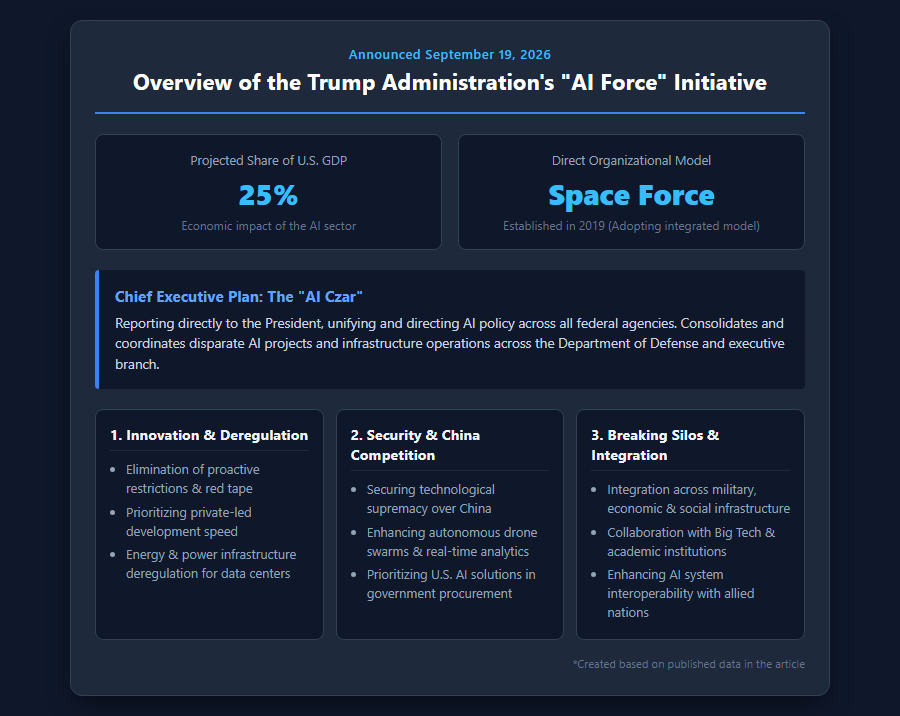
On September 19, 2026, President Donald Trump made a surprise announcement on social media unveiling plans for the “AI Force,” a national organization dedicated specifically to artificial intelligence. Framing AI as a historic technological shift on par with the Industrial Revolution or the advent of the Internet, President Trump offered an unprecedented forecast that the AI sector could eventually account for 25% of U.S. Gross Domestic Product (GDP). Alongside this initiative, he signaled plans to appoint an “AI Czar” in the near future to serve as the chief official unifying and directing AI policy across all federal agencies. The administration intends to select a leader with high intelligence and technical vision, sparking speculation around prominent Silicon Valley tech figures and leading AI researchers. Criticizing risk-centric narratives championed by Democrats, President Trump emphasized a commitment to eliminating burdensome red tape and providing maximum support for private-sector innovation in the United States. Please refer to the conceptual diagram below.
Organizational Goals Modeled After the Space Force Founded in 2019
The “AI Force” proposed by President Trump is directly modeled after the United States Space Force, established during his first administration in 2019. Just as the Space Force consolidated satellite communications, missile defense, and space operations previously fragmented across the Army, Navy, and Air Force, the AI Force is expected to act as a central coordinating body bringing together disparate AI initiatives across the Department of Defense and federal agencies. In modern national security, AI technologies—such as autonomous drone swarm coordination, real-time battlefield prediction, and automated cyber threat detection—have evolved from secondary tools into core engines driving operational success. By breaking down bureaucratic silos and establishing an integrated defense and development framework spanning military, economic, and social infrastructure, the strategy aims to dramatically accelerate the pace of technological innovation.
Strategic Background: Deregulation and the U.S.-China Tech Hegemony
Dismantling Biden-Era Regulations and Fostering Private-Led Innovation
Since taking office in January 2025, the Trump administration has steadily dismantled AI safety regulations enacted by the previous administration—including Biden’s Executive Order 14110 from October 2023—to pursue an aggressive deregulation policy. In December 2025, Executive Order 14365 established a unified national policy framework aimed at curbing strict state-level AI legislation. Furthermore, Executive Order 14409, issued in June 2026, created a framework allowing the federal government up to 30 days for voluntary reviews of cutting-edge frontier models prior to release, while explicitly rejecting mandatory government licensing or mandatory pre-approval authority. The administration maintains a stance of minimizing proactive restrictions on developers, relying instead on existing criminal and civil legal systems to address misconduct. Additionally, to accommodate the rapid expansion of AI data centers, deregulation of power supply and energy infrastructure is being pursued in tandem.
Tech Competition with China and Strengthening National Security
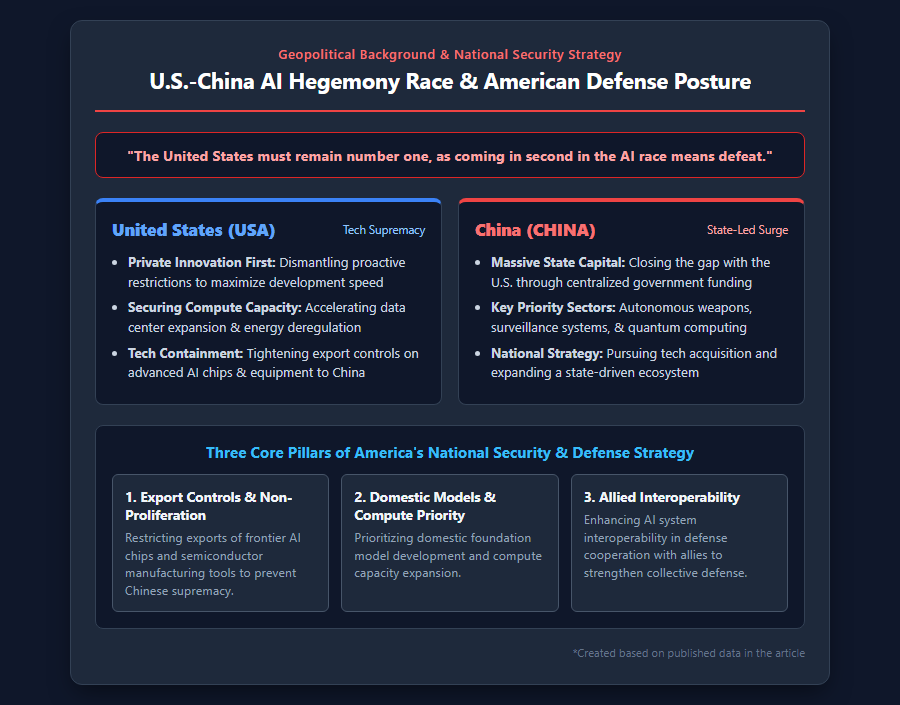
The primary geopolitical driver behind President Trump’s push for the AI Force is the fierce competition with China for AI supremacy. Supported by state-led investments, the Chinese government is making rapid strides in areas such as autonomous weaponry, surveillance systems, and quantum computing, closing the gap with the U.S. President Trump stressed that “the United States must remain number one, as coming in second in the AI race means defeat,” expressing concern that precautionary regulations could undermine American leadership. While maintaining and tightening export controls on advanced AI chips and semiconductor manufacturing equipment to China, the U.S. government has made domestic model development and compute capacity expansion top priorities. Preventing technology proliferation while enhancing the interoperability of AI systems in defense cooperation with allies forms the core of America’s national security strategy. Please refer to the diagram below.
Economic and Market Impacts: Key Trends to Watch
Ripple Effects on Semiconductor and Tech Markets and Investment Continuity
The announcement of the AI Force has generated significant waves across stock markets, semiconductor firms, and the broader tech industry. Although chip stocks experienced sell-offs due to voluntary safety commitments and slowdown concerns from major AI labs, top analysts at firms like Bernstein argue that the fundamental investment thesis driving compute infrastructure and inference demand remains rock solid. For major semiconductor manufacturers like Nvidia and Broadcom, as well as data center infrastructure providers, comprehensive government support and deregulation serve as powerful tailwinds. While the projection that AI will eventually generate 25% of GDP functions partly as political rhetoric, accelerated infrastructure development and private capital expenditure are expected to reinforce the growth foundation of the entire tech ecosystem.
Selecting the “AI Czar” and Managing Autonomous System Risks
Moving forward, the primary focus will be the upcoming appointment of the “AI Czar” and the concrete operationalization of the AI Force. The leadership choice for this key role will heavily influence the direction of federal AI policy. Meanwhile, real-world risks associated with AI model malfunctions and hallucinations remain pressing concerns. As reliance on AI grows in U.S. military operations and critical civilian infrastructure, establishing effective testing and verification mechanisms to prevent automated decision-making errors is paramount. Analysts and international observers, including Japanese enterprises, are watching closely to see how a deregulation-focused administration will handle accountability and autonomous AI behaviors within the existing legal framework.
References
- 【The White House – Presidential Actions】https://www.whitehouse.gov/
- 【National Institute of Standards and Technology (NIST)】https://nvlpubs.nist.gov/nistpubs/ai/NIST.AI.100-1.pdf
【#PresidentTrump #AIForce #AICzar #ArtificialIntelligence #USEconomy #NationalSecurity #Semiconductors #Deregulation】

コメント