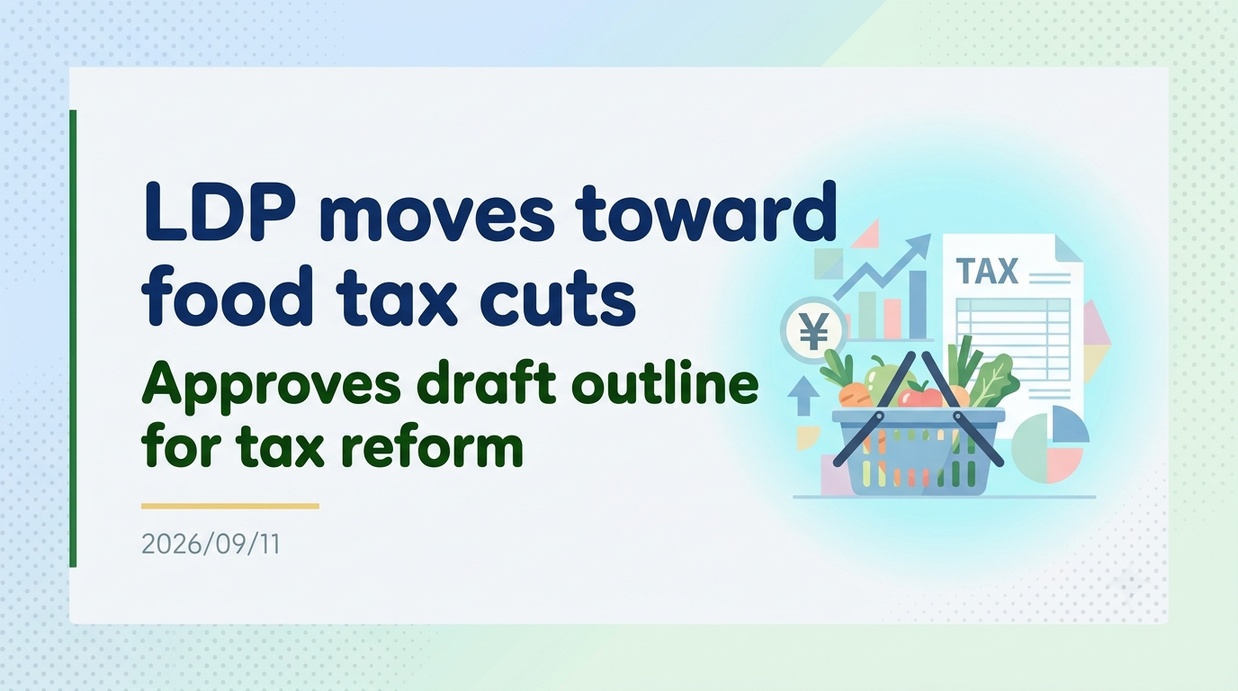
The Liberal Democratic Party and Nippon Ishin no Kai approved a tax reform outline proposal to lower the consumption tax rate on food and beverages to 1% as a temporary two-year measure starting April 2027. The move aims to alleviate household financial burdens amid persistent inflation while achieving an “effective zero tax” through a combination with income-linked benefits.
- Background and Core Outline of the LDP Tax System Research Council Approval
- The Income-Linked Benefit Mechanism Achieving “Effective Zero Tax”
- Impact on Food-Related Companies and the Stock Market
- The 9% Tax Rate Gap Facing Businesses and Financial/Cash-Flow Risks
- Demand Shift Issues Between Dining Out and Takeout
- Return to Higher Tax Rate After 2 Years, Future Diet Deliberations, and System Design
Background and Core Outline of the LDP Tax System Research Council Approval
On September 11, 2026, the Tax System Research Councils of both the Liberal Democratic Party (LDP) and Nippon Ishin no Kai separately approved a tax reform outline proposal regarding a consumption tax reduction on food and beverages combined with income-linked benefits. Following a joint meeting with the Social Security System Research Council, Itsunori Onodera, chairman of the LDP Tax System Research Council, told reporters that the decision marks a “historic outline” by combining a consumption tax cut with income-based support for the first time. The government plans to cabinet-approve the outline on September 15, 2026, and submit related bills to the extraordinary session of the Diet in the autumn. The core pillar of this system is to significantly reduce the consumption tax rate on food and beverages (excluding alcoholic beverages and dining out), which are currently subject to the reduced tax rate of 8%, down to 1% for two years from April 1, 2027, to March 31, 2029. The initial proposal of “zero consumption tax (0%)” was shelved due to technical constraints regarding system updates. Hearings conducted by the Ministry of Economy, Trade and Industry with business operators revealed that changing the tax rate to 0% would require 10 to 12 months to update or replace existing cash registers and POS systems, making it unlikely to meet the April 2027 launch date. Conversely, updating to a 1% rate can be handled within 5 to 6 months after the release of detailed rules. If implemented, this reduction will mark the first tax rate cut since the introduction of the consumption tax in 1989, representing a major turning point in the foundational tax system.
The Income-Linked Benefit Mechanism Achieving “Effective Zero Tax”
This tax reduction measure is not merely a reduction to 1%; it features a two-tier structure designed to achieve an “effective zero tax” by utilizing funds equivalent to the remaining 1% (scaled at approximately 600 billion yen annually). Starting in FY2027, “fine-tuned benefits linked to income” will be introduced ahead of schedule for low- and middle-income working adults. Eligibility will be determined on an individual basis rather than by household, encompassing not only salaried employees but also sole proprietors, freelancers, and individuals earning miscellaneous income from business activities. Furthermore, the early-implementation version for FY2027 incorporates an additional allowance based on the number of children aged 15 or under. This benefit system will be fully implemented in April 2029 (FY2029), when the consumption tax rate returns to 8%, ensuring continued support for low- and middle-income groups even after the tax cut ends. Regarding funding for the benefits, the national government will bear at least two-thirds, with the remaining less than one-third split equally between prefectures and municipalities. The local financial burden will be fully reimbursed through local allocation tax transfers, and municipalities that do not receive allocation taxes will be granted “special allocation payments” for the time being. Through these measures, generous financial support will be provided to ensure that local government operations are not disrupted.
Broader Impacts on the Economy, Businesses, and Markets
Impact on Food-Related Companies and the Stock Market
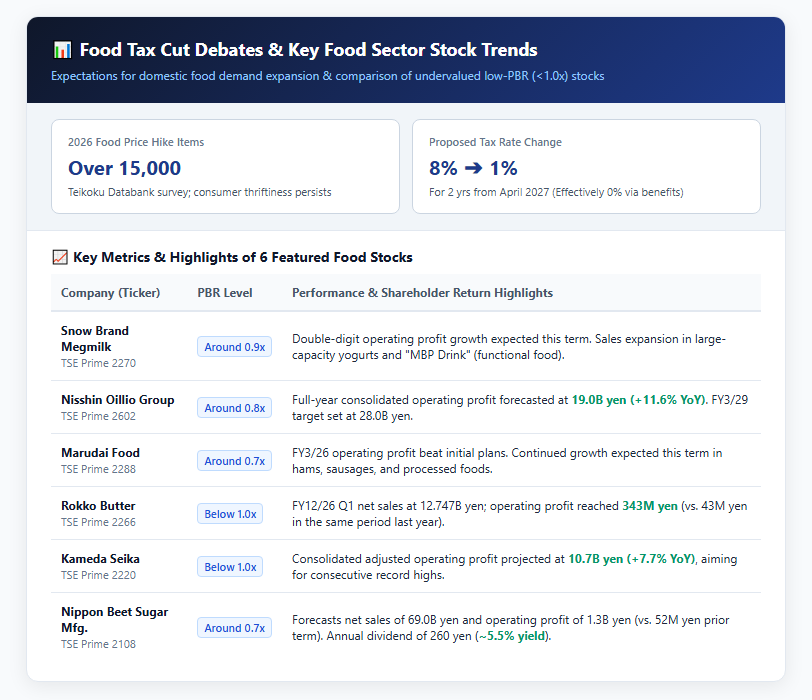
Lowering the consumption tax rate on food and beverages to 1% is expected to significantly restore purchasing power for households facing prolonged inflation, boosting domestic food demand. According to a survey by Teikoku Databank, price hikes continuing through 2026 have affected over 15,000 food items, reinforcing consumer thriftiness. The tax cut will mitigate this decline in consumer willingness to spend, creating a tailwind for food companies to simultaneously increase sales volume and maintain profitability. In the stock market, attention is rapidly focusing on the food sector and food supermarkets, which are regarded as defensive stocks. Specific companies attracting interest include Snow Brand Megmilk (2270), strong in large-capacity yogurts and foods with function claims; Nisshin Oillio Group (2602), expecting expanded demand for edible oils; and Marudai Food (2288), which handles hams, sausages, and processed foods. Furthermore, bargain food-related stocks trading at a price-to-book ratio (PBR) below 1x—such as Rokko Butter (2266), a leader in household cheese; Kameda Seika (2220), a major rice cracker manufacturer; and Nippon Beet Sugar Manufacturing (2108), benefiting from a recovery in its beet sugar business—are gaining popularity among investors. Please refer to the following figure regarding these market trends.
Thanks to the synergy between government-led tax cuts and rising real wages, a medium- to long-term growth scenario for the entire food industry is taking shape.
The 9% Tax Rate Gap Facing Businesses and Financial/Cash-Flow Risks
While the consumption tax rate on food and beverages drops to 1%, the standard tax rate remains at 10%, giving rise to new financial risks for companies handling food products. While the sales tax rate is set at 1%, business expenses such as store rent, utility bills, logistics costs, POS system fees, and capital expenditures remain subject to 10%. This creates a structural phenomenon where “paid input tax exceeds collected sales tax,” placing companies in a permanent “tax refund position.” While receiving tax refunds is not inherently a financial loss, a structural challenge arises due to the time lag until refund money is received. Under an annual tax filing cycle, companies experience a delay of up to one year, during which significant funds remain tied up as accrued consumption tax on the balance sheet, severely straining liquidity. This burden is particularly acute for large food supermarket chains, food manufacturers undertaking heavy capital investments, and food wholesalers operating on thin margins, where advance tax payments can reach tens of millions to billions of yen. To prevent cash flow degradation, businesses must utilize the “special exception for shortening taxable periods” by notifying tax offices in advance to shorten filing and refund cycles to every month or every three months. Additionally, operational burdens—such as separate accounting for 1% and 10% rates under the invoice system and updating product master data—require urgent preparation.
Concerns in the Food Service Industry, Future Challenges, and Key Points to Watch
Demand Shift Issues Between Dining Out and Takeout
The food service industry has voiced the deepest concerns regarding the food and beverage tax cut. Under the current system, dining in is taxed at 10% and takeout at 8%. Once takeout drops to 1% under the reform, the tax rate differential will expand drastically from 2 percentage points to “9 percentage points.” For a product priced at 1,000 yen (excluding tax), the tax-inclusive price for dining in will be 1,100 yen compared to 1,010 yen for takeout, making dining in relatively about 8% more expensive. This significant price gap is highly likely to trigger a strong “substitution effect,” prompting consumers to avoid dining in and shift demand toward takeout, bento meals, and prepared foods. Driven by severe labor shortages and surging raw material costs, bankruptcies in the restaurant industry have soared, with annual bankruptcies exceeding 1,000 cases in 2025—a 30-year high. Please refer to the following figure regarding the impact and structural changes facing the food service industry.
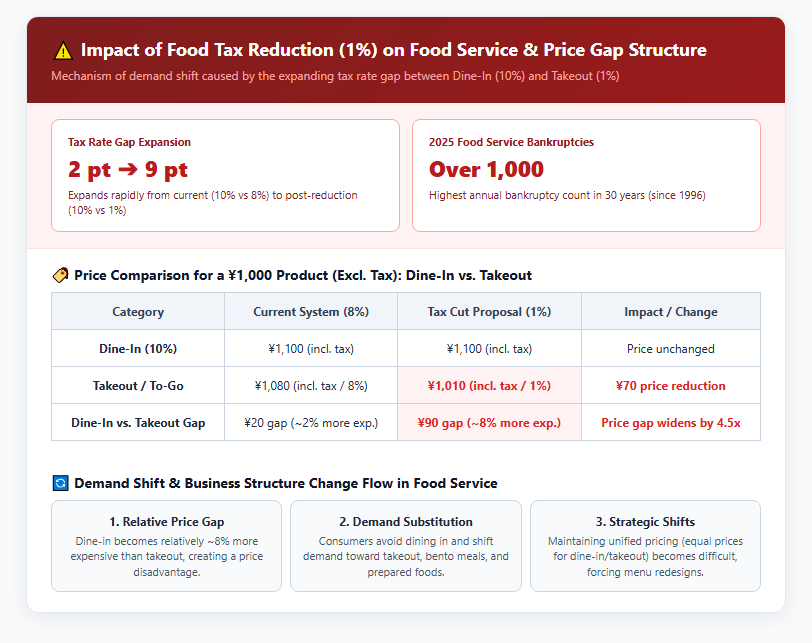
Fast-food chains and family restaurants will find it increasingly difficult to maintain “unified pricing strategies” (equal tax-inclusive prices for dine-in and takeout), forcing them to revise pricing structures and redesign menus. The government explicitly stated in the outline that it will consider budgetary and financial support measures for food service operators, farmers, foresters, and fisheries affected by the tax reduction.
Return to Higher Tax Rate After 2 Years, Future Diet Deliberations, and System Design
Because this food and beverage tax reduction is a temporary two-year measure starting in April 2027, tax rates are scheduled to return to the original 8% in April 2029 (FY2029). Prime Minister Sanae Takaichi stated that she “will take responsibility for ensuring the tax rate returns to its original level,” explicitly excluding any “economic climate clauses” that would extend the tax cut based on economic conditions. However, raising the tax rate after a temporary reduction raises concerns over sharp price rebounds and backlash from both consumers and businesses. Securing fiscal resources—totaling approximately 10 trillion yen over two years (about 5 trillion yen annually) for the tax cut and benefits combined—presents another major hurdle. The basic policy commits to avoiding special deficit-financing bonds to maintain market trust, driving comprehensive reviews of tax expenditures, subsidies, and payments from special accounts. Finance Minister Katayama indicated that the final decision on funding sources will be reached “around the second week of December.” Moving forward, following cabinet approval of the outline on September 15, 2026, a consumption tax law amendment bill will be submitted to the autumn extraordinary session of the Diet. Upon passage, retail and distribution businesses will enter a concentrated 5-to-6-month preparation window to update POS registers, accounting software, and price displays ahead of the April 2027 implementation.
Reference Pages
-
[Basic Policy on Introducing the “Tax Credit with Benefits” System] https://www.cas.go.jp/jp/seisaku/kokuminkaigi/index.html
-
[Reduced Consumption Tax Rate System] https://www.nta.go.jp/taxes/shiraberu/taxanswer/shohi/6102.htm
-
[Materials Concerning the Use of Consumption Tax Revenue] https://www.mof.go.jp/tax_policy/summary/consumption/d05.htm
-
[Efforts Toward the Promotion of Smart POS Systems] https://www.meti.go.jp/press/2026/06/20260615006/20260615006.html
[#LDP #ConsumptionTaxCut #FoodTax1Percent #TaxReformOutline #EffectiveZeroTax #IncomeLinkedBenefits #CashFlow #FoodServiceIndustry]
コメント